China: Baked Nian Gao

My sister is home from SLO for the weekend, and she made some baked nian gao! She was surprised to find out that my family didn’t have a proper nian gao for Chinese New Year, so she made two 12″ nian gao today! It’s my favorite variation of the Chinese New Year cake! In fact, I already ate a quarter of one…

You have probably noticed I didn’t have many Lunar New Year food-related posts. I don’t normally cook or bake … and my mom was sick with pneumonia (in both lungs!) during Lunar New Year, so we didn’t really celebrate it this year. However, we had lots of taro cake from friends and I just found a banh tet in the fridge last night!

baked nian gao - 1 baked nian gao - 2

Niangao (nin gou in Cantonese), sometimes translated as year cake or Chinese New Year’s cake, is a food prepared from glutinous rice and consumed in Chinese cuisine. It is available in Asian supermarkets and from health food stores. While it can be eaten all year round, traditionally it is most popular during Chinese New Year. It is considered good luck to eat nian gao during this time, because “nian gao” is a homonym for “higher year.” The Chinese word 粘 (nián), meaning “sticky”, is identical in sound to 年, meaning “year”, and the word 糕 (gāo), meaning “cake” is identical in sound to 高, meaning “high or tall”. As such, eating nian gao has the symbolism of raising oneself taller in each coming year (年年高升 niánnián gāoshēng). It is also known as a rice cake. This sticky sweet snack was believed to be an offering to the Kitchen God, with the aim that his mouth will be stuck with the sticky cake, so that he can’t badmouth the human family in front of the Jade Emperor. (Wikipedia)

Nian Gao (年糕) or Chinese New Year’s Cake is an auspicious food item made during the Chinese (Lunar) New Year period. It has been around for more than 3000 years. There are many regional variations, even Korean and Japanese have their own versions but essentially this is made with glutinous rice and sugar. It’s believed that eating Nian Gao can bring us good luck because ‘Nian Gao’ is a homonym for “higher year”, thus symbolises promotions, prosperity or simply for kids: growing taller. (Kelly Siew Cooks)

“Nian gao” or “leen go” (translation: year cake) is a cake that is traditionally eaten at Chinese New Year. It has a soft, dense, sticky and chewy texture and is not meant to be very sweet. Traditionally, it is vegan and steamed. The baked version combines a Western cake-like crust with the traditional sticky and chewy middle. Traditional nian gao / leen go is usually made in 9″ or 10″ pie plates. Baked nian gao tastes best when served hot. (Cooking with Alison)

The texture of the outside is different from the steamed version, but the inside is still the same chewy, sticky texture. The difference besides how both is cooked, is how you can eat it afterwords. For the steamed version, you just beat up an egg, dip a slice of the cake in, and fry it. This baked version, you can eat anytime. You can microwave it if you like it warm, or re-bake it. (Hevil’s Special Delights)
California: Dynamite Roll

Restaurant: Niji Sushi
City: Mountain View, CA

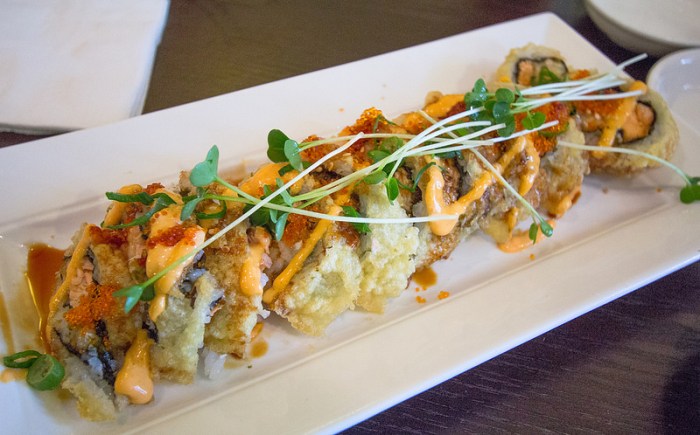
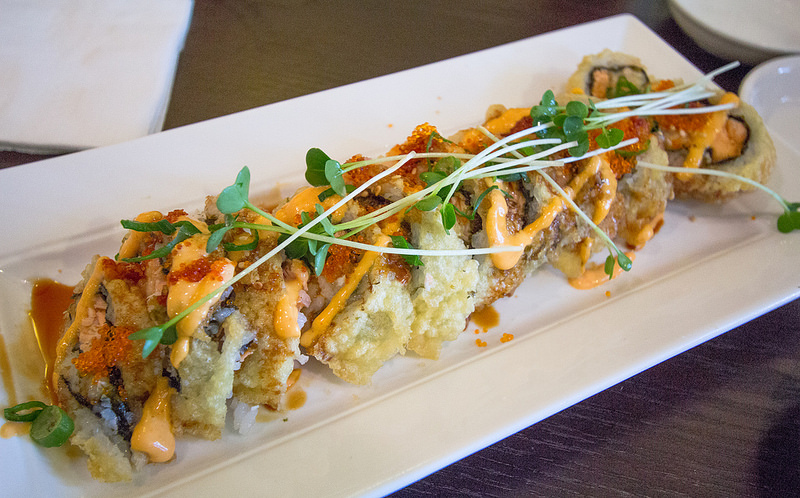
Went to a sushi place in Downtown Mountain View with several coworkers, to celebrate a birthday! I ordered the dynamite roll.

dynamite roll

Deep fried salmon, tuna, and hamachi with spicy special sauce. Garnished with sprouts.

Did you know sushi rolls often found in sushi places in America are not typically found in sushi places in Japan?

The increasing popularity of sushi around the world has resulted in variations typically found in the Western world, but rarely in Japan (a notable exception to this is the use of salmon which was introduced by the Norwegians in the early 1980s). Such creations to suit the Western palate were initially fueled by the invention of the California roll (anorimaki with crab (later, imitation crab), cucumber, and avocado). A wide variety of popular rolls (norimaki and uramaki) has evolved since. Though the menu names of dishes often vary by restaurant, some examples include Alaska roll, British Columbia roll, California roll, dynamite roll, Hawaiian roll, rainbow roll, Seattle roll, mango roll, spider roll, and Michigan roll. (Wikipedia)

Most students–especially those who have been to or are from Japan–note that the sushi you find in California restaurants can be different from the sushi in the East. In fact, “Western sushi” is a style of sushi that is very popular in the U.S. After the California Roll was invented in Los Angeles, the sushi industry exploded with new, inventive rolls. The dynamite roll is one of the common sushi menu items in California. (Converse International School of Languages)

The fusion roll recipes consist of multiple ingredients and require to roll the sushi with the rice facing outside (uramaki). In fusion sushi terminology, a dynamite refers to a dish that is covered with spicy sauce and quickly grilled. The inner part of the roll is frequently a spicy tuna roll (rolled outside) but it depends on the chef, and it can be substituted with any other roll. After cutting the roll into their individual pieces, it is covered with spicy mayonnaise. A chef’s gas torch is often used to burn the mayonnaise quckly. (Sushi Encyclopedia)

Japan: Genmaicha

Restaurant: Niji Sushi
City: Mountain View, CA

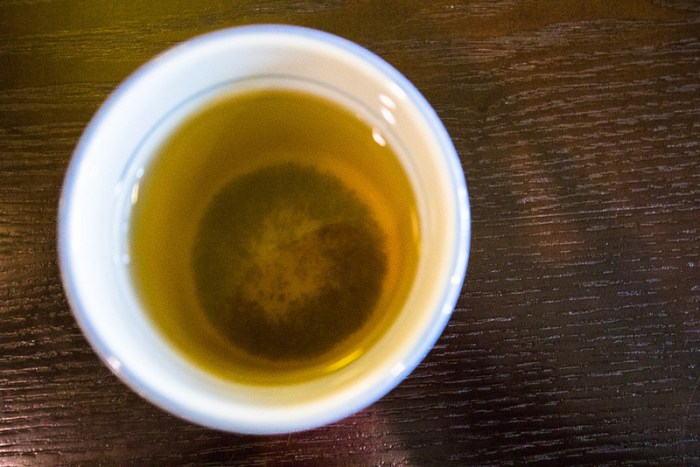
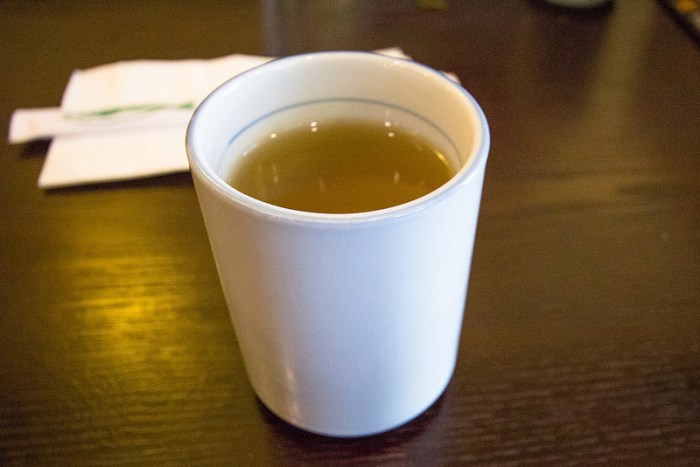
Went to a sushi place in Downtown Mountain View with several coworkers, to celebrate a birthday! We were all served tea, which had the taste of roasted brown rice. Genmaicha is one of my favorite teas; you can get them in teabags or boxes at most Asian supermarkets.

genmaichagenmaicha - 2

Genmaicha (玄米茶, “brown rice tea”) is the Japanese name for green tea combined with roasted brown rice. It is sometimes referred to colloquially as “popcorn tea” because a few grains of the rice pop during the roasting process and resemble popcorn. This type of tea was originally drunk by poor Japanese, as the rice served as a filler and reduced the price of the tea; which is why it is also known as the “people’s tea.” It was also used by those persons fasting for religious purposes or who found themselves to be between meals for long periods of time. Today it is consumed by all segments of society. Tea steeped from these tea leaves has a light yellow hue. Its flavor is mild and combines the fresh grassy flavor of green tea with the aroma of the roasted rice. Although this tea is based on green tea, the recommended way to brew this tea is different from that of green tea. To make best aroma, it is recommended to use boiled water with brewing time of 30 seconds. (Wikipedia)

Baja California: Fish Taco

Restaurant: Tres Potrillos Taqueria
City: 
Sunnyvale, CA

Had dinner with two college buddies I hadn’t seen for a while! I ordered two fish tacos, with a side of rice and refried beans w/ cheese.

fish taco - 1 fish taco - 2

The fish tacos were deep fried fish with pico de gallo (salsa consisting of diced tomatoes, onions, cilantro) and lettuce, on top of two flour tortillas. They are best eaten right away; if you order these to-go, they tend to get soggy by the time you eat it.

The following is a background of fish tacos, from Sunset:

From this perspective, there is little question that people have been eating fish tacos in the coastal areas of Mexico for an awfully long time. It probably goes back thousands of years to when indigenous North American peoples first wrapped the plentiful offshore catch into stone-ground-corn tortillas.

More recently, somewhere in Baja California, sometime in the last 40 or 50 years, someone concocted what is generally considered to be the prototypical fish taco. According to aficionados ― call them the codnoscenti ― this humble delicacy consists of a lightly battered mild white fish that is deep-fried, then served in a corn tortilla (often two) with shredded cabbage, a thin sour-cream- or mayonnaise-based sauce, a bit of salsa, and a most vital spritzito of lime.

On this everyone agrees. What everyone doesn’t agree on is where in Baja the archetype originated. San Diego fish-taco mogul Ralph Rubio, whose chain of stores makes him the great white shark of the fish-taco world, cites San Felipe as the source. But the señoras hustling and hawking virtually identical fish tacos at virtually identical stands at Ensenada’s fish market won’t stand for that. They say their port town is the fish taco’s true home, dating at least from the opening of the Ensenada mercado, in 1958.

Hong Kong: Pan Fried Rice Roll w/ XO Sauce

Restaurant: New Port Restaurant
City: Sunnyvale, CA

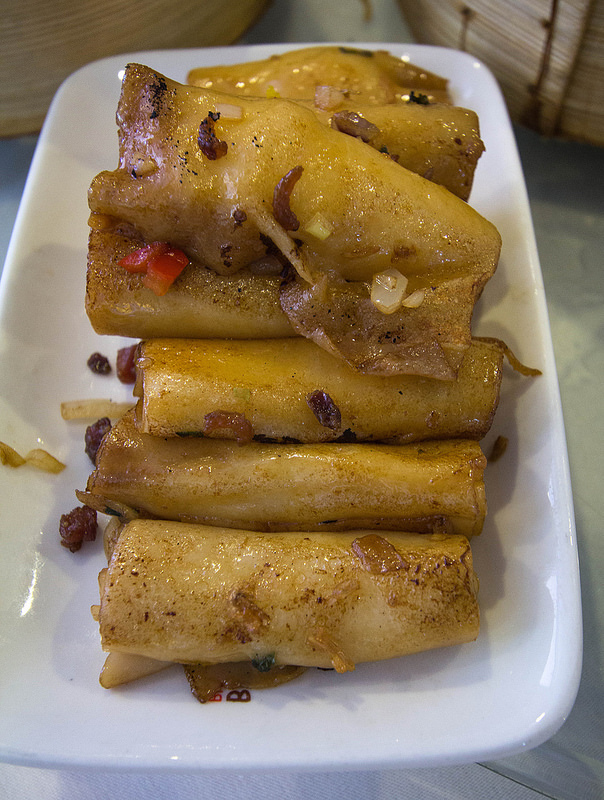
This was one of the dishes I had during dim sum with coworkers.

pan fried rice roll

This is one of my favorite dim sum dishes, along with chicken feet. A few places may serve hoisin sauce with this dish.

Rice roll is noodle rolled up into a roll.  It is a must have dish when we go out for dim sum.  A simple dish to make with few ingredients which include dried shrimp, green onions, red pepper flakes, and rice roll noodles. (Whisks & Chopsticks)

Developed in the 1980s in Hong Kong for Cantonese cuisine, XO sauce is made of roughly chopped dried seafoods, including scallops, dried fish and shrimp, and subsequently cooked with chili peppers, onions, and garlic. This dried seafood-based sauce bears similarity to the Fujianese Shacha sauce. Spring Moon, the Peninsula Hong Kong’s Chinese restaurant is often credited with the invention of XO sauce, although others claim the sauce’s origin in the urban area of Kowloon. The name XO sauce comes from fine XO (extra-old) cognac, which is a popular Western liquor in Hong Kong and considered by many to be a chic product there. In addition the term XO is often used in the popular culture of Hong Kong to denote high quality, prestige, and luxury. In fact, XO sauce has been marketed in the same manner as the French liquor, using packaging of similar colour schemes. (Wikipedia)

Guangdong: Har Gow

Restaurant: New Port Restaurant
City: Sunnyvale, CA

This was one of the dishes I had during dim sum with coworkers.

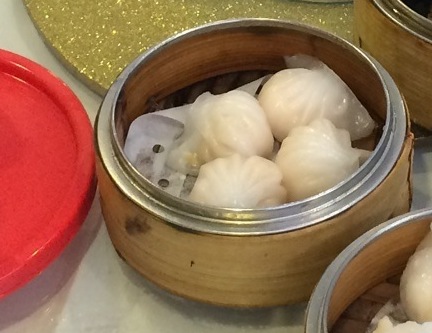
har gow

Ha gow (anglicized as har gow) or xiā jiǎo is a traditional Chinese dumpling served in dim sum. The dumpling is sometimes called a shrimp bonnet for its pleated shape. This dish is often served together with sieu mai; when served in such a manner the two items are collectively referred to as hagowsieu mai (蝦餃燒賣). These shrimp dumplings are transparent and smooth. This dish is said to be the one that the skill of a dim sum chef is judged on. Traditionally, ha gow should have at least seven and preferably ten or more pleats imprinted on its wrapper. The skin must be thin and translucent, yet be sturdy enough not to break when picked up with chopsticks. It must not stick to the paper, container or the other ha gow in the basket. The shrimp must be cooked well, but not overcooked. The amount of meat should be generous, yet not so much that it cannot be eaten in one bite. (Wikipedia)

There are usually two types of filling you would find in har gow. Number one: A lump of shrimp meat usually with mince size pieces of bamboo. Number two: Minced shrimp combined with either bamboo or water chestnut. (Rasa Malaysia) Continue reading

Guangdong: Chicken Feet

Restaurant: New Port Restaurant
City: Sunnyvale, CA

This was one of the dishes I had during dim sum with coworkers.

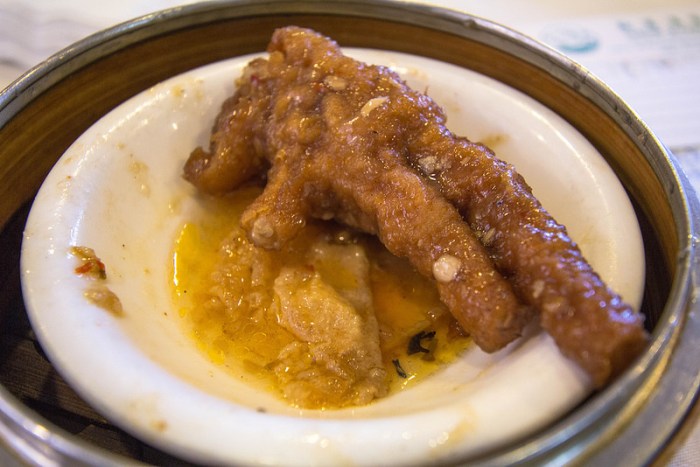
chicken feet

You may be wondering why there’s only one… Well, I was the one ordering all the dishes for the table. I had no time to take decent photos, but managed to secure a piece for myself. There are usually 3 or 4 pieces in a dish, at dim sum places I’ve been to in the Bay Area. So, this photo was taken shortly before I devoured it! :D

In Guangdong and Hong Kong, they are typically deep fried and steamed first to make them puffy before being stewed and simmered in a sauce flavoured with black fermented beans, bean paste, and sugar; or in abalone sauce. (Wikipedia)

These morsels of skin and bones are a unique combination of textures: the wrinkled, puffed up skin on the surface and the soft, gelatinous tendons within. In dim sum restaurants across the country, chicken feet are a staple—always reliably good and due to their humble beginnings, always cheap. Chicken feet are the pinnacle of gnawing for pleasure and the Chinese people, paramount gnawers. If I were to generalize, I’d say that half of what goes into the mouth of a Chinese diner comes right back out. Little bones, cartilage, centers of eyeballs, and other delicate treats are eaten and then returned with great relish. (Serious Eats)

Guangdong: Cha Siu Bao

Restaurant: New Port Restaurant
City: Sunnyvale, CA

This was one of the dishes I had during dim sum with coworkers.

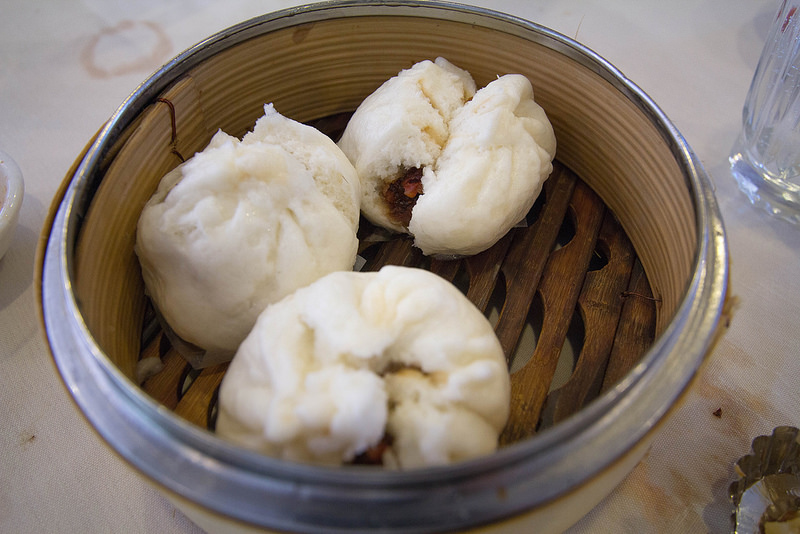
cha siu baocha siu bao

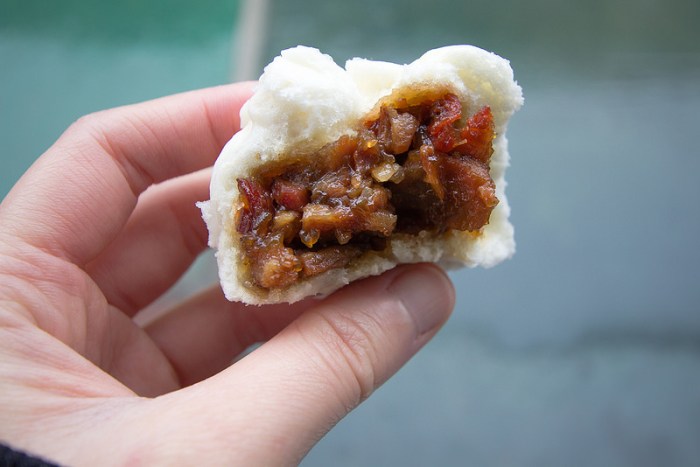
Cha siu bao or char siu bao is a Cantonese barbecue-pork-filled bun (baozi). The buns are filled with barbecue-flavored cha siu pork. They are served as a type of dim sum during yum cha and are sometimes sold in Chinese bakeries. Cha siu refers to the pork filling; the word bao simply means “bun”. Although visually similar to other types of steamed baozi, the dough of steamed cha siu bao is unique since it makes use of both yeast and baking powder as leavening. This unique mix of leavening gives the dough of cha siu bao the texture of a slightly dense, but fine soft bread. Encased in the center of the bun is tender, sweet, slow-roasted pork tenderloin. This cha siu is diced, and then mixed into a syrupy mixture of oyster sauce, hoisin sauce, roasted sesame seed oil, rice vinegar, shaoxing wine or dry sherry, soy sauce, sugar and cornstarch. (Wikipedia)

[Edit on 02.06.2014] Second photo added, to show the inside of the cha siu bao. I took two buns home for my parents and sister. Had half of one bun for breakfast this morning!

[Edit on 08.28.2014] Buzzfeed posted the second pic in the article “21 Reasons Every Food Lover Needs To Go To Hong Kong Immediately“. Found it when searching “hong kong eats”. !!!

Guangdong: Siu Mai

Restaurant: New Port Restaurant
City: Sunnyvale, CA

Siu mai was one of the dumplings ordered during dim sum with coworkers.

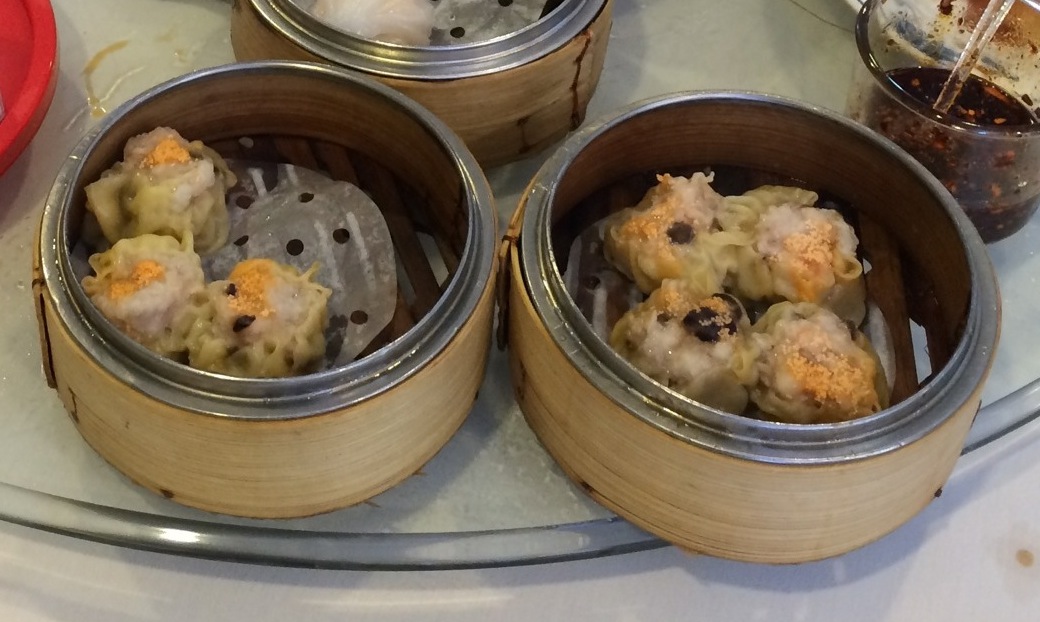
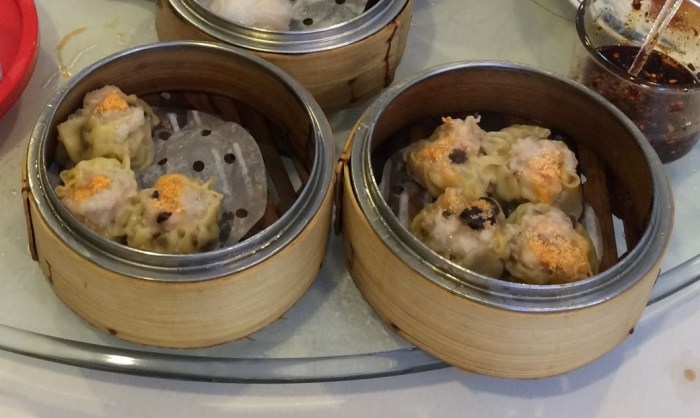
siu mai

Shumai (simplified Chinese: 烧卖; traditional Chinese: 燒賣; pinyin: shāomài), also spelled as siu mai or shaomai, also called pork dumplings (although often other types of dumplings could also be filled with pork), is a type of traditional Chinese dumpling served as dim sum. Cantonese shumai is the most well-known variety from the south-eastern province of Guangdong. As prepared in Cantonese cuisine, siumai is also referred to as “pork and mushroom dumpling.” Its standard filling consisting primarily of ground pork, small whole or chopped shrimp, Chinese black mushroom, green onion (also called scallion) and ginger with seasonings of Chinese rice wine e.g. Shaoxing rice wine, soy sauce, sesame oil and chicken stock. Bamboo shoots, water chestnuts and pepper can also be added. The outer covering is made of a thin sheet of lye water dough. The center is usually garnished with an orange dot, made of crab roe or diced carrot, although a green dot made with a pea may be used. The decorative presentations vary. (Wikipedia)

The Cantonese shumai, the oldest variation, is believed to have originated in the Guangdong province in southern China in such a teahouse. The Guangdong province, particularly the central capital city of Guangzhou (home to the third largest harbor in China), would have encountered a lot of trade and foreign merchants (Schlotter 234), thus making it an ideal location for dim sum and consequently shumai. Although the first documented evidence of shumai is from the Song dynasty (Dunlop 191), it is possible that shumai was “born” alongside the emergence of tea, foreign foods, and many other dumplings during the Tang dynasty (Anderson 54). The origin of the dumpling itself in China is widely debated, but there is evidence to indicate it is a central Asian/Near Eastern borrowing (Anderson 180). (Food For Thought: Dumpling Migration)

Guangdong: Dim Sum (Yum Cha)

Restaurant: New Port Restaurant
City: Sunnyvale, CA

I had dim sum with 15 coworkers at lunch today! It’s prolly been a year since I had dim sum… The more people in your party, the better dim sum is because you get to order more and have a better variety of dishes. In the SF Bay Area, restaurants serving dim sum is typically held from late morning to early afternoon. Also, many dim sum places are packed on weekends as it’s very popular among Cantonese families, so go on a weekday if you can!

dim sum - 1dim sum - 2

We had a good variety; we had 38 dishes! Here are some of the dishes we had, with a few of them posted individually:

Har Gow – shrimp dumplings
Siu Mai – pork dumplings
Cha Siu Bao – barbeque pork bun
• Cheong Fun – rice noodle roll (typically with shrimp, beef, or bbq pork)
• Lo Mai Gai – glutinous rice filled with various ingredients
Chicken Feet
• Shrimp and Spinach Dumpling
• Deep Fried Taro Dumpling
Pan Fried Rice Rolls w/ XO Sauce
• Gai-lan – Chinese broccoli
• Dan Tat – egg tart

In the U.S. and UK, the phrase dim sum is often used in place of yum cha; in Cantonese, dim sum (點心) refers to the wide range of small dishes, whereas yum cha, or “drinking tea”, refers to the entire meal. The Cantonese Chinese term yam cha or yum cha primarily refers to the tradition of morning tea in Cantonese cuisine exemplified by the traditional tea houses of Guangzhou (Canton). Due to the prevalence of Cantonese cuisine outside China, the Cantonese yum cha tradition can be found in many parts of the world. By analogy, yum cha is also used to refer to morning or afternoon teas in other Chinese cultural traditions, even though such meals have different native names. Similarly to a Western morning or afternoon tea, despite the name, yum cha is focused as much on the food items served with the tea as the tea itself. These food items are collectively known as “dim sum”, a varied range of small dishes which may constitute or replace breakfast, brunch or afternoon tea. (Wikipedia)

The unique culinary art of dim sum (Cantonese) or dian xin (Mandarin) means “a little bit of heart” or “touch the heart” and originated in China hundreds of years ago. Teahouses sprung up to accommodate weary travelers journeying along the famous Silk Road. Rural farmers, exhausted after long hours working in the fields, would also head to the local teahouse for an afternoon of tea and relaxing conversation. Still, it took several centuries for the culinary art of dim sum to develop. At one time it was considered inappropriate to combine tea with food. In the third century AD, Hua To, a highly respected Imperial physician, advised that eating food while drinking tea would cause excessive weight gain. But the Cantonese in southern China disregarded that advice and turned quiet teahouse into a lively eating experience, which is also how the term “yum cha” (to drink tea) became synonymous with consuming dim sum. As tea’s ability to aid in digestion and cleanse the palate became known, tea house proprietors began adding a variety of snacks, and the tradition of dim sum was born. (Nom Wah Tea Parlor)

Cantonese dim sum is a form of brunch stemming from baozi, which originated in Guangdong. First seen in written records from the Yuan dynasty. one story says that shāomai/siu mai (燒賣) were first sold in teahouses as additional refreshments. Like jiaozi, the play on pronunciation applies here. Eating dim sum remains a daily activity in Guangdong and Hong Kong for older generations and a weekend family tradition for eating, playing mahjong and chatting. There are hundreds of dishes available from stainless steel pushcarts. (About.com)

The unique culinary art of dim sum originated with the Cantonese in southern China, who over the centuries transformed yum cha from a relaxing respite to a loud and happy dining experience. In Hong Kong, and in most cities and towns in Guangdong province, many restaurants start serving dim sum as early as five in the morning. It is a tradition for the elderly to gather to eat dim sum after morning exercises. For many in southern China, yum cha is treated as a weekend family day. More traditional dim sum restaurants typically serve dim sum until mid-afternoon. However, in modern society it has become common place for restaurants to serve dim sum at dinner time, various dim sum items are even sold as take-out for students and office workers on the go. (Wikipedia)