Italy: Pizza Quattro Stagioni

Restaurant: Terún
City: Palo Alto, CA

An Italian coworker ordered Pizza Quattro Stagioni; this must be one of his favorites, since he ordered this last time we came here! Also, he says the pizzas here are remniscent of his hometown in Italy, so the pizzas here are authentic! Terún bakes their pizzas in a Marra Forni wood burning oven.

pizza quattro stagioni

San Marzano tomato, fior di latte mozzarella, prosciutto cotto, artichoke, funghi, and olive.

Pizza quattro stagioni (literally translated as ‘four seasons pizza’) is one of the classic pizzas of the Italian repertoire. The pizza is divided in four quadrants, and each space is dressed with a different ingredients: prosciutto, mushrooms, olives, and marinated artichokes. (Anna Maria’s Open Kitchen)

One thing to keep in mind when ordering pizza in an Italian pizzeria is that the product is personal size. Each person at a table should order their own individual pizza – one bite will explain why. In certain areas outside Italy, there are a few piazzioli who keep to their homeland traditions as best they can with the ingredients they have. (Life in Italy)

Friuli-Venezia Giulia: Pizza San Daniele

Restaurant: Terún
City: Palo Alto, CA

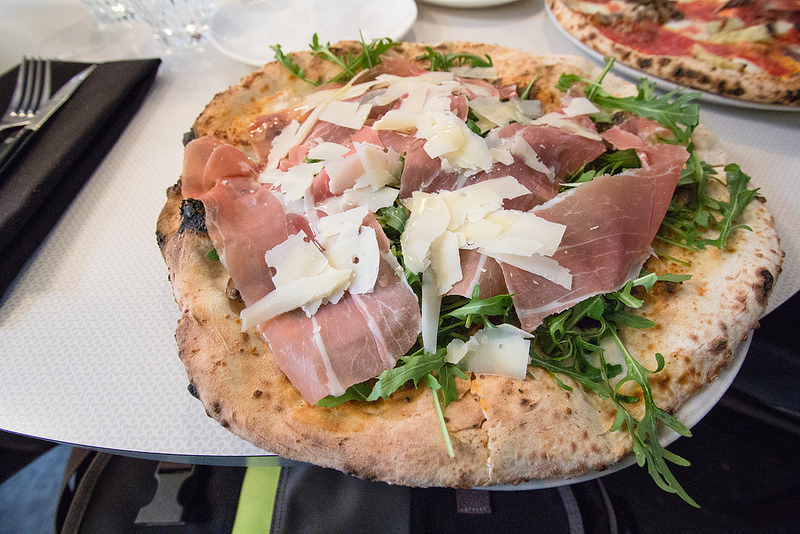
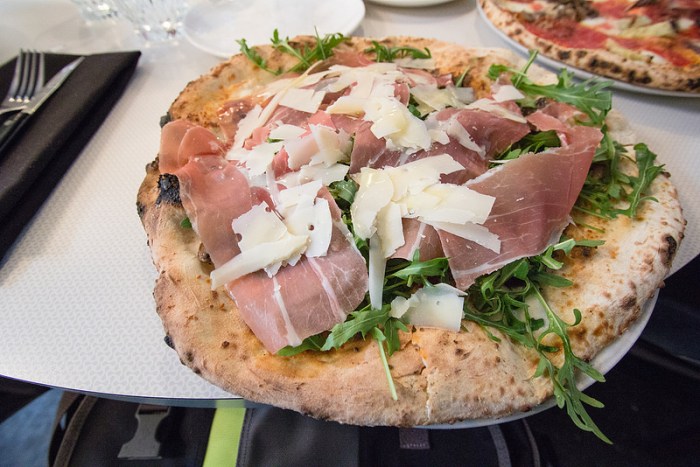
Went to an Italian restaurant in Downtown Palo Alto with a few coworkers for lunch today! I ordered Pizza San Daniele; I really like pizzas with arugula.
pizza san daniele

Prosciutto San Daniele 24mo, cremini mushrooms, mozzarella, arugula, shaved Parmigiano, and truffle oil. This pizza was ‘light’, with the absense of tomato sauce. It was also salty from the cheese and prosciutto, but the bitterness of the arugula countered the saltiness!

Prosciutto San Daniele is from San Daniele, as its name implies. San Daniele is located in the Friuli-Venezia Giulia region, in northeastern Italy. San Daniele is the name of the “prociutto crudo”, translated as “crude ham”.

The following is a bit of history about San Daniele prosciutto, from Consorzio del Prosciutto di San Daniele:

In the pre-Roman era, San Daniele del Friuli was an important Celtic settlement, thanks to its special position en route to Northeast Europe. The surrounding area contains the remains of various “castellieri”, the typical Celtic constructions used as watchtowers.

It was the ancients who experimented with the fact that reduced humidity, good aeration and the climate of the San Daniele hills enable optimum preservation of meat, thus inventing maturation. In subsequent eras, pigs were constantly present in the San Daniele region, and the practice of breeding developed in the area.

From patriarchal domain, San Daniele developed into a “free commune”. Documents handed down to Consorzio del Prosciutto di San Daniele show communal usages which regulate the areas of pastureland, prescribe the regulations allowing pigs to be left free within the city, and more. From that point on, pig breeding became an important economic source for the city of San Daniele.

In more recent history, San Daniele became widespread and well-known as a typical product, and was referred to by this name from 1800. Dating back to the 30s is a note in which Gabriele D’Annunzio entreated a Brescian friend to obtain some for him. In the 20s the first ham factories were established: the domestic cellar was transformed into the centre of a true autonomous production activity. At the end of the 40s, the ham factory had become an industry, and from the 60s its development resulted in some of the production companies contributing to the formation of the national and international prosciutto crudo market.

Taiwan: Sheng Kee’s Black Sesame Mochi Pastry

Sheng Kee is a Taiwanese bakery chain founded in Taipei, Taiwan. It looks like they’re based in the SF Bay Area now, with stores in San Francisco, Foster City, Richmond, Berkeley, Union City, Milpitas, and Cupertino. (I’m not sure if they still have any locations in Taiwan.)

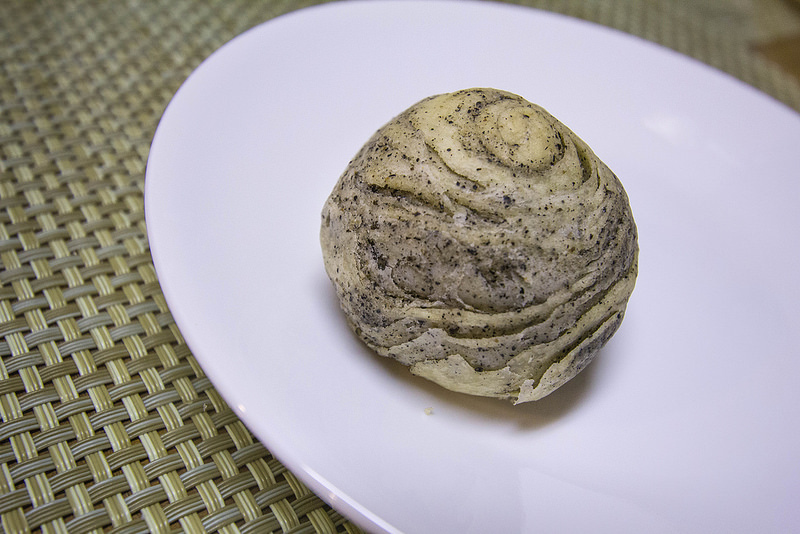
My mom and I picked up a black sesame mochi pastry. Sheng Kee also has green tea red bean pastry, sweet potato mochi pastry, and taro mochi pastry.

black sesame mochi pastry - 1black sesame mochi pastry - 2

The black sesame mochi pastry has a flaky crust, with black sesame paste filling, and mochi center. The mochi center reminded me of the dessert soup with mochi balls filled with black sesame paste.

Sichuan: Beef Tendon

Market: Marina Food
City: Union City, CA

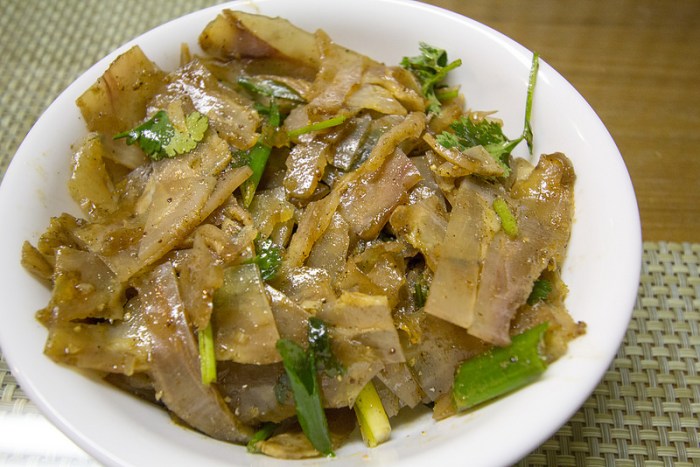
Another appetizer we picked up along with the pig’s ear was the (cold cut) beef tendon. It’s another one of our favorite appetizers. The beef tendon they had was a mild version, shown below. I’ve had spicier before, where the beef tendon dish is much redder.

beef tendon - 1 beef tendon - 2

Served cold with a dense but chewy texture, the beef tendon accompanied by chili oil is not immediately spicy, although if you start eating mouthfuls of tendon the spiciness can start to creep up on you. (World to Table)

Sichuan: Pig’s Ear

Market: Marina Food
City: Union City, CA

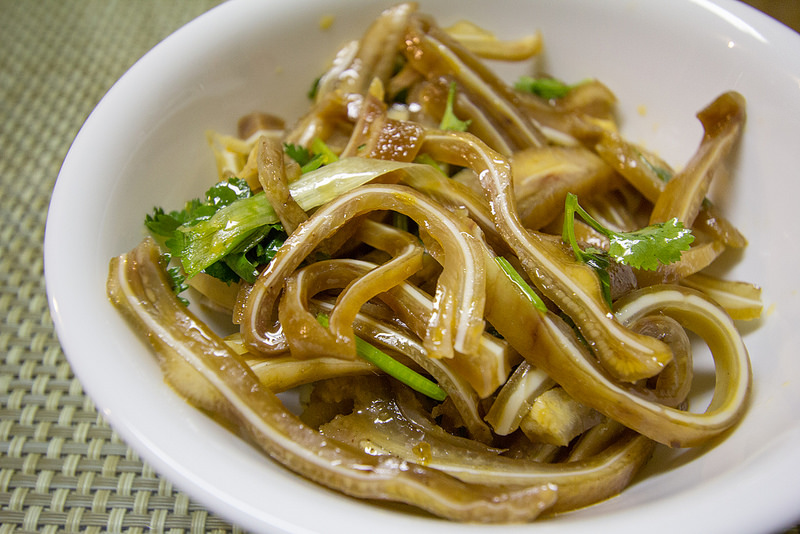
I went with my mom to Marina Food’s deli to get some BBQ pork, and we saw one of our favorite appetizers, the pig’s ear! We were excited to see it and just had to get some for dinner. :D

pig's ear

In Chinese cuisine, pig’s ear is often an appetizer or a side dish, called 豬耳朵 (pinyin: zhū ěr duo, “pig’s ear”). Pig’s ear can be abbreviated in Chinese to simply 豬耳. In some regions, pig’s ears are known as 层层脆 (ceng ceng cui, literally “layers of crunch”). It can be first boiled or stewed, and then sliced thin, served with soy sauce or spiced with chili paste. When cooked, the outer texture is gelatinous, akin to tofu, and the center cartilage is crunchy. Pig’s ear can be eaten warm or cold. (Wikipedia)

Classic Sichuan preparation: Pig ears are boiled with aromatic spices until tender, then stacked up and pressed down just like a classic French terrine. Once set, the terrine is thinly sliced, marinated in vinegar and spices and served cold. The cross section of the ears sort of looks like a cross between a relief map and strips of bacon. It’s the high gelatin content of the ears — easy to miss when fried — that makes the dish work. Cut paper thin on a meat slicer the ears become soft and supple, almost like mortadella. Slice it by hand slightly thicker and you’ll get a better sense of the crunchy cartilage and firm gelatin. (Los Angeles Times)

Vietnam: Bánh Da Lợn

Market: D & K Market
City: Oakland, CA

I came home to a small package of banh da lon on the kitchen table… My mom found this dessert while shopping at Oakland Chinatown, and got one for me! We can usually find this at a local Vietnamese sandwich shop, but the one near home stopped carrying it. Banh da lon is usually found on packaged square styrofoam plates with plastic wrap. But without a flower like in the photo below; my mom just wanted to make the dish look pretty! Also, the ridges on the cake is most likely from the knife used to cut it into strips; it was already cut in the package.

banh da lon

Bánh da lợn (literally “pig skin cake”) is a Vietnamese steamed layer cake made from pandan leaves, tapioca starch, rice flour, mashed mung beans, coconut milk and/or water, and sugar. Durian or taro may also be used. The green color is obtained from the pandan leaves, usually by using a motar. The pandan extract is then mixed with the rice flour. The cake is sweet and gelatinously soft in texture, with thin colored layers alternating with layers of mung bean, durian, and/or taro, and pandan. (Wikipedia)

As for the name of the dessert (“pig skin cake”), don’t you think it kinda looks like pork belly? That’s probably where the name came from.

Philippines: Lumpia

Restaurant: Goldilocks
City: Union City, CA

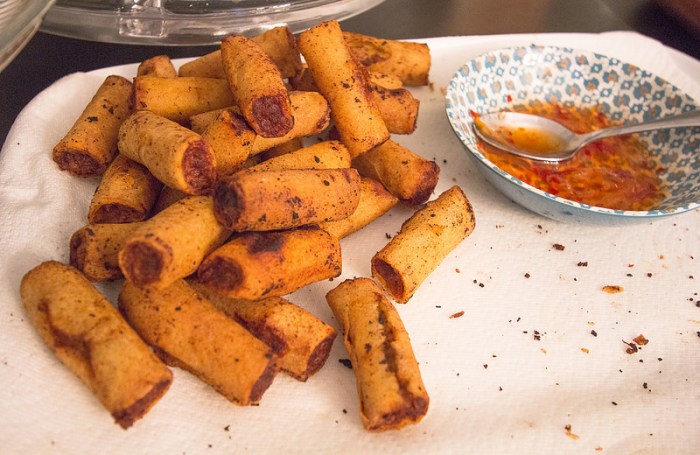
Drove back to the SF Bay Area today, to attend a baby shower. Aaaaand lumpia from Goldilocks was one of the yummy appetizers served!!

Goldilocks is a bakeshop chain based in the Philippines, that makes Filipino cakes, breads, and pastries. They also have a foodshop that makes Filipino dishes (including beef, chicken, pork, seafood, and vegetable dishes), appetizers, and desserts. In the United States, there are several locations in the SF Bay Area and Southern California, plus one in Las Vegas.

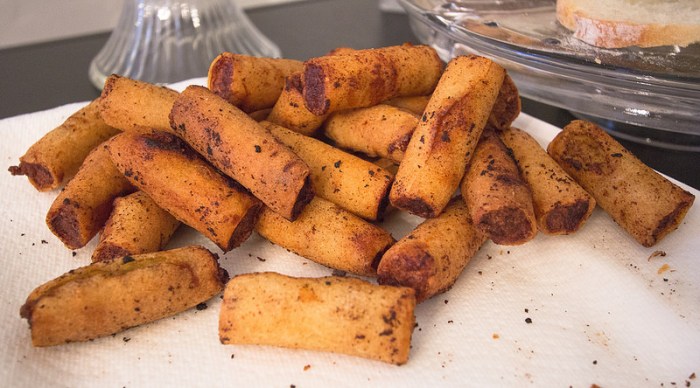
lumpia-1 lumpia-2

Goldilocks’ lumpia can be ordered in two ways, with the filling wrapped in an egg roll or crepe wrapper, to make the lumpia done in the deep fried crispy variety or soft crepe variety, respectively. The ones shown in the photos above were the deep fried ones, which are like mini egg rolls, and they were accompanied by sweet chili sauce.

The following is a bit of history about lumpia, from Wikipedia:

Lumpia are pastries of Chinese origin similar to fresh popiah or fried spring rolls popular in Southeast Asia. The term lumpia derives from Hokkien lunpia (Chinese: 潤餅; Pinyin: rùnbǐng; Pe̍h-ōe-jī: jūn-piá, lūn-piá), which is an alternate term for popiah. The recipe, both fried and fresh versions, was brought by the Chinese immigrants from the Fujian province of China to Southeast Asia and became popular where they settled in Indonesia and the Philippines.

Lumpiáng Shanghai is believed to be originated from Shanghai, these meat-laden, fried type of lumpia are filled with ground pork or beef, minced onion, carrots, and spices with the mixture held together by beaten egg. They may sometimes contain green peas, cilantro (Chinese parsley or coriander) or raisins. Lumpiyáng shanghai is commonly served with sweet and sour sauce owing to the influence of Chinese cuisine, but catsup (tomato or banana) and vinegar are popular alternatives. This variety is by standard 2.5 cm in diameter and around 10-15 cm in length. However, most restaurants and street vendors often serve lumpiáng shanghai in smaller diameters, typically 12 to 20 cm, and serve these with a spicy sauce instead of a sweet and sour sauce.

United Kingdom: Fish and Chips

Restaurant: Mac’s Fish & Chip Shop
City: Santa Barbara, CA

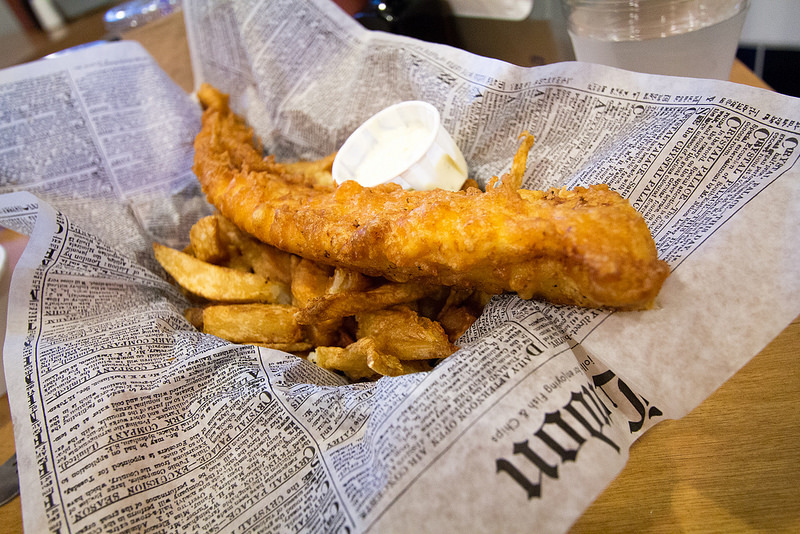
Mac’s Fish & Chips Shop is a British restaurant that was featured on Food Network’s Diners, Drive-Ins & Dives in 2012. Bumped into this place while walking along State Street!

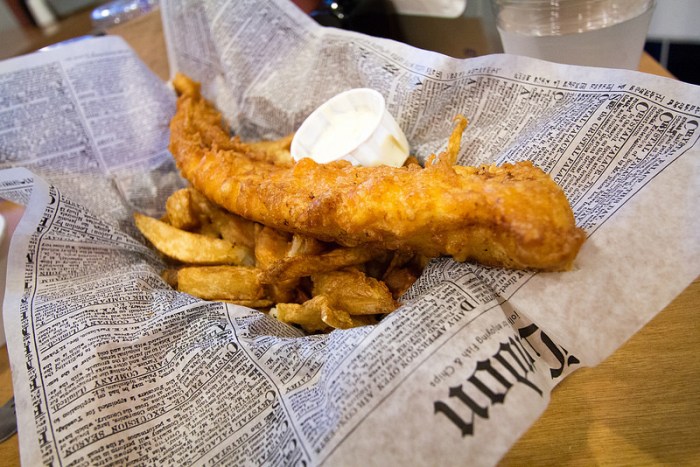
fish and chips

Whole fillet of premium, sustainable Alaskan Cod cooked to order in a thin, crisp coating of beer batter. There was the option of ordering the fish alone, or with chips and/or sides (mushy peas, baked beans, gravy, curry sauce, coleslaw, buttered bread roll, pickled onions, dill pickle, or battered dill pickle). Tartar sauce was served with the fish, and malt vinegar was available on the table.

The following is a bit of history about fish and chips, from Wikipedia:

Fish and chips is a hot meal of English origin. It consists of battered fish, commonly Atlantic cod or haddock, and deep-fried chips. A common side dish is mushy peas.

Fish and chips became a stock meal among the working classes in the United Kingdom as a consequence of the rapid development of trawl fishing in the North Sea, and the development of railways which connected the ports to major industrial cities during the second half of the 19th century, which meant that fresh fish could be rapidly transported to the heavily populated areas. Deep-fried fish was first introduced into Britain during the 17th century by Jewish refugees from Portugal and Spain, and is derived from pescado frito. In 1860, the first fish and chip shop was opened in London by Joseph Malin.

Deep-fried chips (slices or pieces of potato) as a dish may have first appeared in Britain in about the same period: the Oxford English Dictionary notes as its earliest usage of “chips” in this sense the mention in Dickens’ A Tale of Two Cities (published in 1859): “Husky chips of potatoes, fried with some reluctant drops of oil”.

The modern fish-and-chip shop (“chippy” or “chipper” in modern British slang) originated in the United Kingdom, although outlets selling fried food occurred commonly throughout Europe. Early fish-and-chip shops had only very basic facilities. Usually these consisted principally of a large cauldron of cooking fat, heated by a coal fire. During World War II, fish and chips remained one of the few foods in the United Kingdom not subject to rationing.

Denmark: Pandekager (aka Danish Pancakes)

Restaurant: Paula’s Pancake House
City: Solvang, CA

My sister and I took a small roadtrip to Solvang and Santa Barbara. Solvang is a quaint Danish town, in between San Luis Obispo and Santa Barbara. Solvang was founded in 1911 by three Danish-American educators; they named the settlement Solvang, meaning ‘Sunny Meadow’, for the rich farm and ranch lands of the Santa Ynez Valley. Solvang is now considered as California’s “Little Denmark”.

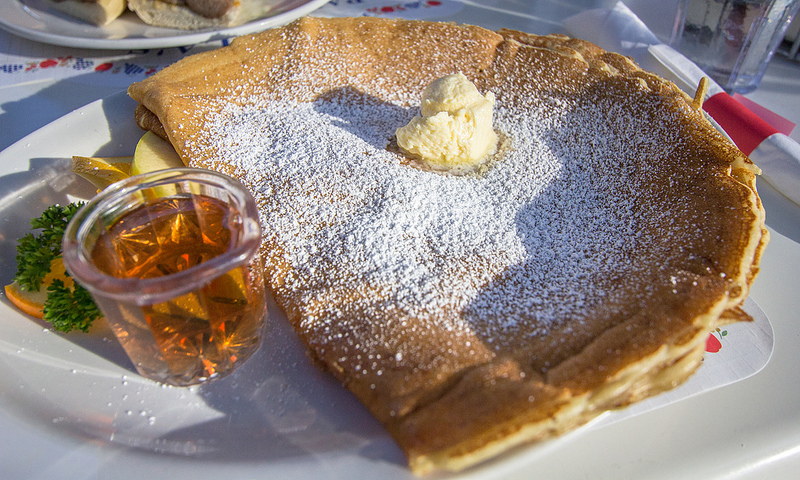
danish pancakes

Two Danish pancakes with powdered sugar, whipped butter, and warm maple syrup.

Danish pancakes (pandekager) are much thinner and lighter than buttermilk pancakes, but thicker than crêpes. These pancakes are now my favorite kind of pancakes!

Pandekager is also not to be confused with æbleskiver, a spherical Danish pancake. We passed by a store that sold the latter kind of pancakes, but were too full from our 3pm lunch. I’ll have to try getting æbleskiver next time I go to Solvang!

Korea: Samgak Kimbap

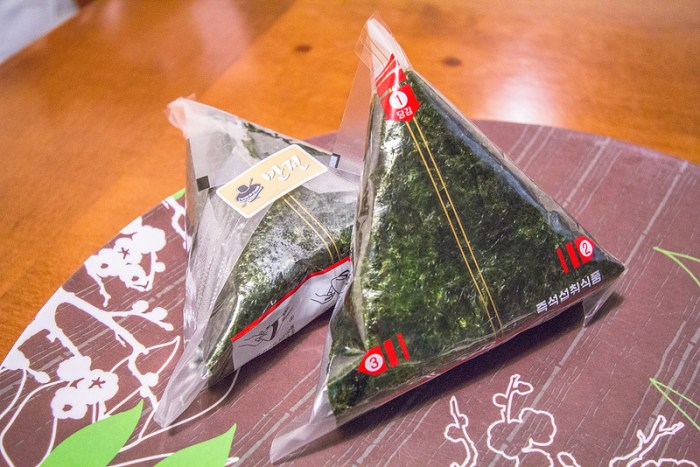
One of my sister’s roommates made samgak kimbap to share! It was triangle-shaped seaweed stuffed with rice and canned tuna. It was my first time eating this particular type of kimbap, and it was quite fun eating it!

samgak kimbap - 1samgak kimbap - 2

Samgak kimbap (삼각김밥) literally translates to triangle (삼각) laver (김) rice (밥).

Samgak kimbap is a triangle-shaped kimbap sold in many convenience stores in South Korea. Samgak kimbap also come in many varieties (different type of meat or stuffing). (Wikipedia)

The simple plastic wrapping is actually a smart trick to keep the food fresh. Unpeel the ripcord marked (1). Then pull out the corners (2) and (3). You’ll see that there’s a double layer of plastic enveloping the seaweed, separating it from the rice and keeping it crispy. When the corners are removed, the seaweed springs back into place around the triangle rice. (Lanie in Korea)

There is a lot of contention about the origin of kimbap. Many believe that kimbap is simply a Korean riff on sushi stemming from the Japanese occupation of Korea. Another take is that kimbap is an evolution of kimssam, a rice and seaweed wrap. In all probability both are correct, given the long history of both peaceful and violent contact between Korea and Japan. (Seoul Plaza)

Below is a YouTube video that shows how samgak kimbap is made, unwrapped, and eaten!