Greece: Dolma

Restaurant: Jaffa Café
City: San Luis Obispo, CA

Jaffa Café is a Mediterranean restaurant with three locations in SLO County, in Arroyo Grande, Paso Robles, and San Luis Obispo.
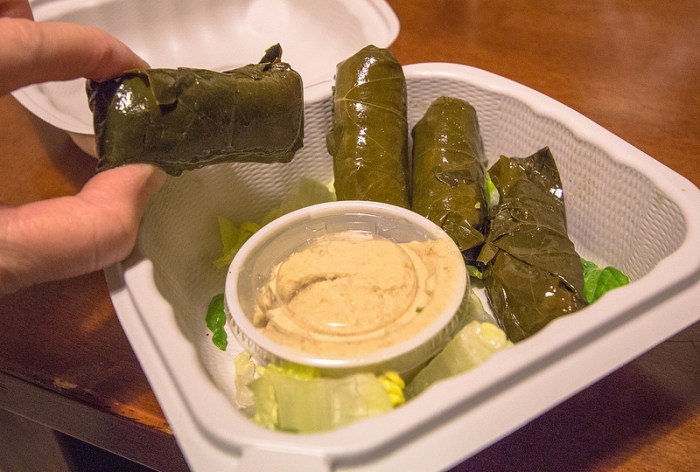
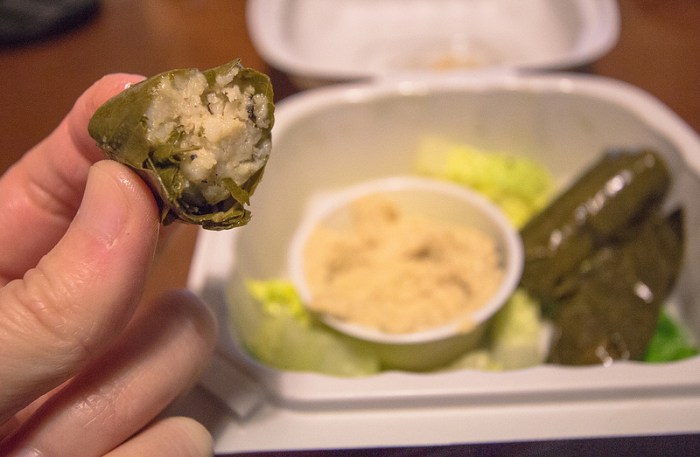
dolma-1dolma-2

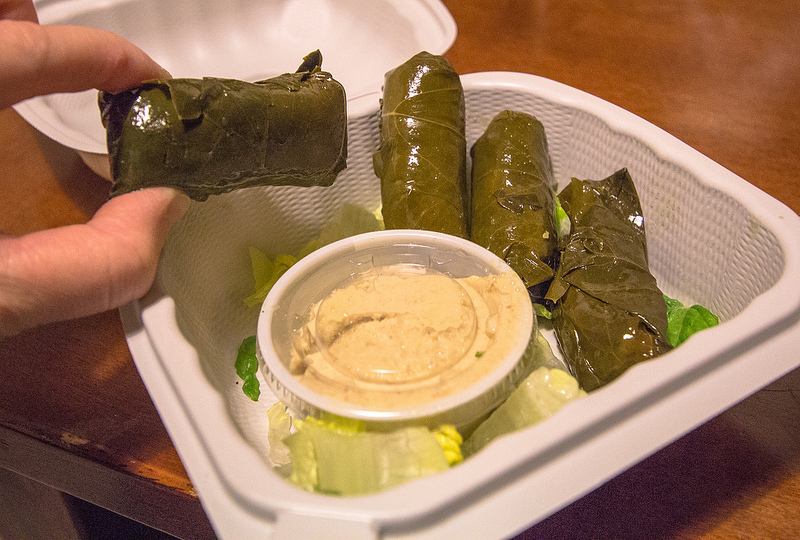
Jaffa Café called this vegetarian appetizer “Grape Leaves w/ Hummus”. The chef said the appetizer is prepared using the Greek method of using grape leaves, whereas the stuffing is Mediterranean.

Dolma comprises a specific style of cuisine wherein various vegetables like tomatoes, eggplants, peppers, etc., are stuffed with fillings made of rice, minced meat, nuts and spices. The word “Dolma” is of Turkish origin and literally denotes the stuffing procedure followed during the preparation of the dish. Dolma recipes are age old and are mainly popular in and around the Mediterranean areas and the Middle East. The variation of the same is found in certain parts of Eastern Europe as well. Though technically speaking a Dolma is a stuffed vegetable preparation, even fillings wrapped in leaves are also considered to be a delicacy that comes under this category. The best example for this would be the famous grape leaf Dolma. (iFood.tv)

In Greek cuisine, dolma (ντολμάς) usually refers to the vine-leaf version, and there are many variations. Some prepare it with an avgolemono (egg and lemon) sauce, others prefer a tomato sauce. They can be cooked in a pan in the oven, while others prefer to cook them on the stovetop. Stuffed peppers, tomatoes, and other vegetables are called gemista (γεμιστά, ‘stuffed thing’); the stuffing is typically rice-based and meatless, though meat versions exist as well. (Wikipedia)
Central Thailand: Tom Kha

Restaurant: Thai Boat
City: San Luis Obispo, CA

Thai Boat is a family owned restaurant, and closes randomly when the family travels back to Thailand. They also only open M-F, 11am-2pm and 4:30pm-8pm.

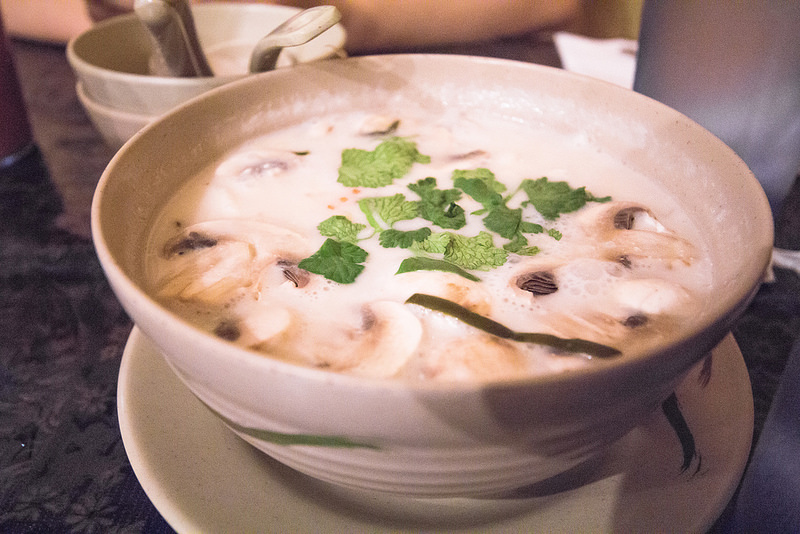
tom kha

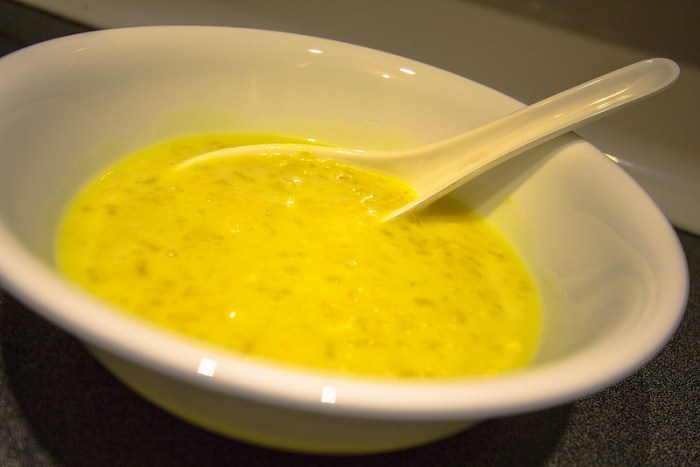
Coconut milk soup with one choice of meat (chicken, tofu, veggie, shrimp, or squid), mushroom, lemongrass, lime juice, and galanga. We chose chicken as the meat.

Central Thailand has a moderate flavor with herbs and sugar. Most curry with coconut milk dishes origin from central Thailand. (Thai Style)

Tom kha kai (ต้มข่าไก่) literally means “chicken galangal soup”. This soup is made with coconut milk, galangal (a type of ginger), lemon grass, kaffir lime leaves, and chicken, and often contains straw, shiitake, or other mushrooms, as well as coriander leaves. There are other versions of this soup made with seafood (tom kha thale), mushrooms (tom kha het), pork (tom kha mu) and tofu (tom kha taohu). (Wikipedia)

Thailand: Pad Thai

Restaurant: Thai Boat
City: San Luis Obispo, CA

I am now 205 miles away from my home, visiting the sister in SLO for a few days! I always try to eat at Thai Boat whenever I’m in town; it’s my favorite restaurant in SLO. It’s also perhaps the best Asian restaurant in SLO; there are very few Asian restaurants here, unlike the SF Bay Area. Thai Boat is a family owned restaurant, and closes randomly when the family travels back to Thailand. They also only open M-F, 11am-2pm and 4:30pm-8pm.

pad thai

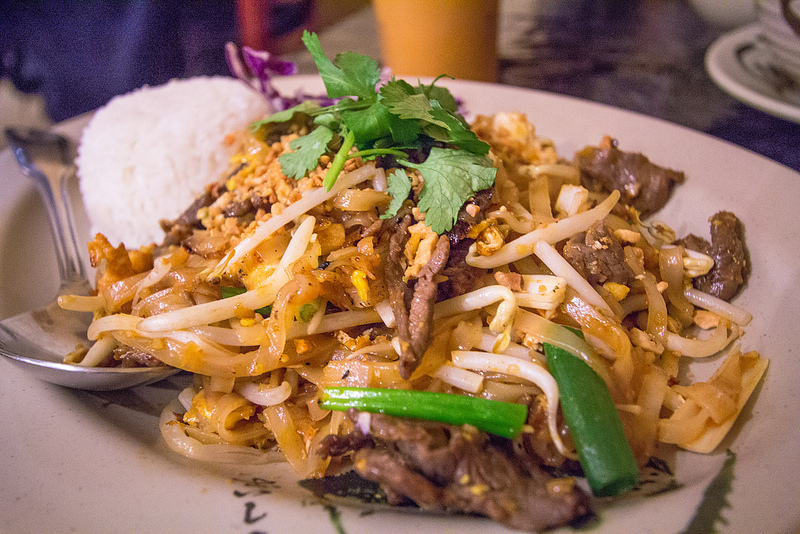
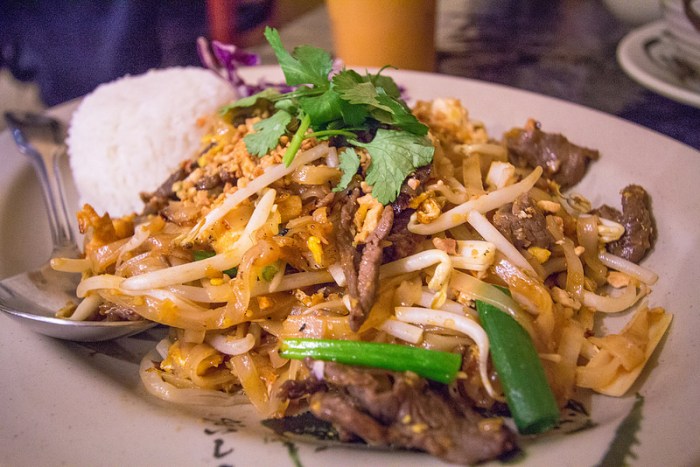
Pan fried small rice noodles with one choice of meat (chicken, pork, beef, tofu, veggie, shrimp, or squid), egg, bean sprouts, and ground peanut. We chose beef as our meat. There’s a scoop of rice on the plate because when we ordered, the waiter said my sister looked really hungry and gave us a free portion of rice on the side! :D

Did you know that pad Thai (ผัดไทย) did not originate in Thailand?

The following excerpt about the origins behind Pad Thai is taken from Gastronomica 9:1.

For many westerners, pad Thai—or, more accurately, kway tow pad Thai (stir-fried rice noodles Thai-style)—symbolizes Thai cooking, thanks in large part to the Thai government’s ongoing efforts to introduce the country’s food to the rest of the world.

If Westerners believe that pad Thai symbolizes Thai cooking, many Thais agree. “Whenever we try Thai food,” says Nick Srisawat, a native of Thailand who now oversees a large Thai restaurant group in the Washington, D.C., metropolitan area, “we try pad Thai first, because that is a way to judge how good a restaurant is. That’s true all over the world—except in Thailand.” Because pad Thai is a specialty dish in Thailand, many restaurants choose not to compete with the street-food vendors, who make and serve only pad Thai all day long and thus have perfected the recipe.

Pad Thai is really nothing more than a regular noodle dish, one that is not even native to Thailand. Its full name, kway teow pad Thai, hints at its possible Chinese origins; kway teow, in Chinese, refers to rice noodles. It is likely that some early version of the dish came to Thailand with settlers crossing from southern China, who brought their own recipe for fried rice noodles. Certainly the cooking style—stir-frying—is Chinese, and most food historians credit the Chinese with the invention of noodles. And, as Chombhala Chareonying, former Minister-Counsellor at the Royal Thai Embassy in Washington, D.C., points out, Thai food is basically Indo-Chinese in origin. The cooked meats and vegetables in pad Thai resemble dishes prepared by the Cantonese and Tae Chiew (Chao Zhou in Mandarin) from China’s eastern Guangdong province. Nevertheless, the flavors and textures are pure Thai.

[Edit on 12.30.2014] I took a video of a chef making pad thai during a Songkran Festival back in 2011, at Wat Buddhanusorn in Fremont, California. They had a food court with various stands selling different types of Thai dishes. Since 2013, they no longer sell food to the public, or to anyone, because their permit only allows them to operate as a church, not a restaurant.

Japan: Ramune

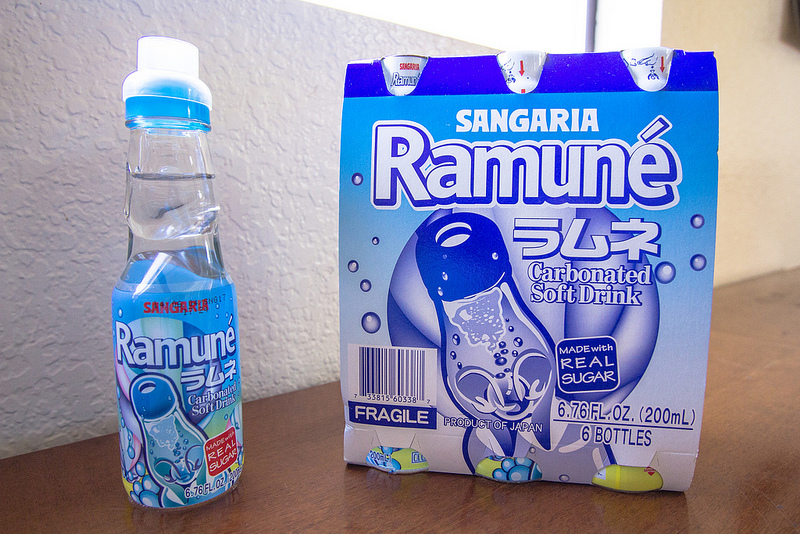
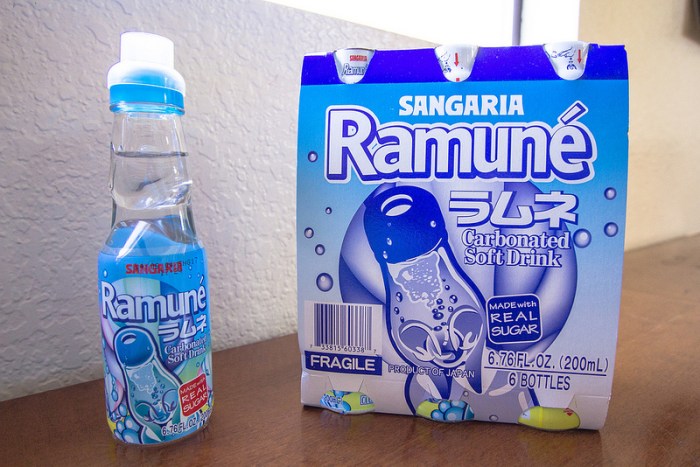
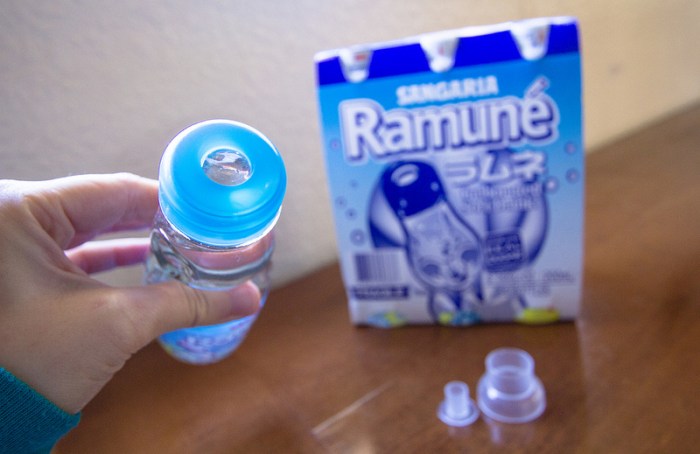
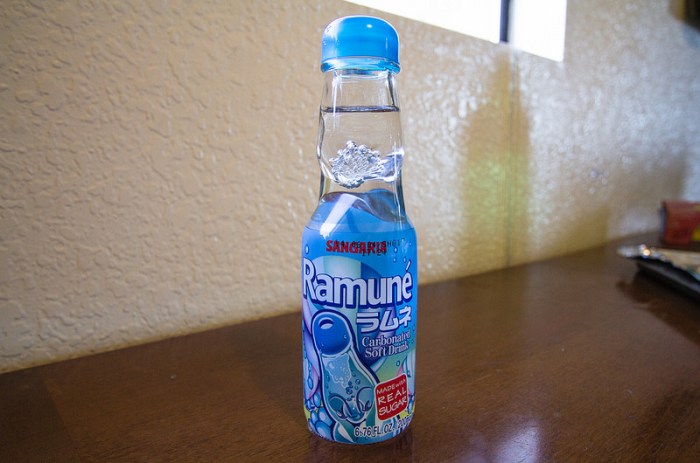
Ramune can be found at most Asian supermarkets. There are many different flavors, in addition to the original flavor. Ramune refers to the type of bottle with carbonated soda, and is manufactured by various companies.

ramune-1ramune-2ramune-3ramune-4

Ramune (ラムネ) is a carbonated soft drink originally sold in Japan which was introduced in Kobe by Alexander Cameron Sim, a Scottish-born pharmacist and entrepreneur. Ramune is widely known for the distinctive design of its bottle, often called Codd-neck bottles after the inventor, Hiram Codd. They are made of glass and sealed with a marble; the codd head is held in place by the pressure of the carbonation in the drink. To open the bottle, a device to push the marble inward is provided. The marble is pushed inside the neck of the bottle where it rattles around while drinking. Therefore, the drinks are sometimes called “marble soda” outside of Japan. Ramune is one of the modern symbols of summer in Japan and is widely consumed during warm festival days and nights. (Wikipedia)

Sweden: Lingonberry Jam

Market: IKEA
City: East Palo Alto, CA

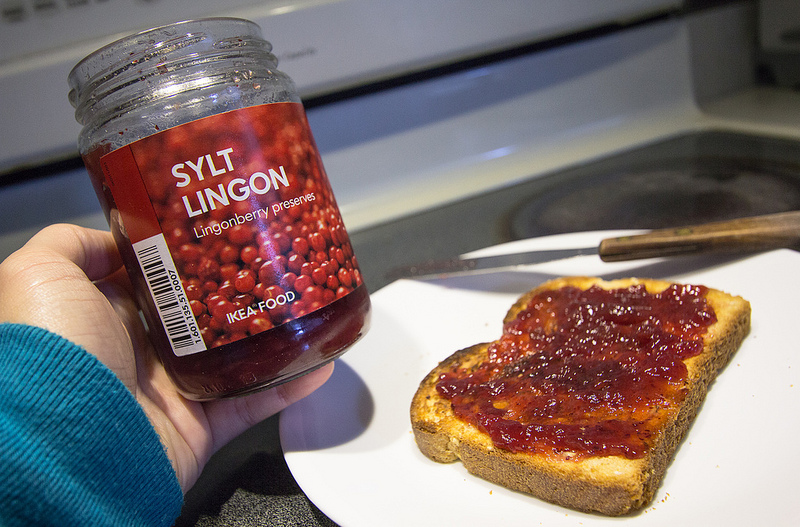
Lingonberry jam can be found at most IKEA stores. In the SF Bay Area, there are two IKEA stores, in East Palo Alto (EPA) and Emeryville.

lingonberry jam

Lingonberries (Vaccinium vitis-idaea) are to Scandinavians what blackberries are to Americans – an abundant wild fruit free for the taking by anyone with a basket, a harvesting fork, and the patience to pick through and clean their harvest. Produced by low, evergreen shrubs throughout Scandinavia’s forests, the tart red berries are much smaller and juicier than their distant cousin, the cranberry. Bursting with natural preservatives and pectin, lingonberries were invaluable to earlier generations of Scandinavians, for they could be kept for months at room temperature simply by placing them in jars of water (vattlingon) or by stirring the raw berries with a small amount of sugar to make rårörda lingon, an easy lingonberry jam (no cooking required). (About)

Lingonberry jam (lingonsylt) always been very popular with traditional Swedish dishes. Fine lingonberry jam is prepared only with berries, sugar and, optionally, a small amount of water. Cheaper varieties are diluted with apples and/or pectin. The finest lingonberry “jam” is prepared fresh by just mixing berries and sugar, without boiling; this is called rårörda lingon or rørte tyttebær (raw-stirred lingonberries). Before the use of refined sugar became common in Sweden, lingonberry jam was prepared with lingonberries as the only ingredient. Because of the benzoic acid, which is found in high amounts in lingonberries, the berries keep well without any sugar or other preservatives. (Wikipedia)

South Korea: Cocohodo’s Walnut Pastry

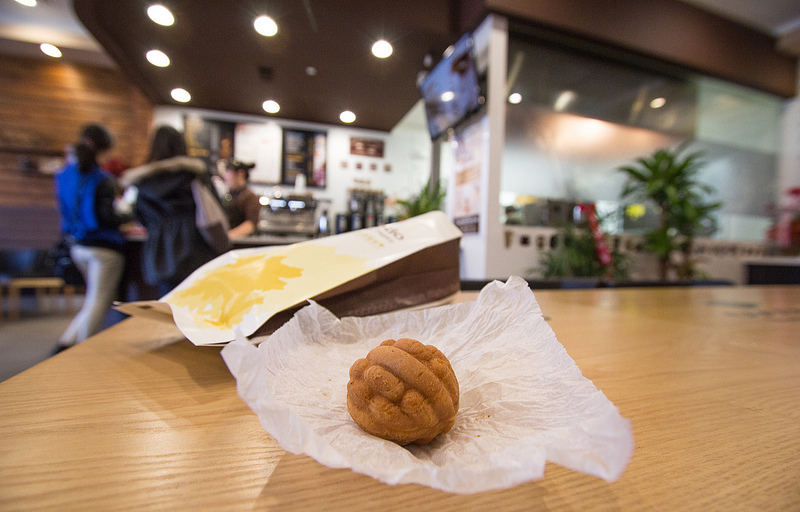
Cocohodo (코코호도) is a South Korean dessert / snack shop franchise, with several stores in Southern California, and they recently opened their first store in Northern California, in Sunnyvale. The store is near Hankook Supermarket.

cocohodo walnut pastrycocohodo walnut pastry

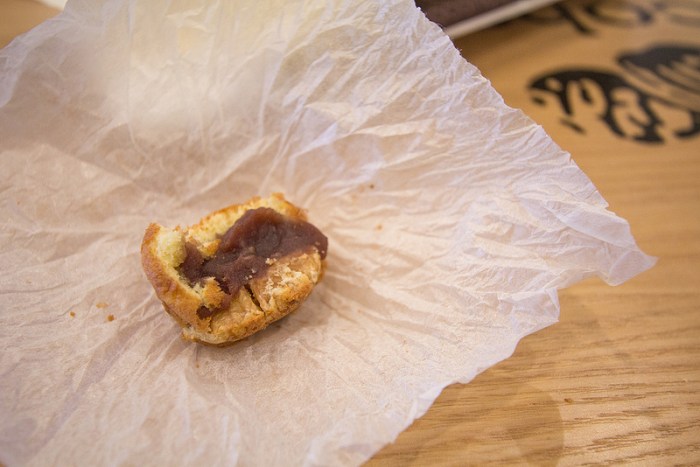
These are small round pastries that resemble walnut shells. The pastries have walnuts and red bean paste inside. You can see how they make the pastries in the back, through the window. It’s kinda like how Krispy Kreme shows you how the donuts get made. It’s cheaper if you order the snack packs instead of the boxes. The pastries are all wrapped individually regardless of how it’s packed at the end. The pastries are made fresh, so it’s very warm when you get your order. I brought a Glasslock so I can take the pastries out from the bag to cool down evenly, before it gets soggy.

[Edit on 1.27.2014] I gave a walnut pastry to one of my sister’s roommates, who was born in South Korea but later moved to Southern California. She recalled buying the walnut pastries from street vendors in Korea, so she thought it was odd how high-end stores (such as Cocohodo) also sell walnut pastries.

Korea: Aloe Vera Drink

Market: 99 Ranch Market
City: Newark, CA

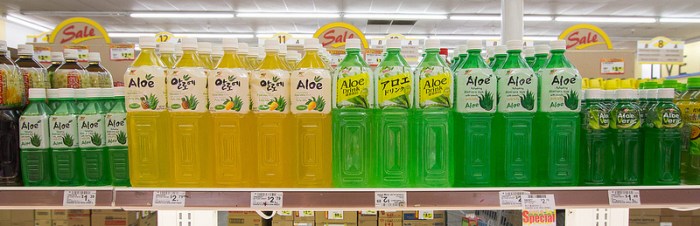
Aloe vera drinks can be found at most Asian supermarkets. There’s several different brands, and there’s also flavored aloe vera drinks, such as pineapple, mango, and pomegranate. I always get the plain, original ones.

aloe vera drinksaloe vera drink

Aloe vera drinks are unique Korean beverages. They are sold in short and tall green tinted plastic bottles. Normally containing thirty percent aloe vera gel in a drinkable form, they are rich in minerals, calcium, potassium, Vitamins B3, B1, B6, B2, and C. Aloe vera drinks are characterized as aiding the digestive system and helping relieve gastrointestinal problems. They are also considered as a treatment for athlete’s foot and acne. (Korea Times)

Northern Vietnam: Bánh Đậu Xanh

Restaurant: Cam Huong
City: Union City, CA

Vietnamese sandwich shops usually carry bánh đậu xanh from other small businesses. However, I might have also seen them at 99 Ranch and/or Marina Food.

banh dau xanhbanh xau danh

The texture is similar to peanut butter, but with the mung bean taste.

Bánh đậu xanh (mung bean cake) is a type of Vietnamese banh (cake or bread). It is a specialty of the Hải Dương Province. The cake is made from powdered mung beans, pureed with sugar and vegetable oil or animal fat, usually lard, and grapefruit oil. The cake is cut into small cubes and packaged into small boxes or greaseproof paper. The cake is often eaten with green tea. (Wikipedia)

Southern Vietnam: Chè Bắp

Restaurant: Cam Huong
City: Union City, CA

che bap11942168174_68741f8850_c

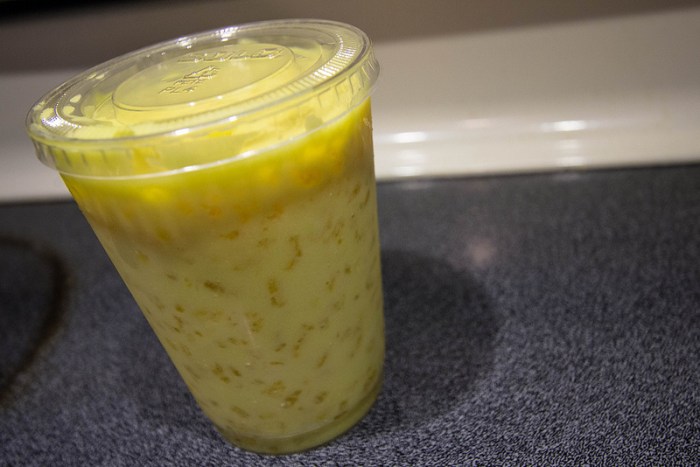
Chè bắp is a Southern Vietnamese chè, made from corn (bắp), tapioca rice pudding, and coconut cream.

Chè is a Vietnamese term that refers to any traditional Vietnamese sweet beverage, dessert soup or pudding. Referred to colloquially as three color drink, varieties of chè are made with mung beans, black-eyed peas, kidney beans, tapioca, jelly (clear or grass), fruit (longan, mango, durian, lychee, or jackfruit), and coconut cream. Other types are made with ingredients such as salt, aloe vera, seaweed, lotus seed, sesame seed, sugar palm seeds, taro, cassava, and pandan leaf extract. (Wikipedia)

Chè can be hot, warm, or cold. They are sold as street food, served at restaurants, and made at home. In Vietnamese communities abroad, there are even cafeteria-like chè bars where you can point to various cooked ingredients and the clerk will combine them in a cup for you to eat in or takeaway. Look for chè at Vietnamese banh mi sandwich shops too; they’re typically sold in plastic see-through cups. (Viet World Kitchen)

Hong Kong: Hong Kong-style Milk Tea

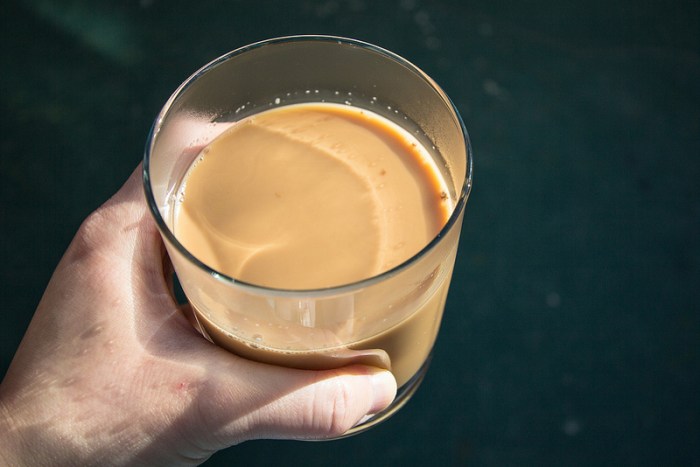
Every morning, either my mom or dad makes tea and put in my tumbler, for me to take to work. The type of tea I get feels like a surprise, because I have no idea what tea it is until I open it, and usually have to figure out what tea it is by taste. So, I’m all beams when I open my tumbler and discover that my drink is of tan color, because it’s my favorite hot drink, the HK-style milk tea! It’s very common for families from HK to have milk tea in the mornings. It’s even more special when your mother or father prepares it for you!

Yesterday, I picked up a clear glass cup from Crate & Barrel so I can take photos of beverages that aren’t sold in clear containers. I put that to good use for today’s drink! I poured it out of my tumbler just for this blog! ;D

hk-style milk tea

Hong Kong-style milk tea originated from British colonial rule over Hong Kong. The British practice of afternoon tea, where black tea is served with milk and sugar, grew popular in Hong Kong. Milk tea is similar, except with evaporated or condensed milk instead of ordinary milk. It is called “milk tea” (Chinese: 奶茶, Cantonese: “naai cha”) to distinguish it from “Chinese tea” (Chinese: 茶, Cantonese: “cha”), which is served plain. Outside of Hong Kong it is referred to as Hong Kong-style milk tea. (Wikipedia)