San Francisco: Mission Burrito

Restaurant: Iguanas
City: San Jose, CA (Downtown)

I went to Tech Museum to secure tickets for the Star Wars exhibit, and grabbed a burrito at Iguanas. It’s been 21 months since I’ve been to Iguanas in Downtown San Jose; I’d frequent it when I attended San José State University.
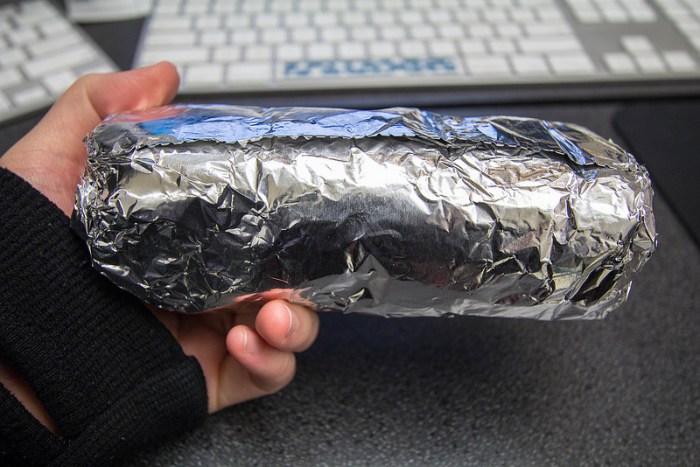
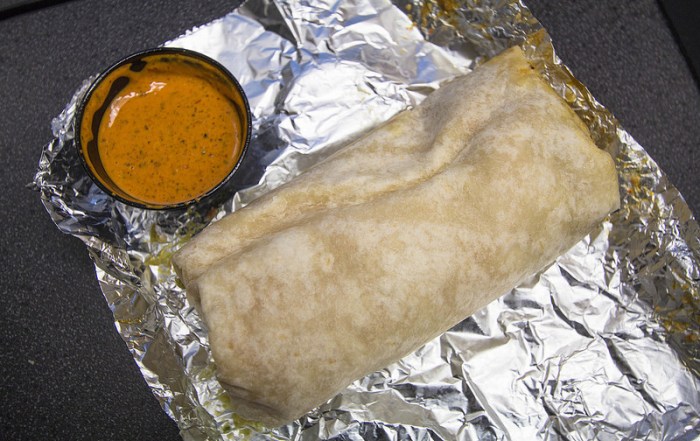
super mini - 1 super mini - 2 super mini - 3

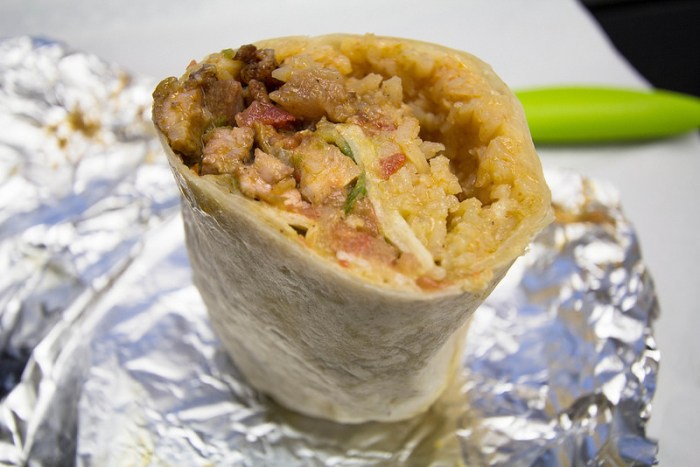
I ordered the Super Mini with al pastor sans beans. The Super Mini is a smaller version of the Super Burrito, which contains guacamole, sour cream, cheese, meat, beans, rice, and fresh salsa. There were seven choices of meat:

Carne Asada – grilled marinated Angus steak
• Pollo Asado – grilled marinated chicken
• Chile Verde – braised pork in tomatillo sauce
• Carnitas – tender braised pork
• Chipotle Chicken – shredded chicken in a spicy chipotle sauce
• Ground Beef – Mom’s seasoned ground beef recipe
• Al Pastor – spicy marinated pork

It was my first time ordering al pastor; I usually get carne asada at Iguanas. I was in the mood for spicy food and also asked for the orange sauce (orange-colored, spicy special sauce). When I got back to work and ate the burrito, my mouth was on fire and my nose was runny! It was worth it because it was delicious! ;D

I was born and raised in the San Francisco Bay Area, and never knew there was a name for the burritos from this area! Do you know what they are called? They’re called Mission burritos and they originated from San Francisco!

The following is a background of the Mission burrito, from Wikipedia:

A Mission burrito (also known as a San Francisco burrito or a Mission-style burrito) is a type of burrito that first became popular during the 1960s in the Mission District of San Francisco, California. It is distinguished from other burritos by its large size and inclusion of extra rice and other ingredients. It has been referred to as one of two major styles of burritos in the United States, following the earlier, simple burrito consisting of beans, rice, and meat and preceding the California burrito containing cheese and potatoes that was developed in the 1980s. Continue reading
Korea: Jjajangmyun

Restaurant: Chef Yu – Yuyu Za Zang
City: Oakland, CA

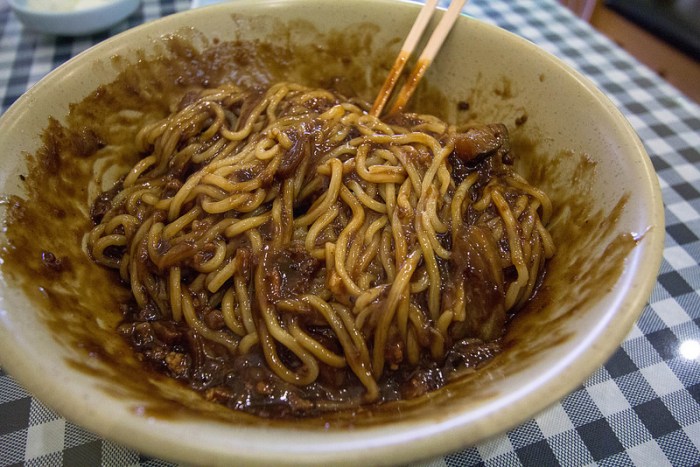
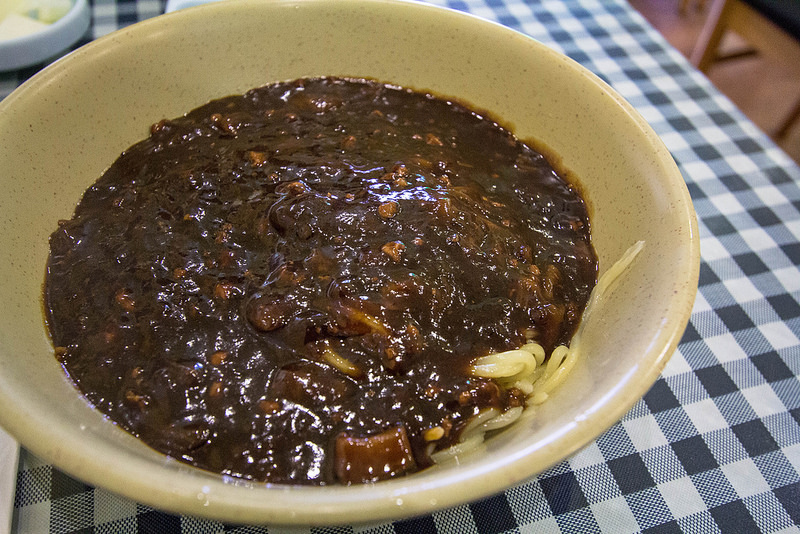
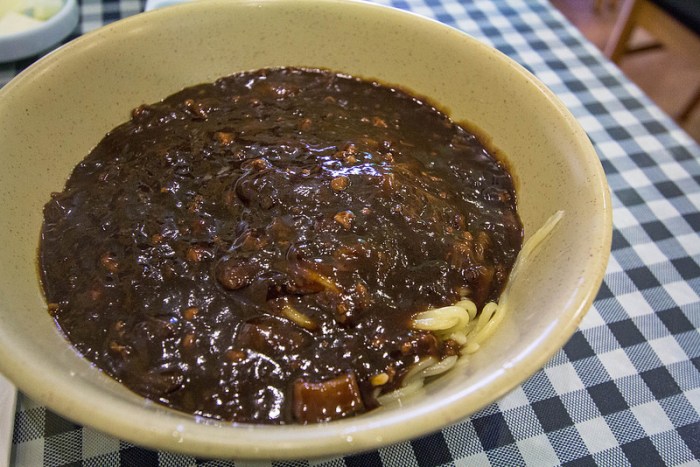
Happy Groundhog Day! I got jjajangmyun for lunch today; it was cold and raining so this definitely warmed me up! I hope it rains the rest of the week, as California is experiencing drought.

jjajangmyun - 1 jjajangmyun - 2

Flour based noodles with black bean paste sauce, with pork and vegetables.

Jajangmyeon (자장면; 짜장면; jjajangmyeon), is a noodle dish topped with a thick sauce made of chunjang (a salty black soybean paste), diced pork and vegetables, and sometimes also seafood. Jajang (alternately spelled jjajang), the name of the sauce, is the Korean pronunciation of the Chinese characters 炸醬, which literally means “fried sauce.” Myeon (also spelled myun) means “noodle”. The dish originated from zhajiangmian (炸醬麵, literally “fried sauce noodles”) in China’s Shandong region. The pronunciation of the dish’s name is nearly identical to that of its Korean counterpart. But Korean jajangmyeon differs from Chinese zhajiangmian, as Korean jjajangmyeon uses black Korean chunjang including caramel, and onions. (Wikipedia)

Bavaria: Bockwurst

Restaurant: Gourmet Haus Staudt
City: Redwood City, CA

One of my coworkers ordered the bockwurst.

bockwurst - 1 bockwurst - 2

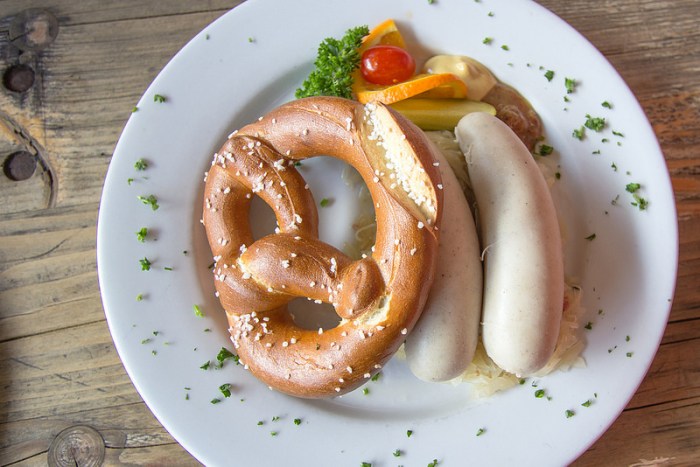
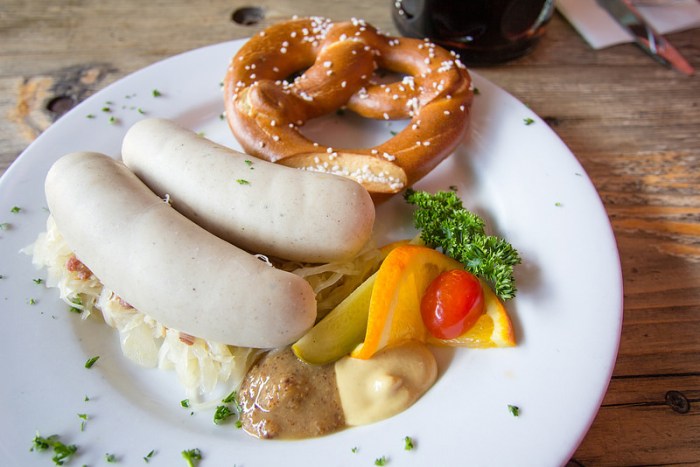
Munich pork and veal white sausage served with sauerkraut and small pretzel. Düsseldorf mustard and a sweet Bavarian mustard was also on the plate.

This lightly spiced pork and veal sausage is traditional in Munich, where they are eaten in much the same manner as Parisians eat onion soup after a night on the town. Once a year from mid-September through late October. Bockwurst shares the honor with Munich beer as the traditional food of the Ocktoberfest. Ocktoberfest dates back to October 17, 1810 on which day King Ludwig I and his bride Theresa were married. Each year Theresa Meadow in Munich comes alive with visitors from around the world who come to celebrate the harvest, Munich beer and Bockwurst. (Schaller & Weber)

This Munich bockwurst is also not to be confused with the Frankfurter bockwurst, and with a similar looking wurst, the weisswurt. Bockwurst also not to be confused with bratwurst.

Weisswurt (literally white sausage) is a traditional Bavarian sausage made from very finely minced veal and freshpork back bacon. It is usually flavoured with parsley, lemon, mace, onions, ginger, and cardamom, although there are some variations. Then the mixture is stuffed into fresh, clean pork casings and separated into individual sausages measuring about ten to twelve centimeters in length and about two centimeters in thickness. (Wikipedia)

“Bratwurst” — “brat” means fried and wurst means sausage.  There is a big difference between a Bockwurst/Weisswurst and a BratwurstWeisswurst (VISE-VURST) is traditionally made with all veal and has chives in it. Bockwurst/Weisswurst is heated in hot water and served with either a sweet grainy mustard. (A Feast for the Eyes)

Franconia: Nürnberger Bratwurst

Restaurant: Gourmet Haus Staudt
City: Redwood City, CA

Had German for lunch today with a few coworkers! The restaurant is connected to a German market; the main entrance of the restaurant is facing the parking lot, while the main entrance of the market is facing the street.

Cool but old fact: Apple engineer Gray Powell lost an iPhone 4 prototype here, which was eventually dissected on the blog Gizmodo a full two months before its official June 2010 release date. (Fast Company via Foursquare)

nūrnberger bratwurst

Traditional German Festival pork sausage, served with sauerkraut and German potato salad. Pickle and Düsseldorf mustard were also on the plate. Sweet Bavarian mustard was also available. Continue reading

Guangdong: Taro Cake

Bakery: New Hwong Kok
City: Milpitas, CA

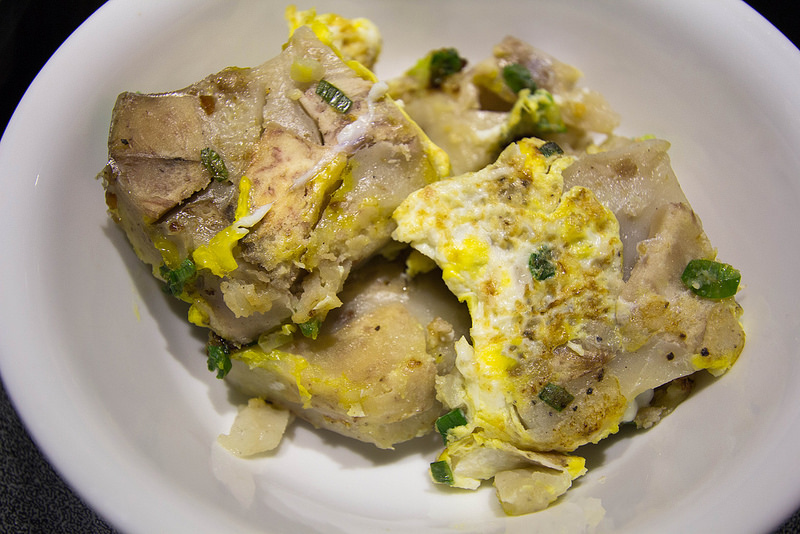
My parents received some taro cake from the family friends we had dinner with on Saturday night. They got it from New Hwong Kok, a Chinese bakery in Milpitas. The bakery apparently only makes steamed taro cake for Chinese New Year.

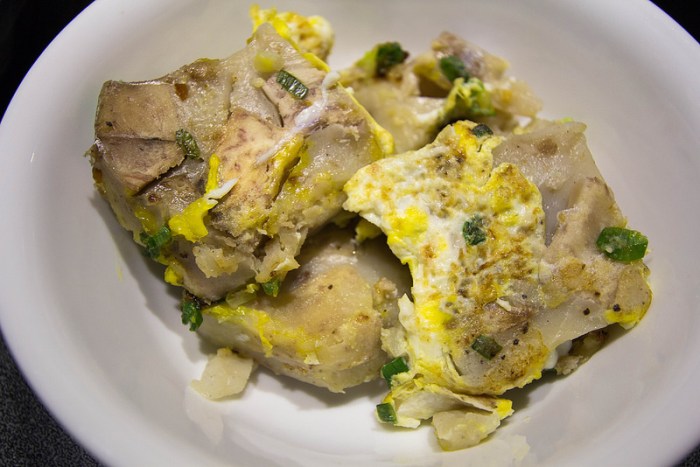
My dad pan fried slices of taro cake with green onion and egg, for dinner tonight! I usually make my own sauce to go with the taro cake, with Ajinimoto gyoza dipping sauce, sesame oil, and Sriracha or garlic chili sauce.

A similar Cantonese dish is daikon cake, where daikon is used instead of taro. Whichever ingredient is used, the taro or daikon in the cake can be in chunky pieces, thin pieces, and/or in a paste with the rice flour. In the photo below, you can tell that the taro is in chunky pieces. Taro and daikon cakes are also popular to make and eat during Chinese New Year.

Speaking of which…that’s tomorrow, Jan 31! Happy Lunar New Year!!! :D

taro cake

Taro cake (simplified Chinese: 芋头糕; traditional Chinese: 芋頭糕; Jyutping: wu6 tau4 gou1) is a Cantonese dish made from the vegetable taro. While it is denser in texture than radish (daikon) cakes, both these savory cakes made in a similar ways, with rice flour as the main ingredient. When served in dim sum cuisine, it is cut into square-shaped slices and pan-fried before serving. It is found in Hong Kong, China, and overseas Chinatowns restaurants. Other ingredients often include pork and Chinese black mushroom, or even Chinese sausages. It is usually topped with chopped scallions. The pan fried square taro cake is semi-crunchy on the outside and medium-soft on the inside. It is also the most consistent version with more or less the same formula in East and Southeast Asia, or among overseas Chinese communities. (Wikipedia)
Continue reading

Java: Kopiko

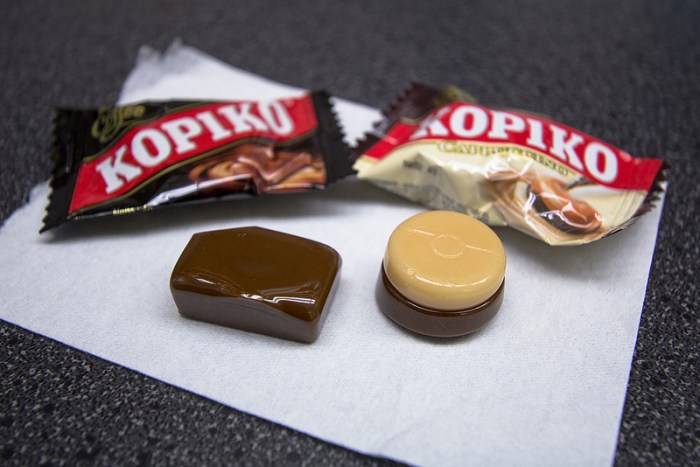
Kopiko can be purchased at most Asian markets.

kopiko - 1kopiko - 2

Kopiko are coffee candies from Indonesia. I’ve only seen two flavors here in the United States, coffee and cappuccino. The coffee candies are made with java coffee beans. The cappuccino candies have milk on one side, and java coffee on the other.

Although Indonesia consists of thousand of islands, Kopiko comes from the appropriately named island of Java. This tiny island hosts fertile, volcanic soil as well as a tropical climate, making this the home of the very best coffee beans in the world. Hence, in the United States and other global destinations, java is synonymous with coffee. Kopiko is owned by the Mayora Group, one of the largest candy manufacturers in Indonesia. Kopiko confectionary, although native to Indonesia, also has distribution centers in several countries around the world. (World of Snacks)

Java coffee refers to coffee beans produced in the Indonesian island of Java. The Indonesian phrase Kopi Jawa refers not only to the origin of the coffee, but is used to distinguish a style of strong, black, and very sweet coffee. Java’s Arabica coffee production is centered on the Ijen Plateau, at the eastern end of Java, at an altitude of more than 1,400 meters. The coffee is primarily grown on large estates built by the Dutch in the 18th century. The five largest are Blawan (also spelled Belawan or Blauan), Jampit (or Djampit), Pancoer (or Pancur), Kayumas and Tugosari, covering in all more than 4,000 hectares. These estates transport ripe cherries quickly to their mills after harvest. The pulp is then fermented and washed off, using the wet process. This results in coffee with good, heavy body and a sweet overall impression. They are sometimes rustic in their flavor profiles, but display a lasting finish. At their best, they are smooth and supple and sometimes have a delicate herbaceous note in the aftertaste. Some estates age a portion of their coffee for up to three years. During this time, the coffee is “monsooned”, by exposing it to warm, moist air during the rainy season. As they age, the beans turn from green to light brown, and the flavor gains strength while losing acidity. These aged coffees are called Old Government, Old Brown, or Old Java. (Wikpedia)

Hawaii: Mauna Loa Macadamia Nuts

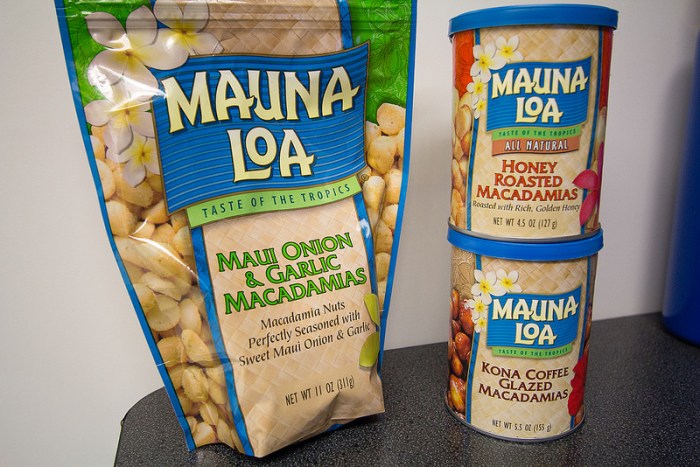
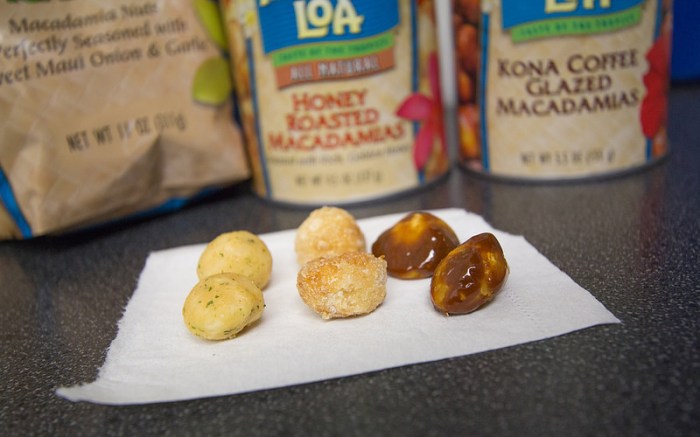
I think I was first introduced to macadamia nuts through my parents’ friends from Hawaii. When they visited the SF Bay Area, they would usually bring some Mauna Loa macadamia nuts as gifts. In the past, it was quite hard to find different varieties of Mauna Loa macadamia nuts in the Bay Area; I dislike macadamia nuts that are chocolate coated or plain. Today, it can be ordered through Amazon.com, though it may still be cheaper to get in Hawaii.

mauna loa macadamia nuts - 1 mauna loa macadamia nuts - 2

Macadamia is a genus of four species of trees indigenous to Australia and constituting part of the plant family Proteaceae. They grow naturally in north eastern New South Wales and central and south eastern Queensland, Australia. Common names include macadamia, macadamia nut, Queensland nut, bush nut, maroochi nut, queen of nuts and bauple nut; and from Indigenous Australians’ languages bauple, gyndl, jindilli, and boombera. The first commercial orchard of macadamia trees was planted in the early 1880s by Rous Mill, 12 kilometres (7.5 mi) southeast of Lismore, New South Wales, consisting of M. tetraphylla. Besides the development of a small boutique industry in Australia during the late 19th and early 20th centuries, macadamia was extensively planted as a commercial crop in Hawaii from the 1920s. Macadamia seeds were first imported into Hawaii in 1882 by William H. Purvis. The young manager of the Pacific Sugar Mill at Kukuihaele on the Big Island, planted seeds that year at Kapulena. (Wikipedia)

By 1921, a far-seeing Massachusetts man, Ernest van Tassel, thought there might be commercial potential in growing macadamias. He planted the first Hawaiian macadamia plantation on government land near Honolulu. Unfortunately, he was ahead of his time. Back then, seedlings from one parent tree couldn’t produce nuts of consistent quality. By the 1930’s a small amount of nuts were sold commercially, but large-scale commercial production was yet to come. In 1922, The University of Hawaii embarked on 20 years of testing and research. Some 60,000 trees were observed and tested in a painstaking process of selection and grafting. Eventually nine strains were developed that could consistently produce a high quality nut. That was the beginning of a long partnership between Mauna Loa and the University of Hawaii, which continues today. The original plantation of what was to become Mauna Loa Macadamia Nut Corporation was established in 1946. The very first macadamia nut trees were planted early that year near Kea’au on the Big Island of Hawaii, where Mauna Loa Macadamia Nut Corporation still resides today. (Mauna Loa Macadamia Nut Corporation)

Laos: Mok Pa

Restaurant: Green Champa Garden
City: Fremont, CA

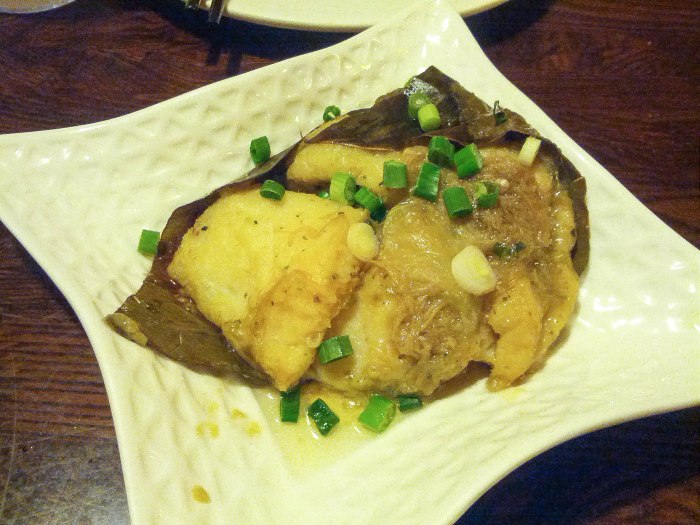
When I was browsing through the menu, I came across their “Moke Pa” (in the salad section…) and the description sounded very similar to amok trey. My mom let me pick this dish so we could try it, and have me compare it to amok trey (they apparently haven’t had amok trey before).

mok pa

Steamed fish wrapped with banana leaf; catfish nugget, lemongrass, ginger, dill, and basil.

Mok pa is similar to amok trey, Cambodia’s signature dish. The main difference is that there’s no coconut milk added to the Lao version. (A foodie’s guide throughout Asia)

Amok trey also uses tumeric root or powder, which gives its orange color and curry flavor. Tumeric is absent in mok pa. (Betsy’s Bites)

Isaan: Larb

Restaurant: Green Champa Garden
City: Fremont, CA

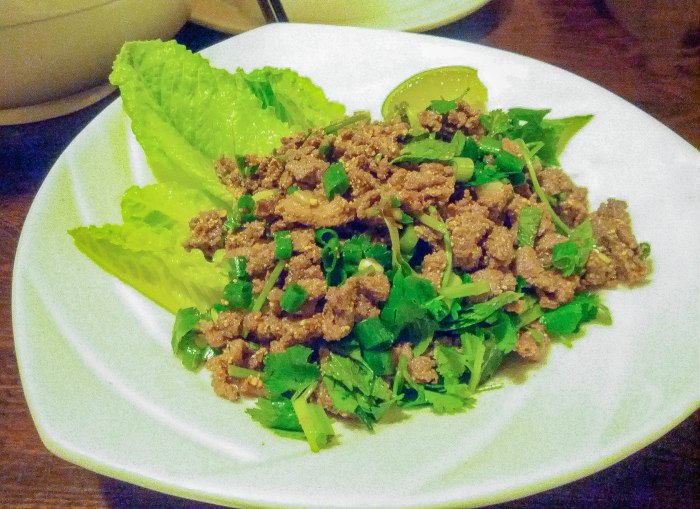
larb

Mixed mint, onions, cilantro, and lime juice. Can be served with pork, minced beef, fish, or minced chicken. We usually pick beef for larb. I’ve had chicken larb at Thai Boat in SLO, and I have yet to try fish larb.

Larb (Lao: ລາບ; Thai: ลาบ; also spelled laaplarp or lahb) is a type of Lao minced meat salad that is regarded as the national dish of Laos. It is also eaten in Isaan, an area of northeastern Thailand of which its inhabitants are for a large part of Laotian descent. (Wikipedia) Continue reading

Laos & Hmong: Kao Poon

Restaurant: Green Champa Garden
City: Fremont, CA

kao poon

Coconut soup in chicken with vermicelli. This dish is served with a mild spiciness; you can tell them to add more chili or use the condiments available on the table to make it spicier.

Khao poon (Lao: ເຂົ້າປຸ້ນ; also known as Lao laksa and sometimes spelled kapoon, kao poon, kaow poon, or khao pun) is a popular type of spicy Lao rice vermicelli soup from Laos that has spread to Malaysia, Thailand, Indonesia, Singapore, and the United States. It is a long-simmered soup most often made with pounded chicken, fish, or pork and seasoned with common Lao ingredients such as fish sauce, lime leaves, galangal, garlic, shallots, Lao chillies, and perilla. Two common versions of khao poon exist: khao poon nam phik (with coconut milk) and khao poon nam jaew (without coconut milk). Khao poon is typically made with rice vermicelli noodles (“sen khao poon”), but rice stick noodles can also be used. It is served with an assortment of shredded cabbage, carrots, and banana blossom along with bean sprouts, fresh mint, cilantro, lime, and dried red chillies. (Wikipedia)

[Edit on 06.02.2014] One of my coworkers is Hmong American, and she has stated that while Hmong and Lao food are similar, kao poon is considered Hmong.