Southern Vietnam: Bò Bía

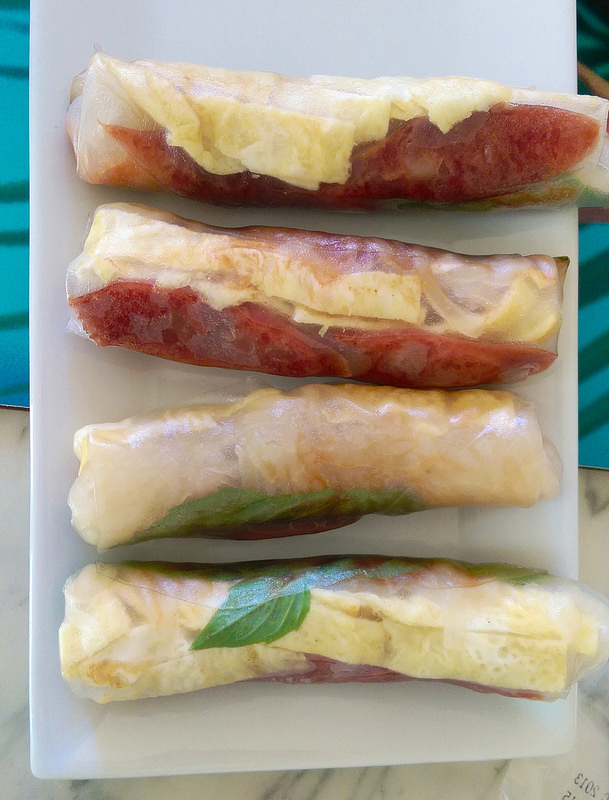
In addition to the developing duck embryo (balut), we had homemade bò bía. It’s a type of rice paper roll with jicama, egg, basil, Chinese sausage, hoisin sauce, and hot sauce (Sriracha sauce). Some versions may include carrots, daikon, and/or Vietnamese mint leaves. My parents and their classmates would get them from a street vendor during their childhood days in Cholon (a Chinese community in Saigon).

bo bia

The photo below captures how it was prepared. The rice wrap was dipped in hot water and placed on a plate, before the sauces and the rest of the ingredients were placed on the rice paper. You need to eat it as soon as it’s made, otherwise the rice paper will harden over time.

making of bo bia

Here’s some info ’bout bò bía, from Hungry Huy:

The name bò bía is likely a Vietnamese adaptation of the Chinese name and roll “popiah” which is pronounced similarly to bò bía. These two foods are quite different though. When bò bía was adapted by the Vietnamese the ingredients changed likely to match local taste and ingredient availability. The first noticeable change is the rice paper wrapper (bánh tráng) instead of a wheat based one. Other changes include the sauce and removal of ingredients like yams, green beans, bean sprouts and more. Popiah is also different in that it has fried variations.

Bò bía, or a type of fresh spring rolls, have a good amount of vegetables in them. Despite the Chinese sausage, these rolls are fairly light, making them suitable for snacking throughout the day. They aren’t typically served as full meals.

And some more info, from Wandering Chopsticks:

Bo bia are the Vietnamese spring rolls version of popiah, a Hokkien-style spring roll popular in Singapore and Malaysia. (If you sound out bò bía with the proper Vietnamese accent marks, they both sound similar. This is not to be confused with bò (beef) and bia (beer) with no accent mark.) The fillings are slightly different and the Vietnamese version uses rice paper wrappers instead of wheat, but in both versions, the spring rolls are stuffed with jicama.

Hokkien cuisine hails from the Fujian province of China, and I can only assume that immigrants must have brought the recipe with them and then adapted it when they dispersed to Singapore, Malaysia, and Vietnam. I also remember eating a Thai version once long ago, and am assuming that’s courtesy of the Fujianese again.

Bo bia are a common street snack in Saigon, where many Fujianese immigrants settled.

Southeast Asia: Developing Duck Embryo

Market: Olivera Egg Ranch
City:
San Jose, CA

My parents had a meet-up with their classmates from Vietnam on Sunday night. The host had informed us ahead of time, that she would be getting duck eggs from an egg ranch by her place. Here in the US, it is commonly known as balut as it’s a delicacy in the Phillipines, but folks all over Southeast Asia have been long eating it. My father said it’s very nutritious and his mother apparently had it often back in Vietnam.

Since both my parents had it in the past, I dared myself to try it, much to my dismay. The 15-day old duck eggs were kept in the fridge and boiled just before consumption.
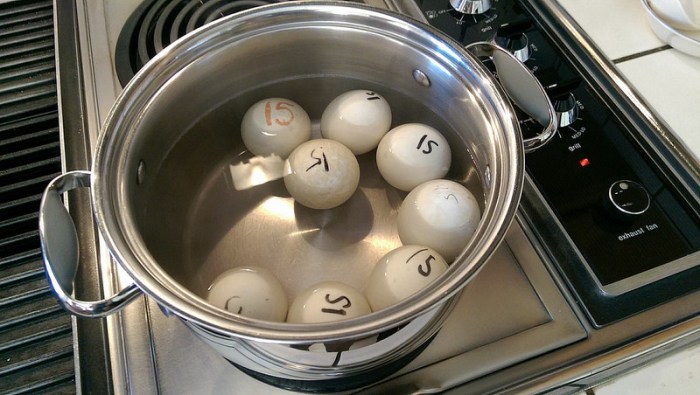
boiling duck eggsboiled duck eggs

I watched the host’s husband eat it first, then I followed suit. I placed the egg on an egg stand, cracked the top of the egg with a spoon, peeled off the cracked part, ripped the membrane gently with the spoon, and slurped the juice.
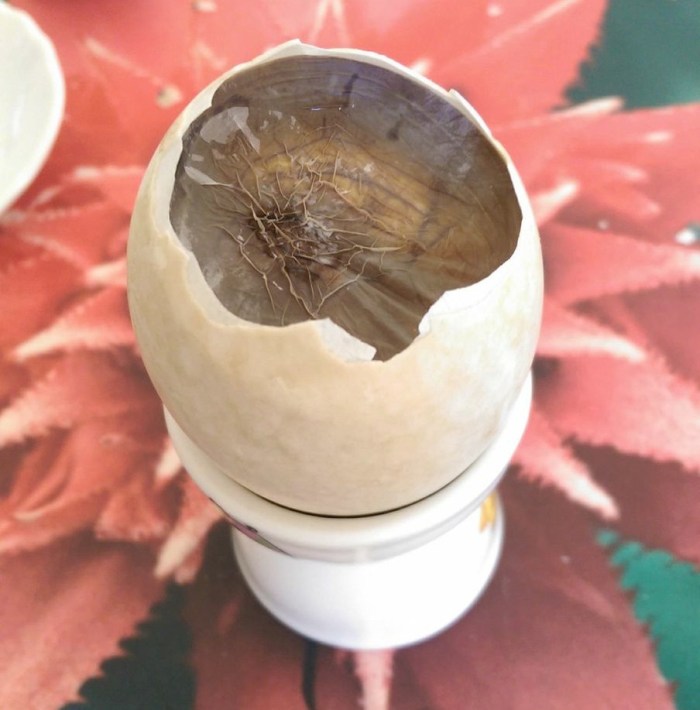
breaking through the duck egg

The juice itself was sweet. Then I scooped out the duck (mine was BIG and ugly; the pic below was the host’s husband’s which looked better) and left it on my spoon for a bit….until I could muster all the courage to eat it!

developing duck embryo

I ate the duck with salt only, but I saw another person eat it with Vietnamese mint leaves. The result? It tasted like any other raw meat. The egg yolk tasted like chicken yolk.
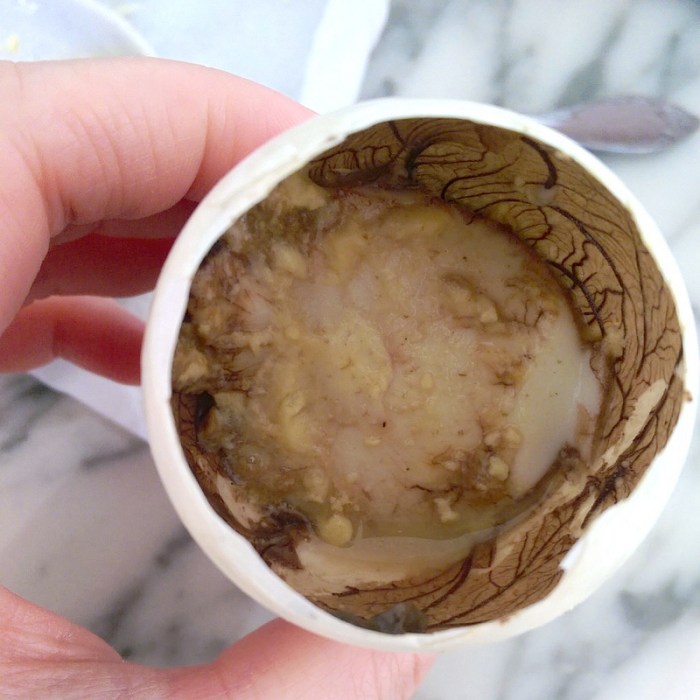
bottom of egg

The above photo is after I’d eaten everything in my egg. I’d eat 15-day old duck embryos again. :)

Here’s info on developing duck embryo, from Wikipedia:

Developing duck embryo is also known as:

Phillipines: balut or balot
Vietnam: trứng vịt lộn or hột vịt lộn
Laos:  ໄຂ່ລູກ, “khai look”
Cambodia:  ពងទាកូន, “pong tia koon”

In the Philippines, balut eaters prefer salt and/or a chili, garlic and vinegar (white or coconut sap) mixture to season their eggs. The eggs are savored for their balance of textures and flavors; the broth surrounding the embryo is sipped from the egg before the shell is peeled, and the yolk and young chick inside can be eaten. All of the contents of the egg may be consumed, although the white may remain uneaten; depending on the age of the fertilized egg, the white may have an unappetizing cartilaginous toughness. In the Philippines, balut have recently entered haute cuisine by being served as appetizers in restaurants, cooked adobo style, fried in omelettes or even used as filling in baked pastries. In Vietnam, balut are eaten with a pinch of salt, lemon juice, plus ground pepper and Vietnamese mint leaves (southern Vietnamese style). In Cambodia, balut are eaten while still warm in the shell and are served with nothing more than a little garnish, which is usually a mixture of lime juice and ground pepper.

Fertilized duck eggs are kept warm in the sun and stored in baskets to retain warmth. After nine days, the eggs are held to a light to reveal the embryo inside. Approximately eight days later the balut are ready to be cooked, sold, and eaten. Vendors sell cooked balut from buckets of sand (used to retain warmth) accompanied by small packets of salt. Uncooked balut are rarely sold in Southeast Asia. In the United States, Asian markets occasionally carry uncooked balut eggs. Alternatively, they can be mail-ordered. The cooking process is identical to that of hard-boiled chicken eggs, and baluts are eaten while still warm.

The age of the egg before it can be cooked is a matter of local preference. In the Philippines, the ideal balut is 17 days old, at which point it is said to be balut sa puti (“wrapped in white”). The chick inside is not old enough to show its beak, feathers or claws, and the bones are undeveloped. The Vietnamese often prefer their balut mature from 19 days up to 21 days, when the chick is old enough to be recognizable as a baby duck and has bones that will be firm but tender when cooked.

Here’s a good article on balut, from SF Gate:

Egg Development

Most eggs you buy in your local grocery are unfertilized eggs, produced by hens who don’t have access to roosters. Fertilized eggs rarely make it to market; egg sellers check them for the presence of an embryo by candling, a technique that illuminates the shell and makes it transparent. Fertilized duck eggs normally incubate for 28 days, while fertilized chicken eggs incubate for just 21 days. Balut eggs have incubated for a total of 18 days for duck eggs and 13 to 14 days for chicken eggs, according to the University of Kentucky Cooperative Extension. At this stage, the bones are soft enough to eat and the feathers haven’t yet developed.

Cooking

Unlike regular eggs, balut eggs fall under the category of an ethnic food. As such, they do not undergo the same inspections and grading that regular eggs undergo, according to the United States Department of Agriculture. You can purchased balut uncooked or already cooked. If they are not already cooked, hard-boil the eggs for 20 to 30 minutes before eating them. Hard cooking will kill any bacteria that might grow in the eggs during the incubation period.

Eating

After hard-boiling, eat the balut directly from the shell. Eat balut while it is still warm. Don’t eat the shell itself. Look at the egg to see which end is larger, peel the top part of the shell, break through the membranes and sip the amniotic fluid liquid from the egg. The egg contains the duckling embryo, the egg yolk and the albumin. The yolk and embryo are completely edible. Many consider the albumin too tough to eat and discard it. Filipinos traditionally season the egg with salt, vinegar or soy sauce as they eat it. Discard the shell when you finish the inside ingredients.

Benefits

Although balut might not sound appealing if you haven’t grown up with it, it does make a nutritious snack, high in protein and calcium. A serving of balut contain 188 calories, including 14 grams each of protein and fat, 2 milligrams of iron and 116 milligrams of calcium.
Taiwan: Jijuan (aka Chicken Roll)

Restaurant: Chou Ma Ma’s Kitchen
City: Newark, CA

I had Taiwanese for dinner with my parents. We 6 dishes for a party of 3…which was way too much food for us! We typically order a little bit more, so we can have leftovers, but we ended up eating almost all of the food!

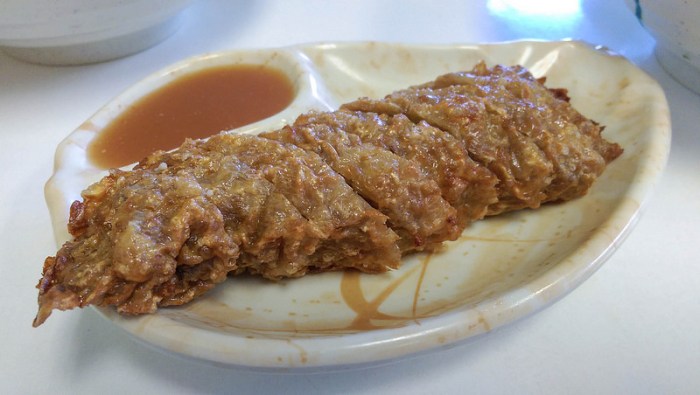
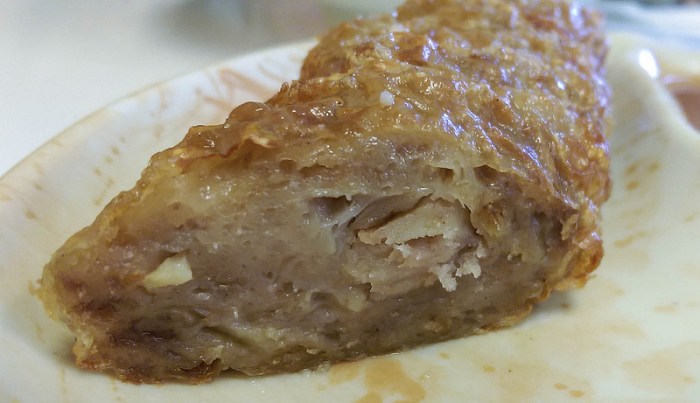
I picked the Taiwanese chicken roll as one of our dishes. It was ground meat with fish paste, with a piece of taro and water chesnut, wrapped in tofu skin. It was crispy on the outside and soft inside.

jijuan - 1jijuan - 2

Chicken roll doesn’t include chicken. Here’s what Just. One. More. Bite said of this particular food:

Taiwanese chicken rolls (ji juan). There’s not an ounce of chicken in this recipe but it is supposed to mimick chicken. The tofu skin represents the skin, the carrots and mushrooms the bones (and give the dish more texture), and of course, the fish paste and pork mimick chicken meat.

In the chicken roll I had, perhaps the water chesnut and taro did a better representation of the “bones” as chicken bones aren’t orange and black…

Taiwan: Pig Feet Noodle Soup

Restaurant: Chou Ma Ma’s Kitchen
City: Newark, CA

I had Taiwanese for dinner with my parents. We 6 dishes for a party of 3…which was way too much food for us! We typically order a little bit more, so we can have leftovers, but we ended up eating almost all of the food!

My mom heard the noodle soups here are pretty good, so she got the pig feet noodle soup to try. It came with the Taiwanese thin noodle, pig feet, and A-choy (Taiwanese lettuce). Overall, this noodle soup was delicious!

pig feet noodle soup

Guangdong: Lo Mai Gai

Restaurant: Fu Lam Mum
City: Mountain View, CA

I had dim sum with several people from work, for a goodbye lunch for Beeta.

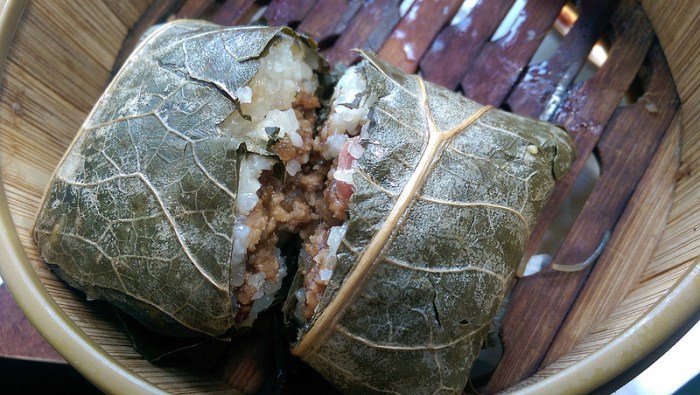
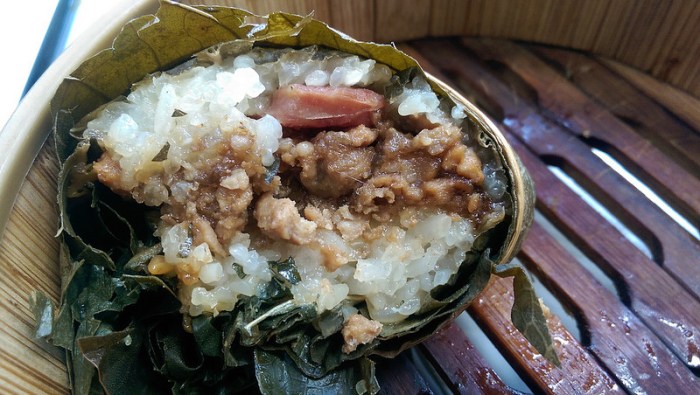
One of the items we had was lo mai gai, also known as steamed sticky rice or glutinous rice in lotus leaf wrap. The one we had also contained chicken, Chinese sausage, and mushroom.

lo mai gai - 1 lo mai gai - 2

Here’s some info about lo mai gai, from Wikipedia:

Lo mai gai (Cantonese; 糯米鸡), is a classic dim sum dish served during yum cha hours. The dish is also called by the literal English translations such as “steamed sticky rice with chicken in lotus leaf wrap.”

Lo mai gai is mostly a southern Chinese food. It contains glutinous rice filled with chicken, Chinese mushrooms, Chinese sausage, scallions, and sometimes dried shrimp or salted egg. The ball of rice is then wrapped in a dried lotus leaf and steamed.

Sometimes lo mai gai is divided into smaller wraps, which are known as chun chu gai (Cantonese; 珍珠雞) literally meaning “pearl chicken” in Chinese. Due to the flexibility of the lotus leaf, lo mai gai is typically wrapped to form a rectangular parcel.

The Grub Files: Cooking with Camissonia has a pretty neat pictorial of making lo mai gai; check it out!


Liguria: Linguine w/ Tomatoes, Artichoke Hearts, Capers, & Olives

Restaurant: Vasso Azzurro
City: Mountain View, CA

I went my coworkers to an Italian restaurant in Downtown Mountain View for a  birthday lunch!

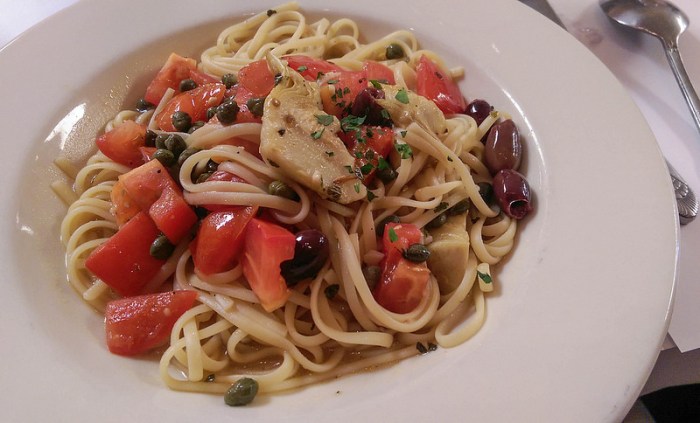
I got Vasso Azzurro’s “Linguine Alla Erbe Con Verdure”, which had fresh tomatoes, artichoke hearts, capers, olives, roasted garlic, and red chili flakes. The dish overall was on the lighter side, as it had no meat (vegetarian) and had a white wine sauce.

linguine alla erbe con verdure

Here’s some info about linguine, from Wikipedia:

Linguine is a form of pasta – like fettuccine and trenette, but elliptical in section rather than flat. It is wider than spaghetti, about 4 mm, but not as wide as fettuccine. The name linguine means “little tongues” in Italian, where it is a plural of the feminine linguina. Linguine are also called trenette or bavette. A thinner version of linguine is called linguettine.

Linguine originated in the Liguria region of Italy.

While spaghetti traditionally accompanies meat and tomato dishes, linguine are often served with seafood or pesto. Linguine is typically available in both white flour and whole-wheat versions; the latter are usually made in Italy.

One of my coworkers from Genoa (the capital of Liguria) said there’s thousands of different linguine recipes typical of every town, so one place would be slightly different from another; linguine with tomatoes, olives, and herbs is unique to Liguria.

Guangdong & Hong Kong: Dried Fried Yee Mein

Restaurant: Chef Lau’s
City: Oakland, CA

My parents and I had lunch with two friends at a Cantonese restaurant in Oakland Chinatown today.

One of the dishes we had was the dried fried yee mein, also known as “Longevity noodles”, a dish traditionally served at birthdays, weddings, and other big events or banquets.

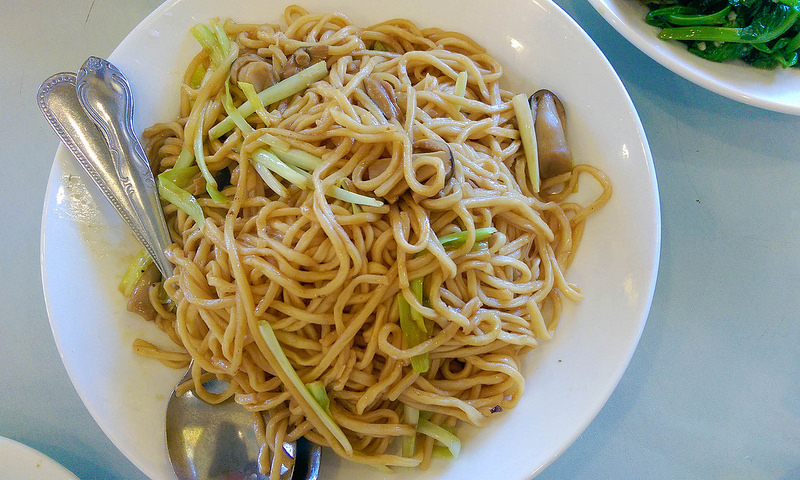
The dried fried yee mein we had also included white garlic chives and paddy straw mushrooms. The noodles are on the chewier side and flavorful from the sauce. In my opinion, Chef Lau’s dried fried yee mein is one of the best I’ve had; the seasoning was spot-on and the noodles weren’t soggy.

dried fried yee mein

tastehongkong.com has some info about the noodle dish (and a recipe):

These braised noodles are cooked by the actions of stirring and turning, but emphasizing on reaching a critical moment that the sauce is precisely dried and that the noodles are still springy. Therefore sometimes it is also translated as Dry-Fried E-Fu Noodles or Dry-Fried Yi Mein. Whichever the translation is, in Chinese, the e-fu noodles cooked in this way is called 干燒伊麵.

Braised E-Fu Noodles is a classic dish often served in Chinese banquets and formal dinners because since the older days they have been regarded as quality noodles, quality fried egg noodles to be specific.

And here’s more info about the dish, from Wikipedia:

Yi mein (also called e-fu noodles, yee-fu noodles, yi noodles, or yifu noodles) is a variety of flat Cantonese egg noodles made from wheat flour. They are known for their golden yellow color and chewy characteristics.

The noodles may be cooked a number of ways. They are boiled first, then can be stir fried or used in soups or salads. Good noodles maintain their elasticity, allowing the noodles to stretch and remain chewy.

When Yi mein is consumed on birthdays, it is generally referred to as Longevity noodles or Sau mein (壽麵/寿面). The Chinese character for “long” (長壽麵/长寿面) is also added as a prefix to represent “long life”.

Hokkaido: Miso Ramen (aka Sapporo Ramen)

Restaurant: Maru Ichi
City: Mountain View, CA

I had ramen for lunch with a few coworkers today!

Maru Ichi’s noodles are freshly made; there is usually a gentleman making the noodles at the front of the shop. Maru Ichi has a few other locations but the Mountain View location seems to be their best one.

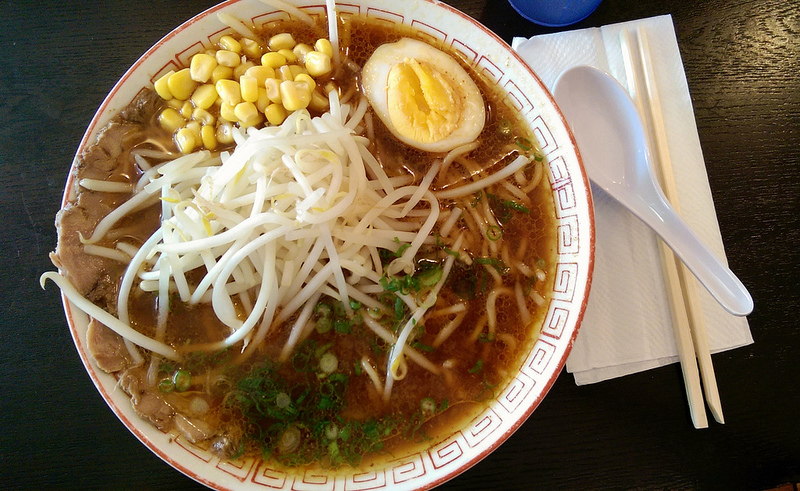
I got the miso ramen, which had egg, char siu (roast pork), moyashi (mung bean sprouts), and green onions in a miso broth. I also asked for corn, which is one of the additional toppings. Each table has a little container of napa cabbage kimchi, which I also added to my bowl (after taking the photo shown below).

miso ramen

Here’s some info about miso ramen, from rameniac:

Sapporo ramen is widely considered one of Japan’s most prominent and influential ramen styles, largely because it is here that miso (soybean paste) ramen first originated. More specifically, Sapporo ramen shops use a soup that features an akamiso (red soybean paste) base, characteristically topped with vegetables such as moyashi, corn, and cabbage, which are frequently stir-fried and tossed with soup in large woks. In response to the cold climate, Sapporo ramen is extremely rich and, despite the intrinsically healthful properties of miso, often loaded with lard; the soup is very kotteri and the portions are fairly large. An additional slab of butter is often added as a signature Sapporo-style topping.

And some more info, from Wikipedia:

Miso ramen is a relative newcomer, having reached national prominence around 1965. This uniquely Japanese ramen, which was developed in Hokkaido, features a broth that combines copious amounts of miso and is blended with oily chicken or fish broth – and sometimes with tonkotsu or lard – to create a thick, nutty, slightly sweet and very hearty soup. Miso ramen broth tends to have a robust, tangy flavor, so it stands up to a variety of flavorful toppings: spicy bean paste or tōbanjan (豆瓣醤), butter and corn, leeks, onions, bean sprouts, ground pork, cabbage, sesame seeds, white pepper, and chopped garlic are common. The noodles are typically thick, curly, and slightly chewy.

Mexico: Churro

Vendor: Olimpos (SJ Giants game at San Jose Municipal Stadium)
City: San Jose, CA

I went to the San Jose Giants game at the San Jose Municipal Stadium after work. The cost of going to these games can be free, if you can snag a ticket at certain San Jose or Santa Clara Orchard Supply Hardware stores; check out the schedule or the OSH ticket location list for more information!

The San Jose Giants are a minor league baseball team in San Jose, CA. They are a Class A – Advanced team in the Northern Division of the California League, and have been a farm team of the San Francisco Giants since 1988. (Wikipedia)

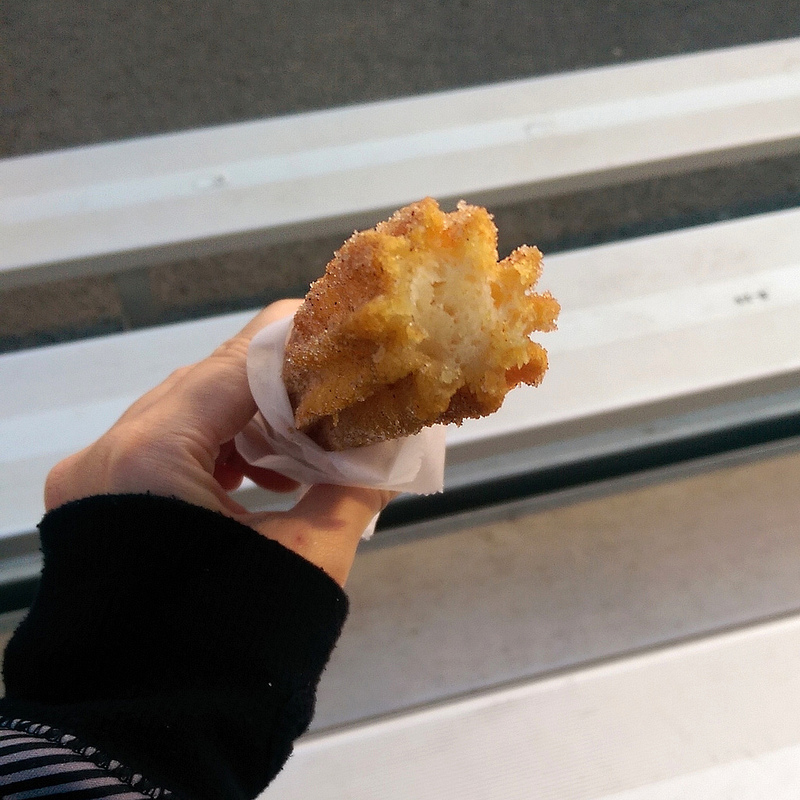
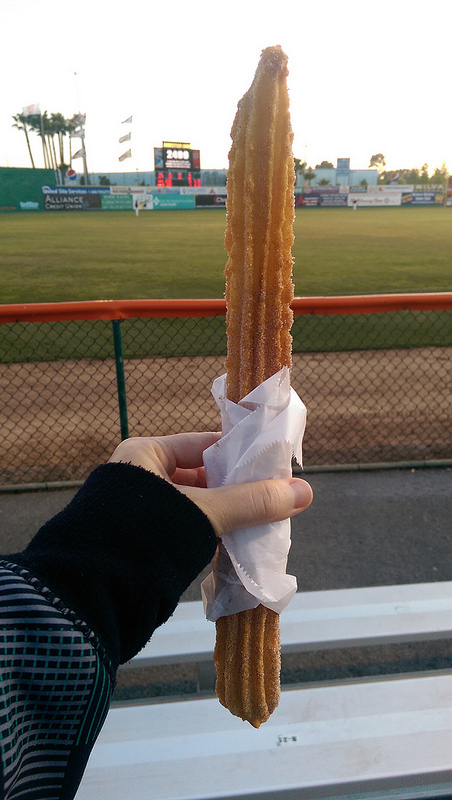
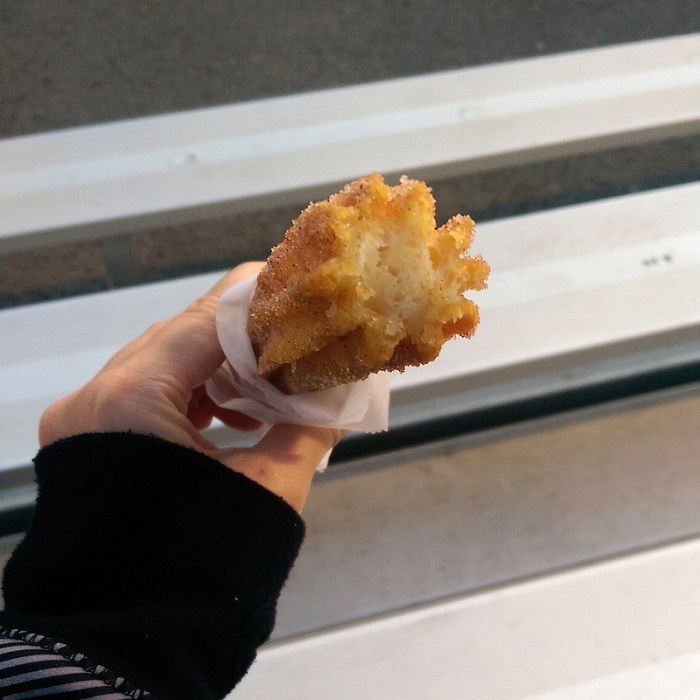
Olimpos is a churro food truck located inside the stadium. They weren’t open until a few innings into the game. After the sun went out around the 5th inning, the churro guy finally came to the bleachers. A churro costs $3, while 2 churros cost $5.

Olimpos’ churros are way better than Costco’s $1 churros! These are crispy, and well flavored with cinnamon and sugar. Costco’s is softer and I’d have to add more cinnamon and rebake it at home. Oh… I just found out that Costco no longer sells churros… Aw!

churro - 1 churro - 2

Do you know what ingredient makes Mexican churros unique from the Spanish ones?

Read on for the answer, and some info about churro, from ifood.tv:

Churros are also popularly referred to as the Spanish donuts or Spanish fritters. Churros have attained cult status as the national food symbol of Spain. Churros are also known by alternate names such as “Porras”, “Papitas”, and “Calentitos “. Churro is favored and savored throughout the Latin American countries, France, Portugal, United States, Morocco and Spanish speaking Caribbean Islands. The dish is a long and soft cake like pastry which is prepared from blended flour and fried in olive oil. The churro’s appear crispy golden brown from outside and are very soft to eat. The churros are enjoyed as desserts, breakfast or snacks. The churros continued to evolve outside Spain too. The original breadstick sized Churro is known as Churrito, and the big-sized stuffed churro is called Churrisimo. And a Churro cook is lovingly called Churrero.

The churros are prepared using the blended flour or multi-purpose flour but in Mexico and Andalusia, Spain – wheat flour is used in the preparation of a churro. These churros are shaped as wheels or spirals, which are further divided into edible portions post preparation. The wheat flour churros are called porras and calentitos or calientes. In other parts of the Spain the churros are called porras and calentitos. In rest of the Spain normally potato dough is used in the preparation of churros which are known as Papitas or Calentitos de Patatas.

Mexican Churros also serve as the bridge between the dessert and savories because salt is added while kneading the flour.

Chaoshan: Spare Rib Noodle Soup

Restaurant: Vien Huong Restaurant
City: Oakland, CA

My dad and I had lunch at our favorite noodle shop in Chinatown!

The name of the restaurant is Vietnamese, but the noodle soups here are actually Teochew cuisine. Teochew cuisine is also known as Chaoshan, Chaozhou, and Chiuchow cuisine. China has one writing system, but many different dialects that can sound completely different from each other. Hence, the transliteration of the name of the dialect or region is different. The name ‘Chaoshan’ appears to be a contraction of the names of two of its administrative areas, the prefecture-level cities of Chaozhou (潮州), and Shantou (汕头). Chaoshan is located in the eastern part of Guangdong, by the sea.  Today, a majority of Teochew people live all over Southeast Asia.

I had spare rib noodle soup, half ho-fun and half mien (wide rice noodle and egg noodle). My dad had the same soup but with just ho-fun.

spare rib noodle soup

In addition to the noodles, there was Chinese cabbage, bean sprouts, broccoli, green onions, and spare ribs in the soup. The soup was rich and just a tad on the thicker side, and the spare ribs were tender. To sum up, it was hecka good!!!