Middle East: Falafel

Restaurant: Jaffa Cafe  null
City: 
San Luis Obispo, California

I had Greek for lunch with my sister and a few of her friends! I highly recommend Jaffa for traditional Greek dishes, and Petra for modern Greek dishes. Since Greece is so close to the Middle East, some Greek restaurants will also carry Mediterranean and/or Middle Eastern dishes.

I had the gyros (Greek) while my sister had the falafel plate (Middle Eastern). The falafel plate had pitas, hummus, salad, and tzatziki, in addition to falafel.

falafel plate - 1

From the outside, the falafel looks like an ordinary meatball. But when you poke it, the surface feels stiffer and crispier than a meatball. And when you cut or bite a piece, you may be surprised to see a difference in color…

falafel plate - 2

It’s yellowish-greenish inside! This is because this particular falafel is made from green chickpea and deep-fried.

Wikipedia has more info about falafel:

Falafel (Arabic: فلافل‎) is a deep-fried ball or patty made from ground chickpeas, fava beans, or both. Falafel is a traditional Middle Eastern food, usually served in a pita, which acts as a pocket, or wrapped in a flatbread known as lafa; “falafel” also frequently refers to a wrapped sandwich that is prepared in this way. The falafel balls are topped with salads, pickled vegetables, hot sauce, and drizzled with tahini-based sauces. Falafel balls may also be eaten alone as a snack or served as part of a meze (appetizers).

The origin of falafel is unknown and controversial. A common theory is that the dish originated in Egypt, possibly eaten by Copts as a replacement for meat during Lent. As Alexandria is a port city, it was possible to export the dish and name to other areas in the Middle East. The dish later migrated northwards to the Levant, where chickpeas replaced the fava. It has also been theorized to a lesser extent that falafel originated during Egypt’s Pharaonic Period or in the Indian subcontinent.

Falafel grew to become a common form of street food or fast food in the Middle East. The croquettes are regularly eaten as part of meze. During Ramadan, falafel balls are sometimes eaten as part of the iftar, the meal that breaks the daily fast after sunset. Falafel became so popular that McDonald’s for a time served a “McFalafel” in some countries. Falafel is still popular with the Copts, who cook large volumes during religious holidays. Debates over the origin of falafel have sometimes devolved into political discussions about the relationship between Arabs and Israelis. In modern times, falafel has been considered a national dish of Egypt, Palestine, and of Israel. Resentment exists amongst many Palestinians for what they see as the appropriation of their dish by Israelis. Additionally, the Lebanese Industrialists’ Association has raised assertions of copyright infringement against Israel concerning falafel.

Falafel plays an iconic role in Israeli cuisine and is widely considered to be the national dish of the country. While falafel is not a specifically Jewish dish, it was eaten by Mizrahi Jews in their countries of origin. Later, it was adopted by early Jewish immigrants to Palestine. Due to its being entirely plant based, it is considered parve under Jewish dietary laws and gained acceptance with Jews because it could be eaten with meat or dairy meals.

Falafel is made from fava beans or chickpeas, or a combination of the two. The use of chickpeas is predominant in most Middle Eastern countries. The dish is usually made with chickpeas in Syria, Jordan, Lebanon, Israel and Palestine. This version is the most popular in the West. The Egyptian variety uses fava beans.

Greece: Gyros

Restaurant: Jaffa Cafe null
City: 
San Luis Obispo, California

I had Greek for lunch with my sister and a few of her friends! I highly recommend Jaffa for traditional Greek dishes, and Petra for modern Greek dishes.

I love Jaffa’s gyros! Gyros are typically pieces of meat with lettuce and tzatziki, wrapped with a pita. Jaffa has different types of meat to choose from- lamb & beef, lamb, chicken, beef, kifta (beef patties), or chicken pesto.

I had the lamb & beef gyros, wrapped with a pita. The pita was soft and moist, while the meat was tender and flavorful!

gyro

Here’s more info on gyros, from Wikipedia:

A gyro is a Greek dish of meat roasted on a vertical spit. It is commonly served in a sandwich with tomato, onion, and tzatziki sauce.

The name comes from Greek γύρος (‘turn’), a calque of the Turkish döner meaning “turn”, a name which was previously used in Greece, spelled ντονέρ [doˈner]. The Greek pronunciation is [ˈʝiros], but the pronunciation in English is often /ˈdʒaɪroʊ/ or, occasionally /ˈɡɪəroʊ/ or /ˈjɪəroʊ/.[4] The final ‘s’ of the Greek form is often reinterpreted as a plural in English.

In Greece and Cyprus, the meat is typically pork or occasionally chicken; with veal gyros occasionally found, referred to as “doner” (ντονέρ). In Athens, and most of Greece, a “pita gyro” will contain tzatziki, tomato, onion and fried potatoes in addition to the meat. However some places offer alternatives to the classic ingredients: tzatziki sauce as a dressing for other meats, whereas the chicken dressings vary from shop to shop, but are most often a variant on mayonnaise mixed with mustard, called “σως” (sauce) in Greek.

Pitas are available in at least three types: ‘plain’, ‘Cypriot’, and ‘Arabic’ in some chain restaurants, however in most places only ‘Plain’ is offered. ‘Plain’ pita is around 20 cm in diameter and the thickest of the three. ‘Cypriot’ pita is crisp and has larger size, and is split like pocket bread. ‘Arabic’ pitas are crisp, and the flattest and largest. Gyros are also served in sandwich-type bread in northern Greece.

It is said that in Thessaloniki one will find the biggest pita and gyros; there, an order will typically include tomato, onion, fried potatoes, mustard and/or ketchup and an optional sauce, most commonly tzatziki or ktipití (a feta cheese and hot pepper dip), in addition to the meat. “Russian salad” (a mixture of diced pickles and mayonnaise) and “Hungarian salad” (a mixture of mayonnaise and diced bacon) are also popular.

On the island of Crete, pork meat is the most popular filling, although in some of the larger cities (notably the city of Chania) there are also chicken alternatives. In Kos, a Greek island in the Aegean sea, the locals wrap chicken and add fried potatoes to gyros. In other Greek cities, like Patras, where gyros are not as popular, the wrap is often prepared and then put in a toaster or toasted under a press, like a panino, a popular grilled sandwich throughout Europe. In Kalamata, it can sometimes be eaten in Thrakópsomo (bread baked on embers), a thick round loaf of country style bread, cut in two halves and stuffed with a double serving of Gyro meat.

Japan: Keema Curry Rice

Restaurant: Curry House null
City: 
Cupertino, California

The sister and I went to a Japanese curry restaurant chain before heading down to San Luis Obispo for the weekend. Yep… that’s TWO trips for me this week! I literally returned from Portland two days ago, and only had one day to unpack and repack!

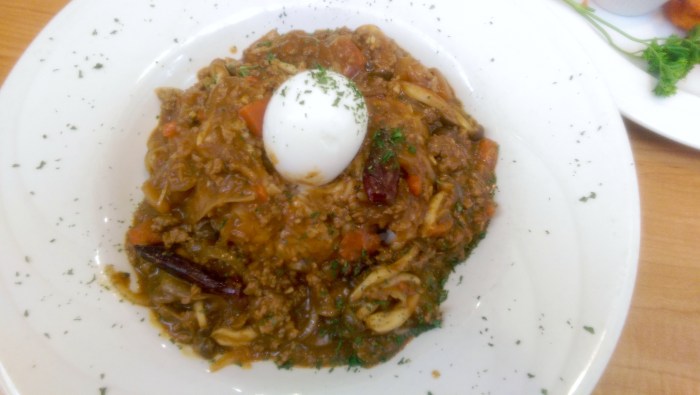
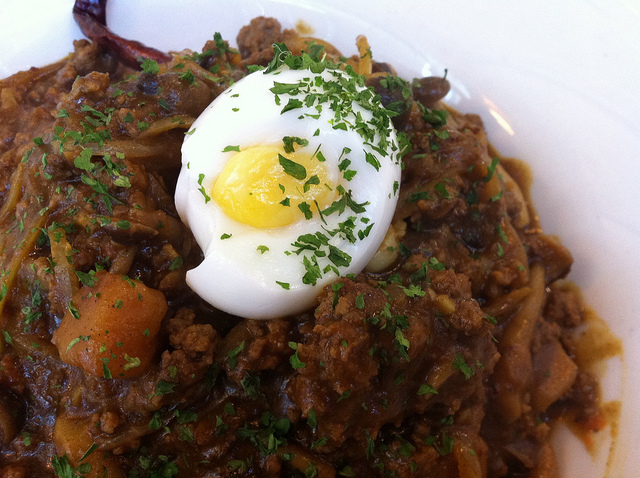
I ordered the keema curry rice, which was ground beef curry with a medley of onions, shimeji mushrooms, carrots, potatoes, garlic, and red chili peppers with your choice of a soft or hard boiled egg. The curry rice also came with an option of getting corn potage, miso soup, or salad.

2014-08-08 18.45.31

I got the soft boiled egg, and my sister poked at it while I took a series of photos.. Google+ made an awesome GIF from the photos!

I had the same dish when I went 3 years ago, where I took a much better close-up photo. But the egg wasn’t pretty.

keema curry rice

Japanese curry is sweeter than Indian curry, while retaining the curry flavor. Wondering how this dish got its name? Here’s some info about (keema) curry, from Nippon Nin:

To say that curry (curry rice) is a national Japanese food is not an over statement. The British Empire once colonized India, and developed Indian curry stew into their own flavor. England’s C&B curry powder landed in Japan in early Meiji Era but some elitists already knew of ‘curry’ existence as early as the Edo Shogunate Era. Japanese curryosity (just kidding) transformed curry to appeal to the Japanese taste..

Since House Foods Inc. developed home friendly curry roux in 1926, made ‘Rice Curry’ a household name. Many other solid curry roux are available now days yet I still favor the revolutionized, not spicy – until then we had mind set of curry equal spicy – House Vermont Curry (1963) and remember the old commercial song – apple and honey, House Vermont Curry! Appearing in a curry commercial is a barometer of a star’s popularity. In 1997 baseball phenomenon Ichiro did his gig here.

Keema is Indian word for minced meat and keema curry is happening in Japan!

And info about keema, from Wikipedia:

Keema, Kheema, or Qeema (Sindhi: قيمو, Hindi: क़ीमा, Urdu: قیمہ‎, Nepali: किमा,pronounced [ˈqiːmaː]; Punjabi: ਕ਼ੀਮਾ) is a traditional South Asian meat dish. The word is borrowed probably form Greek χυμὸς and originally meant minced meat. It is typically minced mutton curry with peas or potatoes. Keema can be made from almost any meat, can be cooked by stewing or frying, and can be formed into kababs. Keema is also sometimes used as a filling for samosas or naan. The word for a similar dish in Armenian is “Gheymah” ղեյմա and in Turkish “kıyma”.

It’s safe to say that this Japanese curry rice was influenced by India.

Japan: Corn Potage (aka Corn Soup)

Restaurant: Curry House null
City: 
Cupertino, California

The sister and I went to a Japanese curry restaurant before heading down to San Luis Obispo for the weekend. Yep… that’s TWO trips for me this week! I literally returned from Portland two days ago, and only had one day to unpack and repack!

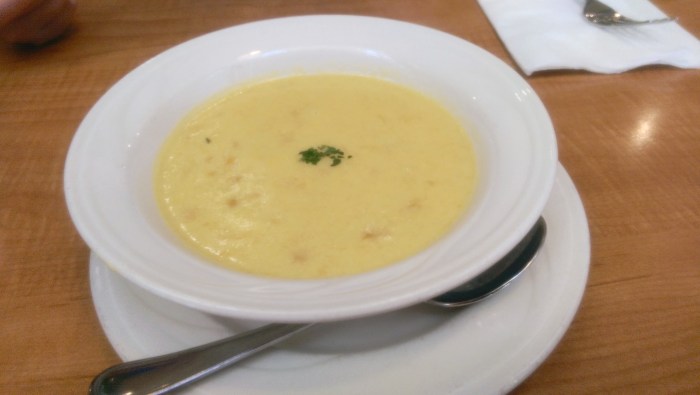
I ordered a dish that came with a choice between corn potage, miso soup, and salad. The waiter suggested the popular choice, the corn potage. I thank the waiter for the suggestion! Miso soup and salad also sounded boring compared to the corn potage!

corn potage - 1 corn potage - 2

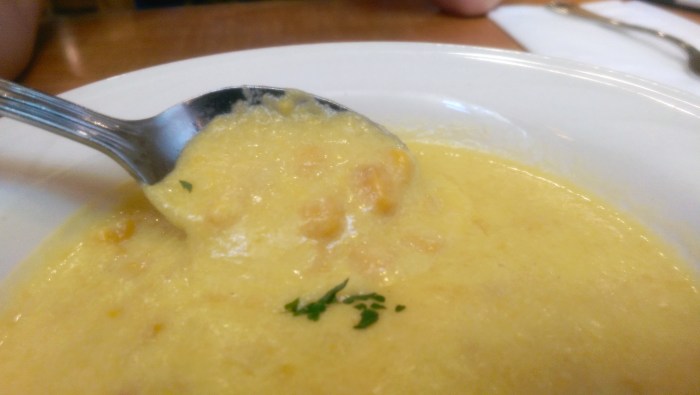
The best way to describe corn potage is creamed corn, thickened with cornstarch, with bits of corn kernels. It’s full of creamy corn goodness. If you’re not a fan of corn, go with the miso soup or salad.

=======

Here’s a little info about corn potage, from Little Japan Mama:

If you’ve ever lived in Japan, you’ve probably had Corn Potage. It probably came to you in a super-convenient form, like from a vending machine, instant soup packet or with your Mos Burger meal.

Corn Potage is French. Just like cream puffs and crepes, Japan adopted it, adapted it, pronounce it something like: “konpotaaj” and serve it in a cup or mug. It always has the same creamy corn taste..

And a little more info, from Umami Holiday:

The word “potage” is an old French term for thick stew (potted dish, literally); as for how potage mades its way to Japan, well… I came up empty in my cursory research. Musings aside, corn potage has become a very popular Western-style food in Japan–but maintains its French origins in its preparation by building its flavor from a basic roux of butter and flour. Blending the corn into the broth creates the mushy consistency that normally takes hours for traditional potage soups, making for a soup that is hearty but altogether different than corn chowder.

Liguria: Linguine al Pesto e Pollo

Restaurant: Pastini Pastaria null
City: 
Beaverton, Oregon

For dinner, Beeta and I went to an Italian restaurant at a shopping mall near her apartment. I was starving from walking all over Downtown and the Pearl District.

I ordered linguine with basil pesto, which had the description “fresh, fragrant basil is the star in this traditional dish from the Liguria region” on the menu. The dish was listed in the vegetarian section, but there was a note for adding chicken for an additional cost.

pesto chicken

Please excuse the blurriness of the photo… It was taken on my phone instead of the 60D. I also took it after I had started eating, as I was hungry… ;)

I really liked how small this dish was! It was a perfect size, enough to make me satisfied and not overly full. The prices are also affordable and not overpriced. I usually find myself taking leftovers home from Italian restaurants, but not from this one. So, if you’re used to eating bigger portions, I would order an appetizer at Pastini Pastaria.

=======

An Italian coworker said he typically eats pesto with linguine only. So the addition of chicken must be an Italian-American thing. Here’s some more info about pesto, from Wikipedia:

Pesto (Italian pronunciation: [ˈpesto], Genoese: [ˈpestu]) is a sauce originating in Genoa in the Liguria region of northern Italy (pesto genovese), and traditionally consists of crushed garlic, basil, and European pine nuts blended with olive oil, Parmigiano Reggiano (Parmesan cheese), and Fiore Sardo (cheese made from sheep’s milk).

Pesto is traditionally prepared in a marble mortar with a wooden pestle. First, garlic and pine nuts are placed in the mortar and reduced to a cream, then the washed and dried basil leaves are added with coarse salt and ground to a creamy consistency. Only then is a mix of Parmigiano-Reggiano and Pecorino added. To help incorporate the cheese a little extra-virgin olive oil is added. In a tight jar (or simply in an air-tight plastic container), covered by a layer of extra-virgin olive oil, pesto can last in the refrigerator up to a week, and can be frozen for later use.

Pesto is commonly used on pasta, traditionally with Mandilli de Sæa (Genovese dialect – literally “silk handkerchiefs”), trofie or trenette. Potatoes and string beans are also traditionally added to the dish, boiled in the same pot in which the pasta has been cooked. It is sometimes used in minestrone. Pesto is sometimes served with sliced beef tomatoes and sliced boiled potatoes.

Portland: Coffee @ Christopher David

Cafe/Shop: Christopher David null  
City: 
Portland, Oregon

Portland is also cray about coffee! There are tons of third wave coffee shops throughout Portland. I had Stumptown with my chicken and waffles the other day, so I wanted to go to a different coffee shop after exploring Downtown. I ended up taking a bus to the Pearl District, and decided to check out Christopher David.

Christopher David isn’t your typical coffee shop. They’ve got a floral, interior design, and coffee section all under one roof!

christopher david - 1 christopher david - 2

Doesn’t the store look amazing?! I ordered a cappuccino.

christopher david - 3 christopher david - 4

I sat down for maybe an hour, to let my legs rest while writing letters/cards to friends. Then I went to the restroom, only to have my jaw dropped…

christopher david - 5

Handwritten on the wall was an excerpt of Peter Pan…!!! Genius.

Thailand: Khao Man Gai

Food Stand: Nong’s Khao Man Gai null
City: Portland, Oregon

I love Portland for their public transportation, with Tri-Met. Portland’s public transportation system is efficient, unlike the SF Bay Area. We have BART and Caltrain as our main train companies, but BART only goes along the eastern part of the bay while Caltrain goes along the western part. Then we have local bus systems. Tri-Met makes it very convenient and easy to get in and around Portland, with a single mobile app. They have a 1-day ticket for $5, and you can pay by NFC at the train station, or by using the app and showing the pass to the bus driver. And I don’t need the hassle of carrying another card (hear that, Clipper card?!).

Anyhow, I did a solo trip from Beaverton to Downtown Portland, to check out the AT&T MLS All-Star open training session at Providence Park. I thank the King family for informing me about this! I got to watch Bayern Munich and the MLS All-Star teams practice. Both teams had their own way of practicing. Bayern used minimal equipment, while the All-Star team used tons of different equipment. I don’t know if it’s because Bayern was the visiting team, so they naturally wouldn’t bring much gear with them.

providence park

Bayern Munich practiced from 10am to 11:30am. I left around 11am to grab food as I was hungry, and wanted avoid the crowd leaving the park for lunch. The King family had also told me about Nong’s Khao Man Gai and how it was awesome, so I decided to check it out! It was a ~10 min walk from Providence Park.

nong's khao man gai

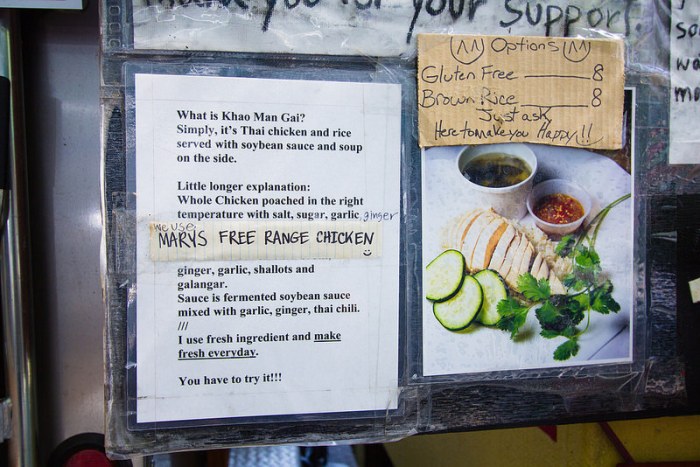
Nong’s Khao Man Gai is located in (literally) a square block full of various food stands. Nong’s Khao Man Gai specializes in only one thing- khao man gai, or Thai chicken and rice, with soybean sauce and soup on the side. They even have a note on their window door that explained their dish.

nong's khao man gai - dish explaination

Free range chicken is the best for chicken and rice dishes! I ordered one khao man gai. They gave my order in a paper bag, as shown below.

khao man gai packaged

I walked to a nearby park to eat my food. After sitting down, I unpacked my lunch and was surprised to see how the chicken and rice dish was packed!

nong's khao man gai - food taken out

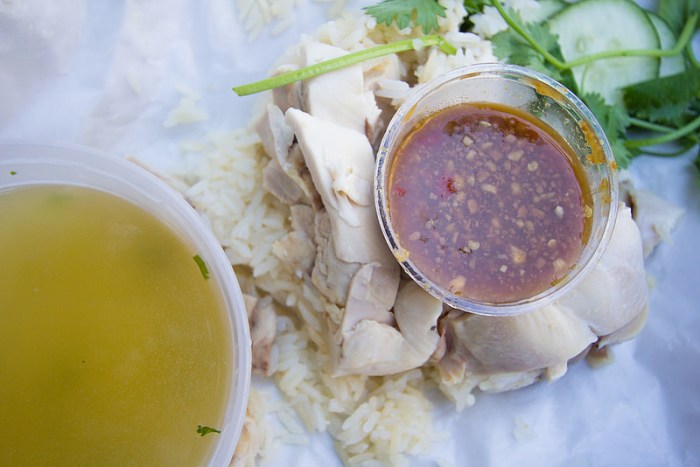
Upon unwrapping, I was further amazed to see how nicely the food was arranged. It was too good-looking for a meal from a street vendor!

khao man gai

I poured the sauce over the chicken and rice, little by little with every bite….

yummy khao man gai

… until it was all gone.

no more khao man gai

Sniff. ‘Twas hecka yummy.

I’m definitely coming back here next time I’m in town. And getting my hands on a bottle of that darn good sauce.

=======

Nong’s Khao Man Gai also has a video of how to “properly” eat the chicken and rice.

Instead of scooping the soup in between bites, I drank the soup all at once, after eating all the chicken and rice. Yum.

=======

And now for some info/excerpt on khao man gai, from shesimmers:

Khao Man Gai, one of the most common street foods in Thailand, is, in short, a mutation, albeit controlled, of Hainanese chicken and rice. Overshadowed by the original dish and rarely included on the menus of most Thai restaurants in the West, Khao Man Gai (RTGS: khao man kai ข้าวมันไก่) is not widely known outside of Thailand. For us, however, this is a national favorite. In fact, just the mere mention of the name could cause collective panting in greedy anticipation.

And the reason is simple — it tastes good. How can you say no to slices of juicy and tender capon meat served with fragrant rice cooked in rich broth and a unique piquant sauce of ginger, garlic, chillies, and soy? As much as I adore the Hainanese version, it just so happens that I had already fallen in love with the Thai version before I discovered the original. I like the more spicy sauce offered by the Thai version as it balances out the richness of the chicken and the rice better, in my opinion.

From my description of this dish as a mutation, you can probably tell that it is not exactly identical to Hainanese chicken and rice. Then again, it should be noted that Khao Man Gai should not be regarded as a failed attempt to replicate the original and, therefore, inferior. The dish has become an almost entirely new entity — a delicacy in its own right. In fact, although most Thai people intellectually know that the dish is inspired by a Hainanese dish, I think we have come to think of this version as our own.

What amuses me about Khao Man Gai is how its appearance is the same regardless of where you find it in Thailand. It’s as if there’s a universal code governing the manner in which the dish is to be presented which all Khao Man Gai vendors nationwide abide by. Slices of steamed or boiled capon meat are placed over a mound of rice. Cucumber slices and fresh cilantro leaves serve as a quintessential garnish. Sometimes, a few slices of cooked congealed chicken blood (it’s not that bad …) is also added to the mix. The chicken-rice plate is then accompanied by a bowl of piping hot chicken consommé with a few pieces of Chinese winter gourd (whose Thai name is pronounced exactly like the way this little girl pronounces “frog“) swimming in it. The broth, to be slurped between bites, helps move the chicken and rice along your esophagus more smoothly.

United States: Chicken and Waffles

Restaurant: Screen Door null
City: Portland, Oregon

I’m in Portland for a couple days, visiting Beeta!

Portland is cray about brunch… There’s tons of restaurants in the area that have an extensive brunch menu. Screen Door is a Southern restaurant specializing in soul food. They had tons of good reviews and praise, so we decided to check it out!

We got there at around 9:30am to put our name down…and waited an hour and half to be seated!! 90 minutes!! To kill time, we walked around the neighborhood for a pre-feasting exercise to get a bigger appetite! Unfortunately, there wasn’t much to see and most of the shops were closed. There were only a few other smaller restaurants/cafes open for brunch. You can also get a cup of Stumptown coffee (refillable) while waiting to be seated.

When we finally got seated at 11am, I ordered Screen Door’s specialty, the chicken and waffles! Three buttermilk battered fried chicken breasts over a sweet potato waffle. At $14.75, that is expensive…but look at how HUGE it came out to be!

chicken and waffleschicken and waffles 2

Three fried chicken stacked on top of a waffle, with a knife stabbed through it! The stacked chicken was as high as the coffee mug!

The chicken was so good and well seasoned with a spicy kick from the black pepper. This was the best chicken and waffles I had in my life (so far). The syrup on the plate isn’t only for the waffles; you can pour it over the chicken too! Screen Door also has a bottle of homemade hot sauce in a unlabled glass bottle on the table, which went well with the fried chicken.

I ended up eating half for brunch… I packed the leftovers, and reheated it in the oven for dinner. It was still good. For 2 meals, $14.75 was worth it.

Screen Door, I miss you….

Portland: Ice Cream @ Salt & Straw

Cafe: Salt & Straw null
City: Portland, Oregon

If you’re in Portland, you must go to Salt & Straw for delicious ice cream!!! There are three locations in Portland; I went to the one on NE Alberta St (linked above). It was ~90°F and humid- perfect for ice cream! The line went out the door but it moved rather quickly.

For the summer season, they decided to do a “Portland Farmer’s Market” theme and concocted some weird-sounding flavors:

  • green fennel and maple
  • tomato water olive oil sherbert
  • bone marror and smoked bourbon cherries
  • carrot watermelon sorbet
  • the bunk hawaiian

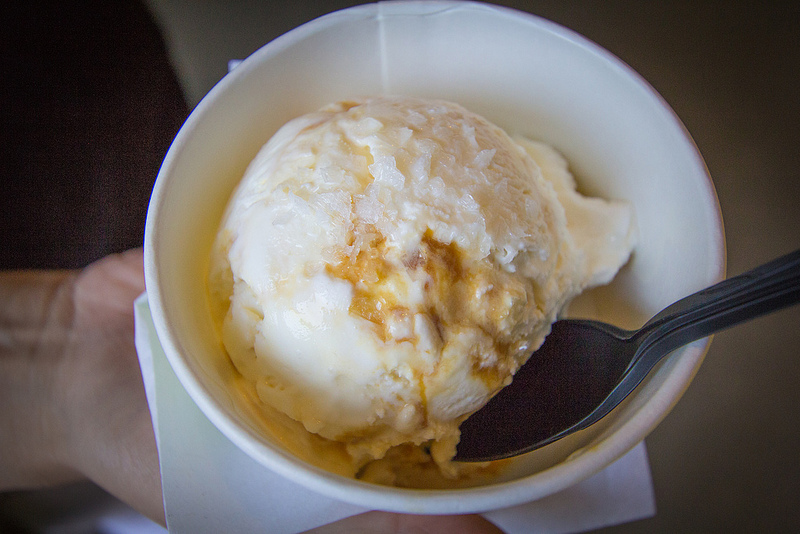
I decided to go with their popular flavor, sea salt ice cream with caramel ribbon, and opted to go with sea salt toppings. The sea salt toppings helped balance the caramel flavor. All together, it was very bold, sweet, and salty! This isn’t your typical supermarket-chain ice cream with standard sprinkles. This one is ice cream to a whole new level!

salt & straw

Salt & Straw also has house-made waffles (I prefer cups), sundaes, ice cream floats, milkshakes, and even draft beverages. I’ve never heard of an ice cream parlor selling beer!

Oh, and if you get your ice cream the NE Alberta location, there’s a store next door that sells minifigures, pins, and other collectibles, that lets you browse while eating your ice cream albeit carefully!

Horn of Africa (Djibouti, Eritrea, Ethiopia, Somalia): Sambusa & Bajiya

Vendor: Horn of Africa null
City: Portland, Oregon

I’m in Portland for a couple days, visiting Beeta!

Beeta and I went to the Portland Saturday Market. There were tons of arts and crafts vendors sprawled around for several blocks, and a row of various food stands parallel to Willamette River.

Horn of Africa was a food stand that stood out most to me, as I had yet to try African food! Horn of Africa refers to the peninsula in Northeast Africa that includes the countries Djibouti, Eritrea, Ethiopia, and Somalia.

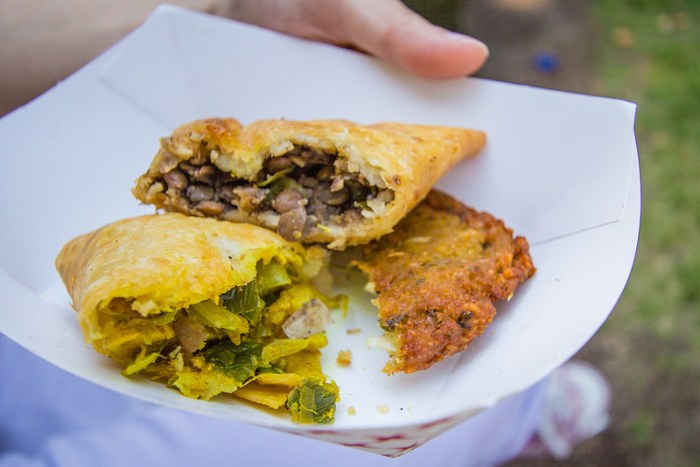
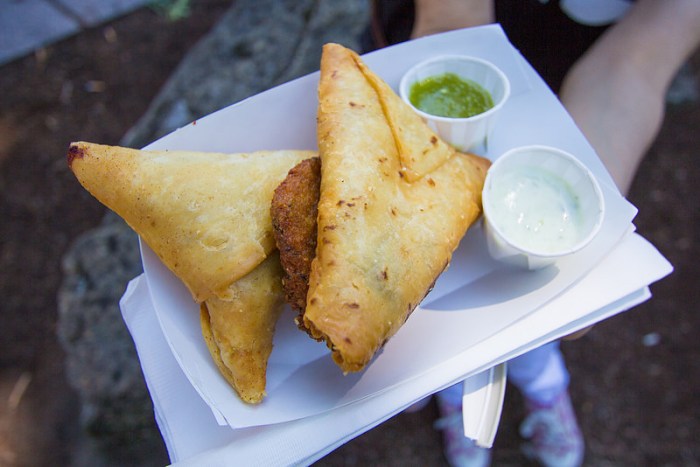
I picked a small appetizer combo for brunch to share with Beeta. The combo allowed for two sambusas and a bajiya. Sambusa is a triangular pastry filled with beef, chicken, or organic green lentils, with fresh East African herbs and spices. Bajiya is a fried seasoned patty of ground garbanzos and split peas.

sambusa - 1 sambusa - 2

We had the chicken and lentil sambusas, as they had run out of beef. Horn of Africa also provided condiments; we got green chutney (not sure if it was coriander or cilantro..) and cucumber yogurt. Horn of Africa’s cucumber yogurt was different than the ones I’ve had at Indian and Middle Eastern restaurants. The cucumber was minced and not in chunks, so the yogurt had a hint of cucumber water in it.

Horn of Africa is next to the Middle East, which explains the many similarities in their cuisine with the neighboring regions (Middle East and Indian).

=======

Here’s some info on the triangular pastry, from Wikipedia:

A samosa /səˈmoʊsə/ or samoosa is a fried or baked pastry with savory filling, such as spiced potatoes, onions, peas, lentils and sometimes ground lamb, ground beef or ground chicken. They may or may not also contain pine nuts. The samosa originated in the Middle East where it is known as sambosa prior to the 10th century. They were introduced to South Asia (India, Pakistan) during the Muslim Delhi Sultanate when cooks from Middle East and Central Asia migrated to work in the kitchens of the Sultan and the nobility. Its size and consistency may vary, but typically it is distinctly triangular or tetrahedral in shape. Indian samosas are usually vegetarian, and often accompanied by a mint sauce or chutney. With its origins in Uttar Pradesh, they are a popular entree appetizer or snack in the local cuisines of South Asia, Southeast Asia, Central Asia and Southwest Asia, the Arabian Peninsula, the Mediterranean, the Horn of Africa and North Africa. Due to cultural diffusion and emigration from these areas, samosas are today also prepared in other global regions.

History

The samosa originated in the Middle East (where it is known as sambosa prior to the 10th century. Abolfazl Beyhaqi (995-1077), an Iranian historian mentioned it in his history, Tarikh-e Beyhaghi. It was introduced to the Indian subcontinent in the 13th or 14th century by traders from the Middle East. Amir Khusro (1253–1325), a scholar and the royal poet of the Delhi Sultanate, wrote in around 1300 that the princes and nobles enjoyed the “samosa prepared from meat, ghee, onion and so on”. Ibn Battuta, the 14th-century traveller and explorer, describes a meal at the court of Muhammad bin Tughluq, where the samushak or sambusak, a small pie stuffed with minced meat, almonds, pistachio, walnuts and spices, was served before the third course, of pulao. The Ain-i-Akbari, a 16th-century Mughal document, mentions the recipe for qutab, which it says, “the people of Hindustan call sanbúsah”.

Horn of Africa

Somali sambusas being deep fried Samosas are a staple of local cuisine in the Horn of Africa (Djibouti, Eritrea, Ethiopia and Somalia), where they are known as sambusa. While they can be eaten any time of the year, they are usually reserved for special occasions, such as Ramadan, Christmas and Meskel.

And more info on bajiya (or baijyo), from Xawash:

Bajiyas, are a regular fixture on iftar tables (breaking the fast in Ramadan), they are part of the Asariyo Quartet (one of the four essential elements of the Somali Afternoon Tea), and they are the ultimate street food. Whether you are in Mogadishu, Brava, Merca, Kismayu, and countless other cities in Somalia, you will find street peddlers selling bajiyas in the market. They are cheap and they don’t spoil easily.

Bajiyas also known as vadas in the Indian subcontinent, are made from black-eyed peas. In Brava, they were also made from azuki beans. Since it is important that bajiyas have some texture, the skins are removed from the peas after soaking them. If the peas were to be ground into a smooth paste, removing the skins would not have been necessary. Bajiyas, however, benefit from having a little coarse texture which makes them more crunchy.
It is a good idea to prepare a large batch of the crushed and skinned black-eyed peas (without the onions, tomatoes, garlic, etc). You can store them in small freezer bags for a couple of months. This way you can make tasty bajiyas at a moment’s notice.

Bajiyas are usually served with a spicy sauce, even though they are great just on their own. You can adjust the heat by using milder peppers and by reducing the quantity of seeds.