Xi’an: Chongqing-style Hot Pot @ 重庆青一色时尚火锅

Restaurant:  重庆青一色时尚火锅 (Chongqing Pure Green Hot Pot)
City: Xi’an, Shaanxi, China

Xi’an is a city in Shaanxi province and located in Western China, which is close to Sichuan province and Chongqing (one of 5 municipalities). Sichuan hot pot is literally full of red peppers, and its broth can easily cause tongue numbness. So, what does Chongqing-style hot pot look like? How different/similar is it to the Sichuan or Cantonese versions?

Today, we went to a restaurant that specializes in Chongqing hot pot, after visiting Shaanxi Bible School. The restaurant gives you the option of having individual hot pot, or one large hot pot for the group. For the individual hot pot setting, each diner has its own stovetop. In the group setting, there is one stove in the middle of the table, for one communal hot pot.

We had party of 7 and sat in a private room in the back of the restaurant, where we had individual hot pot. We also had the choice of different soup bases; you can go for just one soup base, or half and half. I got half spicy, half non-spicy. I like dipping my meats into the spicy broth, and the vegetables to non-spicy broth! After ordering the soup, meats, and vegetables, we all went to the middle of the restaurant where you can make your own dipping sauce from 18 ingredients!!


When I got back to my seat, my hot pot was on top of the stove, ready to be boiled! I had two soup bases; a Chinese herbal soup (white broth) and spicy peppercorn soup (green-yellowish broth). All we had to do now was to let the soup come to a boil, and wait for the food to arrive!

The chopsticks here came into two parts. The handle (longer part) was placed on the table with the bowl and plate. The ends (shorter part) were paper wrapped; you rip it off and attach it to the handles. These chopsticks are also longer than ‘ordinary’ chopsticks, to prevent burning yourself from the bubbling soup.


My soups are boiling now…..but where’s the food?!

The meat, tofu, seaweed, and vegetables are finally here!! Let the dipping and eating commence!
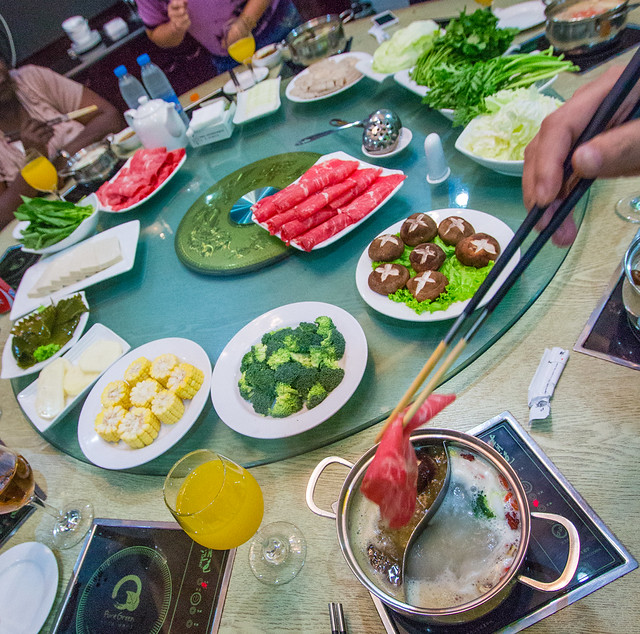
Chongqing hot pot is very similar, if not the same, to Sichuan hot pot. The soup wasn’t bloody red but it was numbing from the peppercorn and green peppers. The dipping sauce/condiments are the same as those typically served with Sichuan hot pot. Chongqing hot pot is definitely different than Cantonese hot pot, though.

Here’s a bit of info about Chongqing hot pot, from Wikipedia:

One of the most famous variations is the Chongqing (Chungking) má là (Chinese: 麻辣 – “numb and spicy”) hot pot, to which Sichuan pepper (Chinese: 花椒 huā jiāo “flower pepper”; also known as prickly ash) is added. Combined with spicy ingredients like chili, it creates a sensation on the tongue that is both spicy and burns and numbs slightly, almost like carbonated beverages. It is usual to use a variety of different meats as well as sliced mutton fillet. A Chongqing hotpot is markedly different from the types eaten in other parts of China. Quite often the differences lie in the meats used, the type of soup base, and the sauces and condiments used to flavor the meat. “má là huǒ guō” could be used to distinguish from simply “huǒ guō” in cases when people refer to the “Northern Style Hot Pot” in China. “Shuàn yáng ròu”, Chinese: 涮羊肉 (instant-boiled lamb) could be viewed as representative of this kind of food, which does not focus on the soup base.

Xi’an: Dinner @ Beyou Restaurant (一石碗)

Restaurant: Beyou Restaurant (一石碗)
City: Xi’an, Shaanxi, China

For dinner, we went to Beyou Restaurant on the second floor of SOHO A in Xi’an Hi-Tech Development Zone. Their workers handed out flyers yesterday as well, but we didn’t realize it was on the second floor. Most of the restaurants open amidst construction were located on the first floor. Beyou had Christmas lights turned on, in the dark stairway to attract customers. The interior of Beyou was modern, with Chinese flags all over the place.

Can you tell what kind of restaurant it is, from its English name or koala mascot alone? We couldn’t and we were confuzzled. The restaurant’s Chinese name ‘一石碗’ translates to “one stone bowl”. Now, that’s a big hint. Can you figure it out?

Beyou is a Korean restaurant! The Chinese name refers to the stone pot that’s frequently used in Korean cuisine.

We started off with three small side dishes, or banchan (반찬): cucumber, radish kimchi, and potato salad.

We were then served complimentary soup, a clear broth with tomato and egg.

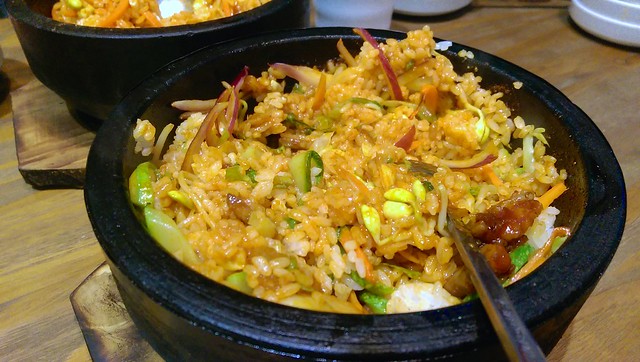
We ordered two dolsot bibimbap (돌솥 비빔밥), one traditional Korean style, and one Korean-Chinese fusion. The latter bibimbap had squash and marinated meat. The waitress mixed the bibimbap with gochujang (고추장) in front of us, then placed it at the center of our table. I then patted the rice down against the stone pot to make the rice crispier.

We also had seafood pancake (hameul pajeon,해물파전)! It was literally packed with octopus, imitation crab, red bell pepper, and green onion! I noticed the bell pepper was cut widthwise instead of lengthwise, which makes it visually different than the ones served at most Korean restaurants in the SF Bay Area. The seafood pancake here wasn’t served with a dipping sauce, though. I wonder why…

Our dinner bill came down to ¥348 RMB (~$57 USD) for the four of us.

Xi’an: Lunch near Terra Cotta Warriors Museum

Today, we went to Terra Cotta Warriors Museum. We signed up for a tour yesterday and had a personal tour guide (in English!) for the four of us. When we finished touring, our tour guide brought us to a restaurant nearby. Unfortunately, I did not make note of the restaurant’s name… But I do remember the dishes were on the pricier side, perhaps to make profit from tourists… Anyhow, here are the three dishes we had!


Vegetables


Pork w/ Green Bell Peppers


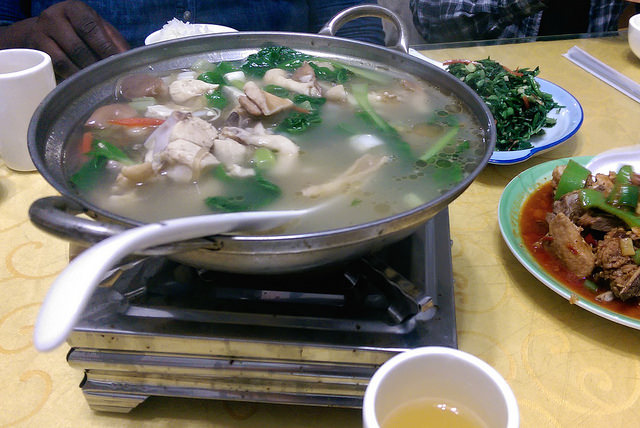
Chicken Soup w/ Mushrooms & Greens

Last but not least…


Rice

The plate of rice literally surprised us. We were used to rice served in individual bowls, or in a rice container. However, they just served us rice on a plate, with a spoon stabbed in it… O_o

Xi’an: Dinner @ 西安调调 (Xi’an Diao Diao)

Restaurant Chain: 西安调调 (Xi’an Diao Diao)
City: Xi’an, Shaanxi, China

We flew to Xi’an from Shenyang, with a stopover at Datong. We stayed at Holiday Inn in the Xi’an Hi-Tech Industries Development Zone, a modernized area currently under development. Some high-rise buildings are completed, while some are under construction but nearing completion.

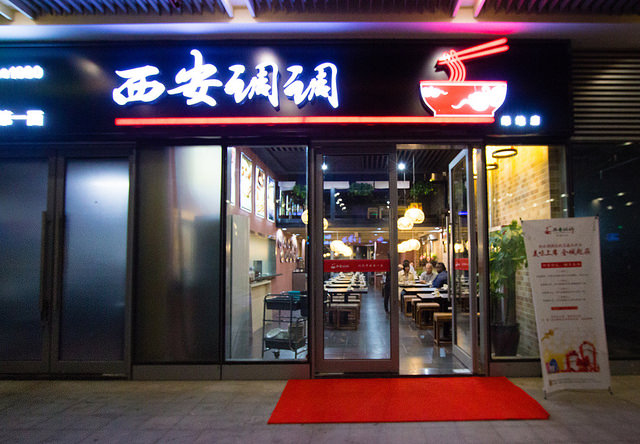
Across the street from Holiday Inn was a high-rise building called SOHO A, which housed several restaurants. The building itself isn’t fully finished and the walkways were dark, but some restaurants were open. The decor of 西安调调 caught our eye, and it had a picture of a noodle bowl in the signage, so we decided to check it out. The waitress said today was the first day of business for this shop! So, all the restaurants open in this area (including this one) must have opened very recently!

西安调调 is a restaurant chain in Xi’an that specializes in noodles. When we were seated, the waitress gave us watermelon slices on a spoon, along with spicy side dishes.

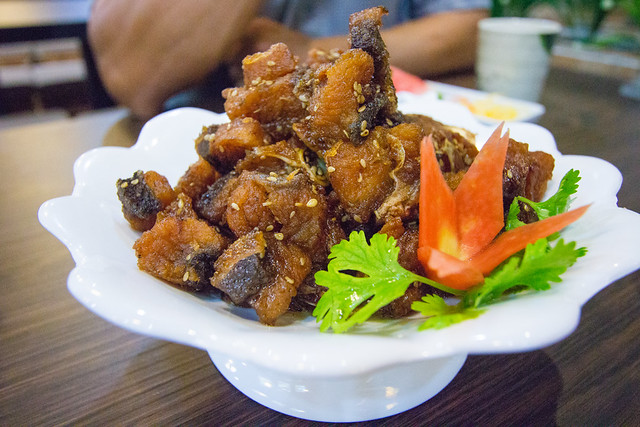
The menu was in Chinese, and Pastor Chan ordered for all of us. We had fried fish for appetizer. It was chewy like beef jerky but also juicy and flavorful.

I had a noodle bowl that had beef, mushrooms, yu choy (also called edible rape or green chouk uyn jak sum), and cilantro in addition to the freshly made noodles. All ingredients were fresh, which made it a very refreshing meal!

Our dinner was approximately ¥395 RMB ($64.10 USD) for the four of us.

China: Breakfast @ McDonald’s (麦当劳)

McDonald’s is literally everywhere, even in China! The menu is slightly different in each country, for the locals’ taste buds and preference, though. It’s fun to find out the differences and compare the McD’s abroad with the ones back home!

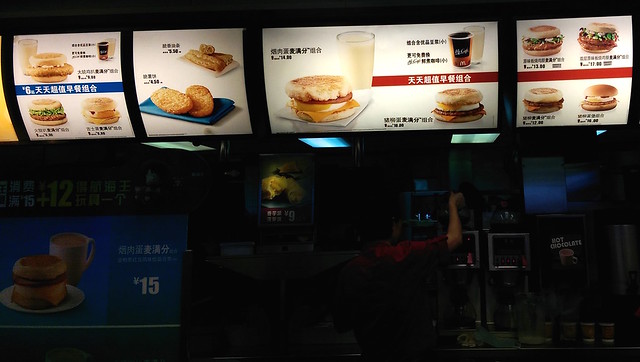
We went to a nearby mall for breakfast before heading to the airport. When we walked into McD, there was a One Piece banner hanging from the ceiling, in front of the cashiers. I thought it refered to its Happy Meal promotion, but the toys on display were different. The menu above the cash registers showed greens in some chicken sandwiches. They also offered soy milk, a sesame drink with boba, black tea, and Chinese donut (油條/油条) for breakfast!

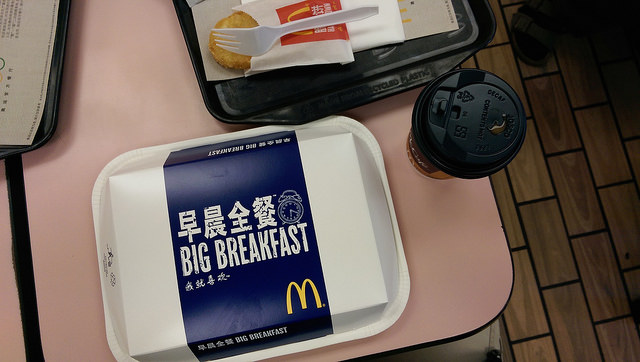
I opted for Big Breakfast, a traditional, classic McD’s combo. I wanted some ‘comfort food’ that reminds me of home, in the midst of eating of Northeastern Chinese dishes.

Big Breakfast came with English muffins, scrambled egg, sausage patty, hash brown, and coffee.  All for ¥24 RMB (~$3.90 USD).

I made a sandwich out of the English muffin, sausage patty, and scrambled egg. I took a bite, then noticed a strawberry jam packet on the tray. There were only two on the tray, and two of us had ordered Big Breakfast while others ordered something different, so one packet must’ve been for my order.

I put the strawberry jam inside my sandwich, and took a bite. It wasn’t bad at all! It actually made the McMuffin sweet and countered the saltiness!

The hash brown was yummy as well; it was less greasy and crunchier than the ones at McDonald’s in the United States.

Thank you McDonald’s, for being available around the world, so travelers can get some ‘comfort food’ anywhere, anytime!

Shenyang: Lunch @ 大获全胜

Restaurant: 大获全胜 (Pinyin: da huo quan sheng, Transl: victory)
City: Shenyang, Liaoning, China

The four of us split into two groups this morning. One group went to a Mandarin-speaking Christian church where Pastor Chan preached. The other group, which I was with, went to a deaf Christian church. Both groups rejoined for lunch.

We had lots of fresh and tasty dishes! Here are close-up shots of some dishes that I managed to take.


Herbal Soup


Purple Yam, Carrot, Corn, Edamame, & Peanut Platter


Jiaozi (Left) & Chive Pancake (Right)


Blueberry Taro (蓝莓芋头)


Potato Flower


Clams

For some reason, two guys at my table kept scooping me clams. Maybe they somehow knew I loved eating clams! The clams were really fresh, though!

At the end of the meal, we had watermelon which was very juicy and sweet. Watermelon is abundant in Asia and imported to the United States. It’s the opposite for orange, which explains why some Chinese restaurants in the US serve oranges, while restaurants in China serve watermelon.

Everyone at the table was chatting primarly in Mandarin. I did not sit next to anyone that could translate to English, so I became bored and got creative with my watermelon slices. :D

China: Dinner @ 苏氏牛肉面 (Sushi Beef Noodle)

Restaurant: 苏氏牛肉面 (Sushi Beef Noodle)
City: All major cities in Northern China

For dinner, we went to a restaurant chain a local pastor recommended. The Chinese name ‘苏氏牛肉面’ translates to Su’s Beef Noodles. However, they made the English name a combination of Pinyin and translation. The first two characters have the Pinyin of “Su Shi” while the last three characters translate into “Beef Noodle” to form “Sushi Beef Noodle”.

Contrary to its English name, the restaurant does not serve sushi or Japanese food. They serve beef noodle soup, hotpot, and bread. Sushi Beef Noodle started in Urumqi, in Northwestern China and close to Mongolia, Russia, and Kazakhstan. Then it spread to Northeastern China and Inner Mongolia.

Sushi Beef Noodle is a very popular restaurant chain. All the tables were taken when we went to one across our hotel in Shenyang! This restaurant had two levels; the beef noodle soups and baked goods were eaten on the lower level while the hot pot was served on the upper level.

I had 三宝牛肉麵 (Three Treasures Beef Noodle Soup). As the name explains, there were three different types of beef in the noodle soup. This particular dish had wide noodles; some of the other dishes offered had thin round noodles. All noodles were flour based.


Doesn’t this noodle soup look like the Vietnamese noodle soup (phở) with a Chinese fusion? That was my impression when I got my bowl!

Remember how I mentioned Sushi Beef Noodle also has bread? There’s a small bakery inside the restaurant and they had a small selection of baked breads. We got three pieces of bread. The flatter ones had red bean paste filling, while the spiral bread had pieces of Chinese herbs in it.


Panjin: Chinese Mitten Crab

Panjin is best known for its Red Beach (红海滩), which is the largest in the world, followed by Japan and South Korea. Food-wise, Panjin is famous for its Chinese mitten crab (大閘蟹).

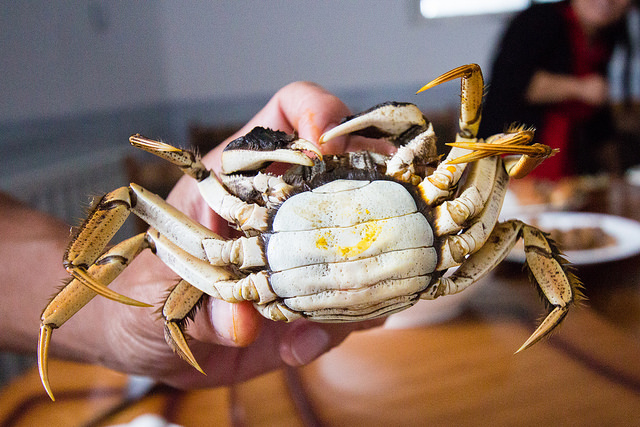
We were invited to a private restaurant for lunch, where we were served plates of Chinese mitten crabs. They’re much smaller than the crabs available in North America. I can easily grab one crab using only one hand.


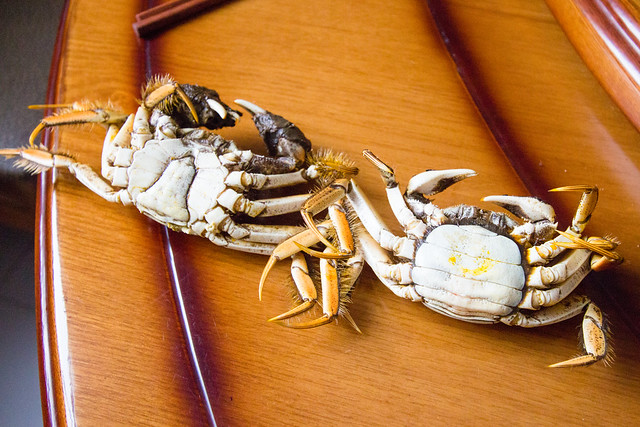
We had both male and female versions of the crab.

The females have a large abdomen (shown above), while the males have a bell-shaped abdomen (shown below, on the left).

All of us were unexperienced at eating Chinese mitten crabs, so the owner showed us how to eat it. The abdomen is popped open first to take out the yucky stuff, and the orange colored yolk is eaten. Then you break off the legs and break the shell to eat the crab meat.

Each crab was so small and the legs were so tiny, that it took me forever to eat just one crab. However, the crab meat and yolk were very tasty.

There were many hawkers all over Panjin selling these crabs. We stopped by one or two to check out the price, which turned out to be more expensive than if you were to buy at the market. It’s always better shop at the local market for a more reasonable price and guaranteed freshness!

Panjin: Rice Milk (米浆) & Pie/Cake (饼)

We visited an organic farm in Panjin, that is run by a Christian. We were given fresh, warm rice milk (米浆) and a pie (饼) similar to the Cantonese husband/wife cake.

Shown above is the warm rice milk. I have no idea why the lid says “Choco Listo”, which appears to be a Colombian chocolate drink. However, the Chinese phrase on the lid (值得一尝) translates to “worth a taste”.

The drink was organic rice milk, and it was thick with a grainy taste to it. The texture and taste reminded me so much of the Cantonese sweet walnut paste/soup (合桃糊/核桃糊) my mom made at home for family friends.

We were also given a snack, which resembled the Cantonese husband/wife cake (老公饼/老婆饼).The wife cake has a wintermelon filling, whereas the husband cake has a red bean paste filling. The snack we were given had the same kind of outer, flaky crust but had a different filling. I don’t know exactly what kind of filling it was, but it was sweet and savory.

Shenyang: Potato Burrito

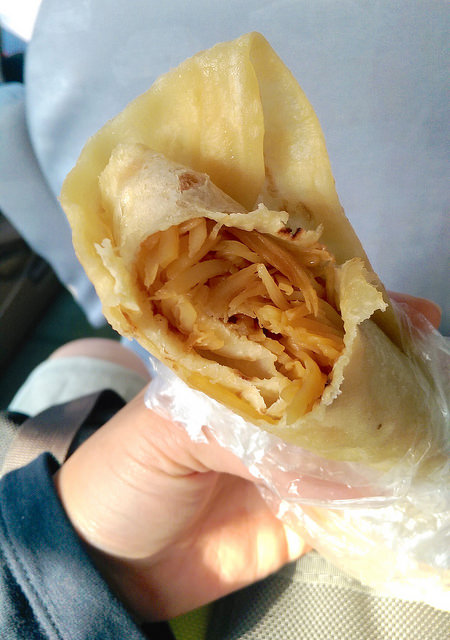
We went on a two hour road trip to Panjin from Shenyang this morning. Just before we hit the highway, we grabbed some street food for breakfast to eat on the road. I was given a plastic bag that contained some kind of roll that resembled a burrito.

I unwrapped the plastic bag and peeked through the wrap to see what was inside.

I couldn’t figure out what the ingredient was by its appearance and smell. So I took a bite, and immediately tasted fried potato!

It turned out to be a potato burrito (土豆卷饼). It was carbs on carbs. I couldn’t finish the whole thing. Since it was street food, the cleanliness of the entire thing was also questionable.

Potato is abundant in Northeastern China. In Shenyang, there were lots of hawkers selling burritos and advertising it as American food. Most hawkers had a large mound of shredded potato on their cart, and a few others carried other type of ingredients.

Street food in Asia can be notorious for giving indigestion and diarrhea, because the vendors have a high chance of inadequate sanitation and contamination. I strongly suggest travelers to bring Pepto-Bismol (or similar product) for the worst case scenario. Pepto-Bismol is available in liquid form, capsules, and chewable tablets. It’s better to be safe than sorry!