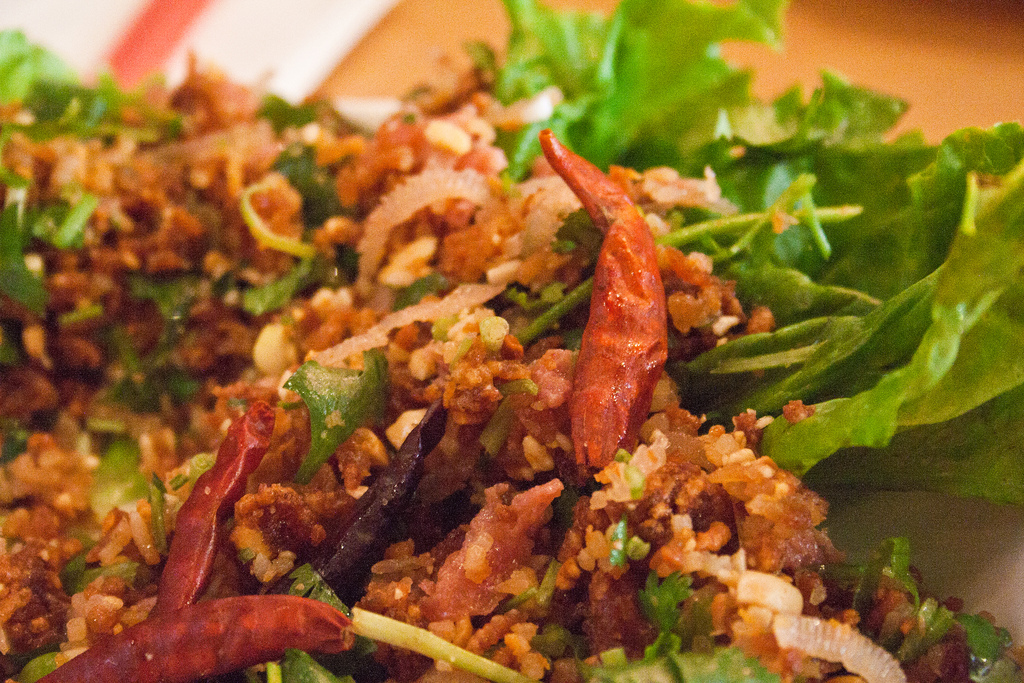
Laos: Nam Kao Tod

Restaurant: Green Champa Garden
City: Fremont, CA

Green Champa Garden has a sister restaurant, Champa Garden, in Oakland.

I treated the parents out to dinner to celebrate Mother’s birthday! She picked Thai/Laos food over ramen, which turned out to be a good move, as we could eat family-style at this restaurant.

My apologies if the photos from tonight’s dinner are blurry; I didn’t have my 60D on me, so the photos were taken from my Galaxy Nexus. I’ll try to update the photos in this series of posts next time I go there…so if you notice a subpar photo, you’ll know why it’s crappy!

nam kao tod

Oh, I found a close-up photo I took in 2010 at Champa Garden. Yay for Flickr!

nam kao tod (2010.06)

Fried rice ball salad – crispy fried rice, mixed with preserved pork, green onions, and lime juice. Served with lettuce wraps, mint, and cilantro. Lime wedges were also included.

Nam khao (Lao: ແໝມເຂົ້າ), also known as Lao crispy rice salad, Lao fried rice ball salad, nam kao tod, naem khao thawt, nem khao, nam khun or naem khao, is a salad from Laos and is made with deep-fried rice balls, chunks of Lao-style fermented pork sausage called som moo, chopped peanuts, grated coconut, sliced scallions or shallots, mint, cilantro, lime juice, fish sauce, and other ingredients. Nam khao is traditionally eaten as a wrap by filling individual leaves (i.e. lettuce) with a spoonful of the tangy Nam khao mixture and then topping it with fresh herbs and dried chili peppers. The traditional Lao method of making Nam khao involves seasoning a batch of cooked rice with red curry paste, sugar, salt, and grated coconut, and then forming the mixture into tightly packed large rice balls to be coated with eggs and then deep-fried to form crispy rice balls. Prior to serving, the crispy rice balls are broken into little chunks of rice and then mixed with the rest of the ingredients to form the eventual crispy rice salad. Nam khao is a very popular Lao appetizer that is gaining popularity in the West. (Wikipedia)

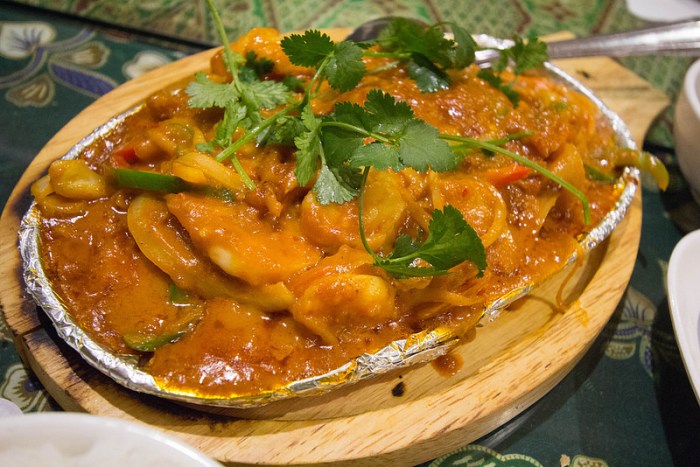
Malaysia: Sizzling Belacan Prawn

Restaurant: Layang Layang
City: Milpitas, CA

sizzling belacan prawn

Sizzling belacan prawn with onion, bell pepper, coconut milk, and spicy belacan sauce.

Belacan, a Malay variety of shrimp paste, is prepared from krill, also known as geragau in Kristang (Portuguese creole spoken in Malaysia) or rebon in Sundanese and Javanese. In Malaysia, normally the krill would be steamed first and after that are mashed into a paste and stored for several months. The fermented shrimp are then prepared, fried and hard-pressed into cakes. William Marsden, an English writer included the word in his “A Dictionary of the Malayan Language” published in 1812. Belacan is used as an ingredient in many dishes. A common preparation is sambal belacan, made by mixing toasted belacan with chilli peppers, minced garlic, shallot paste and sugar and then fried. Sometimes it is toasted to bring out the flavour, but that creates a strong odor. (Wikipedia)

Many types of seafood are consumed in Malaysia, including shrimp or prawn, crab, squid, cuttlefish, clams, cockles, snails, sea cucumber, and octopus. In general, members of all ethnic communities enjoy seafood, which is considered halal by Malaysian Muslims (and indeed all other Muslims), though some species of crabs are not considered Halal as they can live on both land and sea. (Wikipedia)

Malaysia: Bak Kut Teh

Restaurant: Layang Layang
City: Milpitas, CA

The soup at tonight’s dinner was bak kut teh.

bak kut teh

Pork rib, fried tofu puff, and mushroom in Chinese herbal soup. Smelled and tasted like the awfully bitter Chinese herbal medicine that my parents get from the Chinese herbal doctor to cook at home…blech. I had to eat something else from my plate, to get rid of the aftertaste. However, I can assure you that this is the “weak form” of the actual strong, bitter Chinese herbal medicine!

Bak kut teh is a Chinese soup popularly served in Malaysia, Singapore, (where there is a predominant Hoklo and Teochew community) and also, neighbouring areas like Riau Islands and Southern Thailand. Bak kut teh literally translates as “meat bone tea”, and at its simplest, consists of meaty pork ribs simmered in a complex broth of herbs and spices (including star anise, cinnamon, cloves, dang gui, fennel seeds and garlic) for hours. Despite its name, there is in fact no tea in the dish itself; the name refers to a strong oolong Chinese tea which is usually served alongside the soup in the belief that it dilutes or dissolves the copious amount of fat consumed in this pork-laden dish. However, additional ingredients may include offal, varieties of mushroom, choy sum, and pieces of dried tofu or fried tofu puffs. Additional Chinese herbs may include yu zhu (玉竹, rhizome of Solomon’s Seal) and ju zhi (buckthorn fruit), which give the soup a sweeter, slightly stronger flavor. Light and dark soy sauce are also added to the soup during cooking, with varying amounts depending on the variant – the Teochew version is lighter than the Hokkien version. The dish can be garnished with chopped coriander or green onions and a sprinkling of fried shallots. (Wikipedia)

Malaysia: Fried Taro Nest

Restaurant: Layang Layang
City: Milpitas, CA

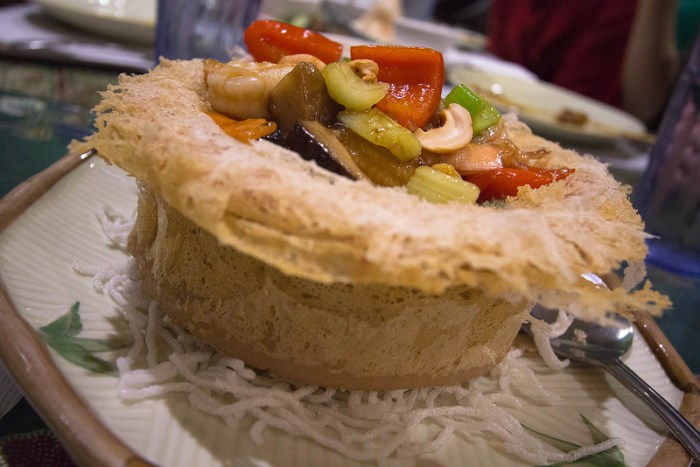
fried taro nest

The restaurant calls it “Sarang Seafood”; fried taro nest topped with shrimp, squid, scallop, corn snow peas, black mushroom, bell pepper, celery, and cashew nuts. Crispy noodles were also at the base of the taro nest.

Seafood birdsnest is a common Chinese cuisine dish found in Hong Kong, China, and most overseas Chinatown restaurants. It is also found within Cantonese cuisine. It is usually classified as a mid to high-end dish depending on the seafood offered. (Wikipedia)

As you can tell from the other posts from this particular restaurant, Malaysian cuisine is influenced by many ethnic groups- Malay, Chinese, Indian, Indonesian, Portuguese, Thai, and Arabian. This dish was obviously influenced by the Chinese. It looks like the Malaysian-Chinese fried taro nest is structured/made differently than the ones found in Cantonese restaurants. If I recall correctly, the Cantonese version of the fried taro nest is in a thick web-like structure, and much crunchier.

Malaysia: Ikan Bakar

Restaurant: Layang Layang
City: Milpitas, CA

ikan bakar

Grilled striped bass coated in spicy lemongrass sauce and wrapped in a banana leaf. Lemon wedges and sambal were also served with ikan bakar. This was my first time having ikan bakar; it had a very undescribable unique taste, but the texture of the black sauce reminded me of black bean sauce. Oh, and as I’m posting this and looking at the photo I took, I realize I totally missed the sambal for my ikan bakar, though I did get a lemon wedge…T_T…will have to try it again next time!

Ikan bakar is a generic term to refer various kinds of Indonesian and Malaysian dish of charcoal-grilled fish or other forms of seafoods. Ikan bakar literally means “burned fish” in Malay and Indonesian. The fish is usually marinated with the mixture of sweet soy sauce and coconut oil or margarine, applied with brush during grilling. The spices mixture may vary among regions and places, but usually it consists of combination of ground shallot, garlic, chili pepper, coriander, tamarind juice, candlenut, turmeric, galangal and salt. In Java and most of Indonesia, ikan bakar usually tastes rather sweet because the generous amount of sweet soy sauce either as marination or dipping sauce. While the ikan bakar of Minangkabau (Padang), most of Sumatra and also Malay peninsula, usually more spicier and yellow-reddish in color because the generous amount of chili pepper, turmeric and other spices, and the absent of sweet soy sauce. Ikan bakar usually served with sambal belacan (chili with shrimp paste) or sambal kecap (sliced chili and shallot in sweet soy sauce) as dipping sauce or condiment and slices of lemon as garnishing. (Wikipedia)

Malaysia: Satay

Restaurant: Layang Layang
City: Milpitas, CA

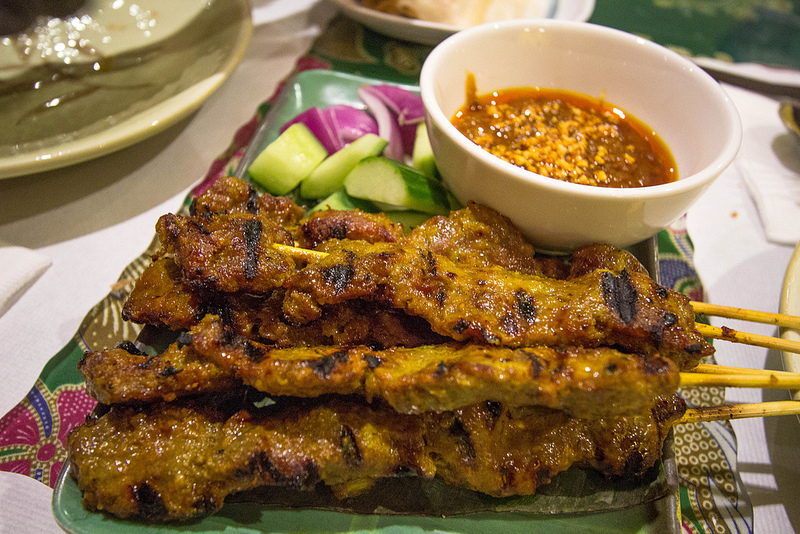
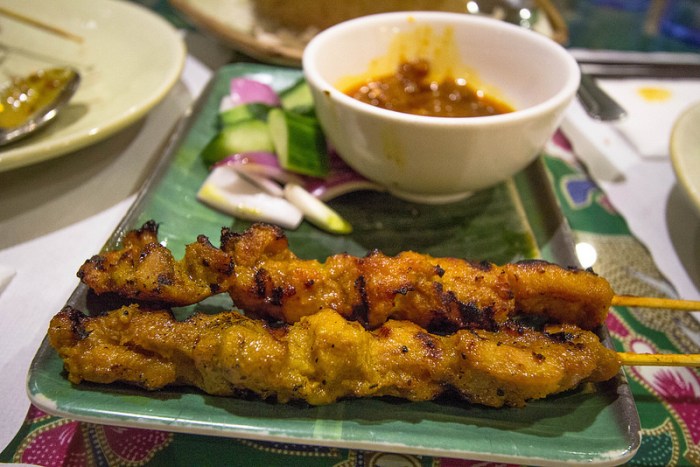
Everytime we eat at a Malaysian restaurant, we get satay. This time, we got both beef and chicken satay (top and bottom photo, respectively).

satay beefsatay chicken

5 sticks of marinated chicken or beef grilled on stick, and served with home made peanut sauce. The peanut sauce also goes well with plain rice; we try to hold onto the sauce after we’ve finished the satays!

Malaysian satay is a very popular dish in Malaysia and universally loved across Southeast Asia. Malaysian satay is made with ingredients and spices commonly found in Malaysian cooking; shallots, lemongrass, turmeric powder (kunyit), and coriander powder. The basic recipe calls for the cook’s meat of choice—be it chicken, beef, lamb, or pork—to marinate for many hours or even overnight so as to lock in the flavor. In addition to the peanut dipping sauce, Malaysian satay is served with ketupat, onions, and cucumber. (Rasa Malaysia)

Satay, or sate, is a dish of seasoned, skewered and grilled meat, served with a sauce. Satay may consist of diced or sliced chicken, goat, mutton, beef, pork, fish, other meats, or tofu; the more authentic version uses skewers from the midrib of the coconut palm frond, although bamboo skewers are often used. These are typically grilled or barbecued over a wood or charcoal fire, then served with various spicy seasonings. A dish with widespread popularity, the origins of satay are unclear. The word “satay” itself is thought to have been derived from Indonesian: sate and Malay: saté or satai, both perhaps of Tamil origin. Satay was supposedly invented by Javanese street vendors as an adaptation of Indian kebabs. This theory is based on the fact that satay has become popular in Java after the influx of Muslim Tamil Indian and Arab immigrants to Dutch East Indies in the early 19th century. The satay meats used by Indonesians and Malaysians — mutton and beef — are also favoured by Arabs and are not as popular in China as are pork and chicken. (Wikipedia)

Malaysia: Roti Canai

Restaurant: Layang Layang
City: Milpitas, CA

Celebrated Mother’s birthday with the parents and family friends during dinner! Layang Layang is a Malaysian restaurant with two locations, in Milpitas and San Jose.

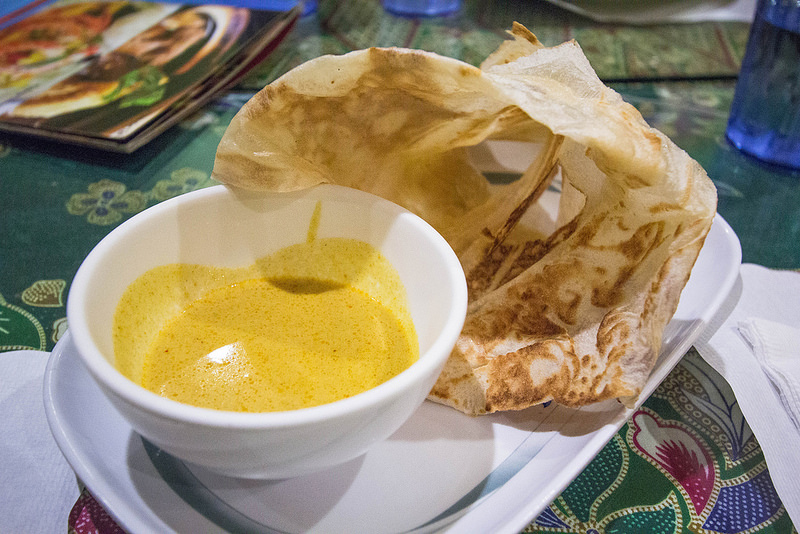
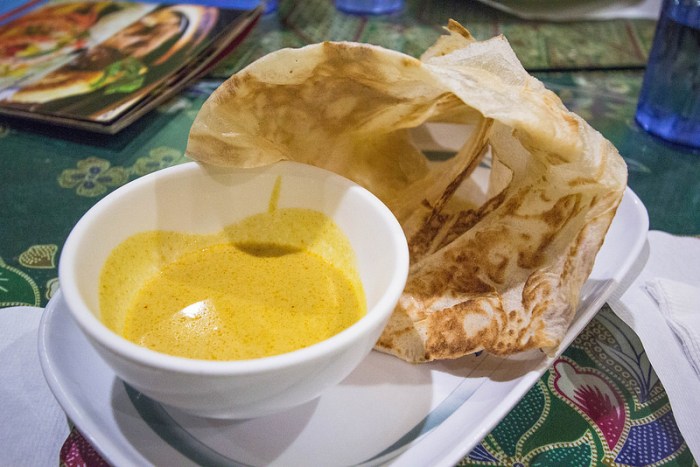
roti canai

Home made Indian style pancake with curry dipping sauce. The curry sauce wasn’t spicy; two elementary school kids could eat their roti canai with the curry sauce!

Roti canai is a type of Indian-influenced unleavened flatbread found in Malaysia, Singapore, and Indonesia. Roti means bread in Hindi, Urdu, most other North Indian languages, and Malay. The word ‘canai’ in Malay means ‘to roll out dough’. Roti canai is often sold in Mamak stalls in Malaysia; also in Malay, Minangkabau, and Aceh restaurants in Indonesia. It is known as roti prata (Malay for ‘plate bread’) in Southern Malaysia and Singapore, and is similar to the Indian Kerala porotta. Roti canai is circular and flat. There are two ways to make roti canai; either to twirl it until the dough becomes a very thin sheet and then fold into a circular shape, or to spread out the dough as thinly as possible before being folded. Then the folded dough is grilled with oil. The first method is more popular and faster than the second. (Wikipedia)

Vietnam: Bánh Mì

Restaurant: Cam Huong
City: Union City, CA

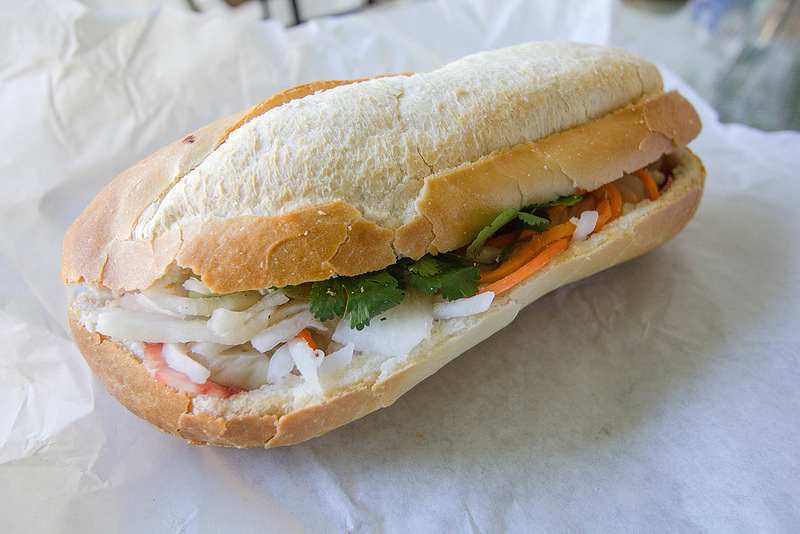
After I woke up, I went to the kitchen to find a Vietnamese sandwich (bánh mì) on the kitchen table waiting for me with a note…thanks, Dad! He got my favorite version, the pork combo sandwich.

banh mi - 1banh mi - 3banh mi - 2

Here’s a breakdown of my sandwich, taken from The Battle of Bánh Mì:

  • Chả or Chả Lụa (pork roll) – Ground up pork is packed tightly into a roll, and wrapped with banana leaves (and or aluminum foil) then steamed or boiled, hence producing the dense “pork roll”. Sliced thin like bologna, these make up one of the most common cold cuts found in bánh mì.
  • Thịt Nguội (cured pork cold cuts) – Thịt Nguội (translated as “Cooled Meats”), is the second most common cold cut filling. Usually made of cured pork & layered with strips of fat. Some makers will call it Ba Chị, which is more like pork belly.
  • Dặc Biệt (Special or Combination) – Every menu has a Combination or House Special, which is a combination of at least one of the following: the pork roll, headcheese and/or cold cuts. Some shops offer ham as an offering to the cold cuts, as well as adding their special house touch of other meats.
  • Paté – Ranging from chicken to duck liver ingredients, pates can normally be a part of every sandwich as a spread, but some menu’s offer pate in larger quantities, making it the main savory filling ingredient.
  • Homemade Mayo – Sometimes made from an egg yolk & vegetable oil combination, or other shops will even have a store bought mayo or miracle whip. Most shops will have some type of rich, white spread.
  • Fresh herbs – In the U.S., we usually see fresh cilantro sprigs. However, other herbs were popular in different regions of Vietnam.
  • Pickled Carrots & Daikon – Usually finely shredded or julienned, these sour, vinegared accompaniments provide the salty, sour layer of flavor.
  • Cucumber slices – Most places put in fresh cucumber slices, while a few may put in pickled cucumbers in the same manner as pickled carrots and daikon.
  • Jalapeño slices or other Chilies – Warning for the lighthearted: Pepper spice potency level will vary heavily. Nibble on a slice from your sandwich first before you bite  The jalapeño slice that tasted like a mild cucumber last week, just might pop back and kick you in the ass this time.

Continue reading

Italy: Caffè Macchiato

Restaurant: Terún
City: Palo Alto, CA

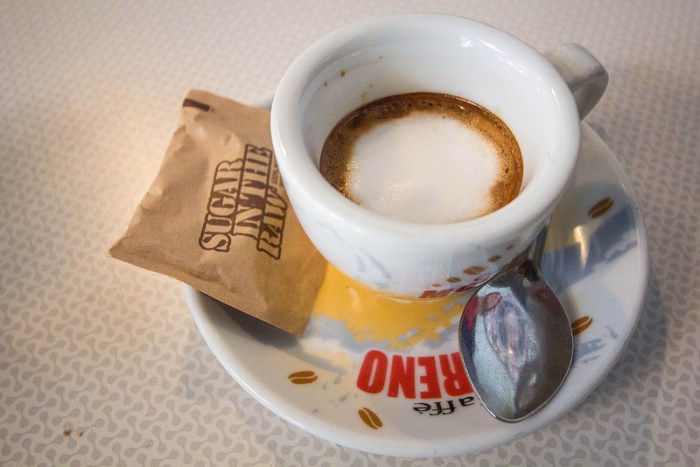
The Italian coworker ordered a caffè macchiato to end his meal at the restaurant.

caffè macchiato

Coffee is often drunk at the end of a meal, even after the digestivo. Italians, unlike many countries, do not have milky coffees or drinks after meals (such as cappucino or caffè macchiato), but strong coffee-drinks such as espresso, which is often drunk very quickly in small cups at very high temperatures. (Wikipedia)

Caffè macchiato, sometimes called espresso macchiato, is an espresso coffee drink with a small amount of milk added, today usually foamed milk. In Italian, macciato means ‘marked’ or ‘stained’, so the literal translation of caffè macchiato is ‘stained coffee’ – the milk ‘stains’ the coffee, hence the name. Traditionally, caffè macchiato is made with one shot of espresso, and the small amount of added milk was the ‘stain’. However, later the ‘mark’ or ‘stain’ came to refer to the foamed milk that was put on top to indicate the beverage had milk in it. In fact, a caffè macchiato in Portuguese is named café pingado which means coffee with a drop, referring to the drop of milk. The reason this coffee drink got its name was that the baristas needed to show the serving waiters the difference between an espresso and an espresso with a tiny bit of milk in it; the latter was ‘marked’. As the term ‘macchiato’ to describe this type of coffee predates the common usage of foam in coffee by centuries, the staining ‘agent’, the additive that lightens the dark espresso, is traditionally the milk, not the foam. (Wikipedia)

Italy: Gnocchi

Restaurant: Terún
City: Palo Alto, CA

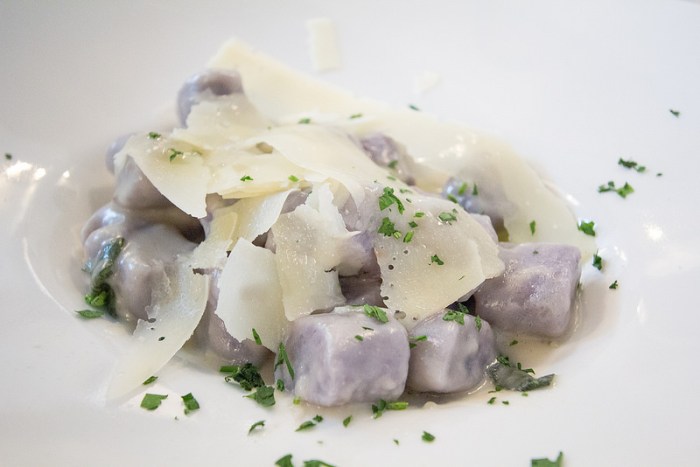
One of the coworkers at lunch ordered a pasta dish, the Gnocchi.

gnocchi

Homemade purple gnocchi, butter, sage, parmigiano, and truffle oil sauce. I tried a gnocco, and immediately tasted purple potato, which is a variation of sweet potato (common in Asia).

Gnocchi (singular gnocco) are various thick, soft pastas that may be made from semolina, ordinary wheat flour, flour, egg, cheese, potato, breadcrumbs, and or similar ingredients. The word gnocchi may derive from the Italian word nocchio, meaning a knot in wood, or from nocca (meaning knuckle). It has been a traditional Italian pasta type of probable Middle Eastern origin since Roman times. It was introduced by the Roman legions during the expansion of the empire into the countries of the European continent. In the past 2,000 years, each country developed its own specific type of small dumpling, with the ancient gnocchi as their common ancestor. In Roman times, gnocchi were made from a semolina porridge-like dough mixed with eggs, and are still found in similar forms today, particularly the oven-baked gnocchi alla romana and Sardinia’s malloreddus (although these do not contain eggs). The use of potato is a relatively recent innovation, occurring after the introduction of the potato to Europe in the 16th century. Potato gnocchi are particularly popular in Abruzzo, Friuli-Venezia Giulia, Veneto, Ciociaria and other provinces of Latium. As with other mashed potato dishes they are best prepared with floury potatoes to keep a light texture. (Wikipedia)