Vietnam: Mì Vįt Tiềm

Restaurant: Thanh Ky Restaurant
City: Oakland, CA

Can you tell that I love noodles by the amount of noodle soup and (dry) noodle dishes I’ve had?! :)

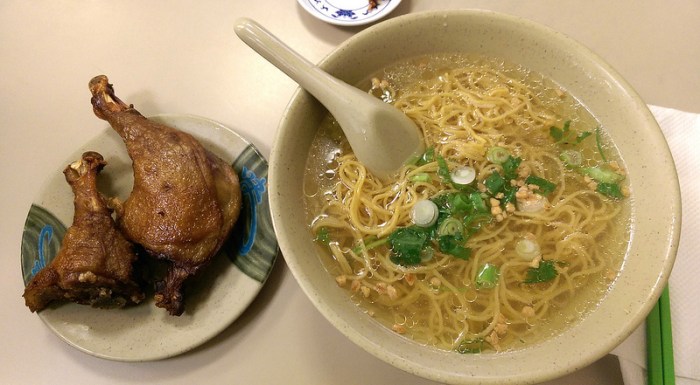
I had egg noodle soup with duck legs for lunch today. The duck was crispy, soft, and delish! Oh, and when ordering this dish, you have the option of getting egg noodle or ho fun (wide white rice noodle), or both.

mi vit tiem

It appears that this dish is popular in Hanoi, as it’s listed on many Vietnamese travel sites, such as Ha Noi Tours:

You’ll notice the echoes of Cantonese cuisine in this soup stuffed with squiggly yellow noodles, roasted duck, and Chinese broccoli.

However, this dish can be found throughout Vietnam. My  mom recalls seeing it in Saigon, but it was considered as an expensive dish. She also says the soup may be  saltier at the Vietnamese restaurants than those served at Cantonese restaurants.

Some places may serve the duck in the bowl, on top of the noodles. Not all places serve the soup with Chinese broccoli (gai-lan), though, like the one I had above. The name “mì vįt tiềm” simply translates as braised duck egg noodle soup.

Guangdong & Hong Kong: Red Bean Soup

Restaurant: Daimo
City: Richmond, CA

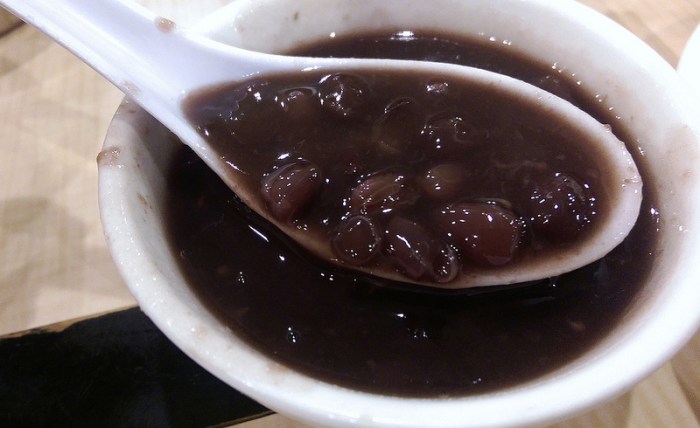
I had dinner with my parents and a friend at a Cantonese restaurant last night. At the end of the dinner, we were served red bean soup. It had been a while since I last had red bean soup at the end of dinner, so I had to post this here! Not all Cantonese restaurants serve red bean soup at the end of the meal; only some higher-end ones will serve it.

I’m actually not a fan of red bean soup even though I like red bean paste… I’m just weird like that! I’ll still have a few spoonfuls to be polite.

red bean soup

Here’s some info about the Chinese red bean soup, from Wikipedia:

In China, red bean soup (紅豆汤, pinyin: hóng dòu tāng) is a popular dish. The soup is commonly thinner than the Japanese oshiruko version. It is categorized as a tang shui糖水, (pinyin: táng shǔi) (literally translated as sugar water), or sweet soup. It is often served cold during the summer, and hot in the winter. Leftover red bean soup can also be frozen to make ice pops and is a popular dessert.

In Cantonese cuisine, a red bean soup made from rock sugar, sun-dried tangerine peels, and lotus seeds is commonly served as a dessert at the end of a restaurant or banquet meal. Common variations include the addition of ingredients such as sago (西米, pinyin: xī mi), tapioca, coconut milk, ice cream, glutinous rice balls, or purple rice. The two types of sugar used interchangeably are rock sugar and sliced sugar (片糖).

And some more info, also from Wikipedia, as red bean soup is one of the many types of tong sui:

Tong sui literally translated as “sugar water”, also known as tim tong, is a collective term for any sweet, warm soup or custard served as a dessert at the end of a meal in Cantonese cuisine. Tong sui are a Cantonese specialty and are rarely found in other regional cuisines of China. Outside of Cantonese-speaking communities, soupy desserts generally are not recognized as a distinct category, and the term tong sui is not used.

Central Thailand: Gaeng Kari Gai

Restaurant: Shana Thai
City: Mountain View, CA

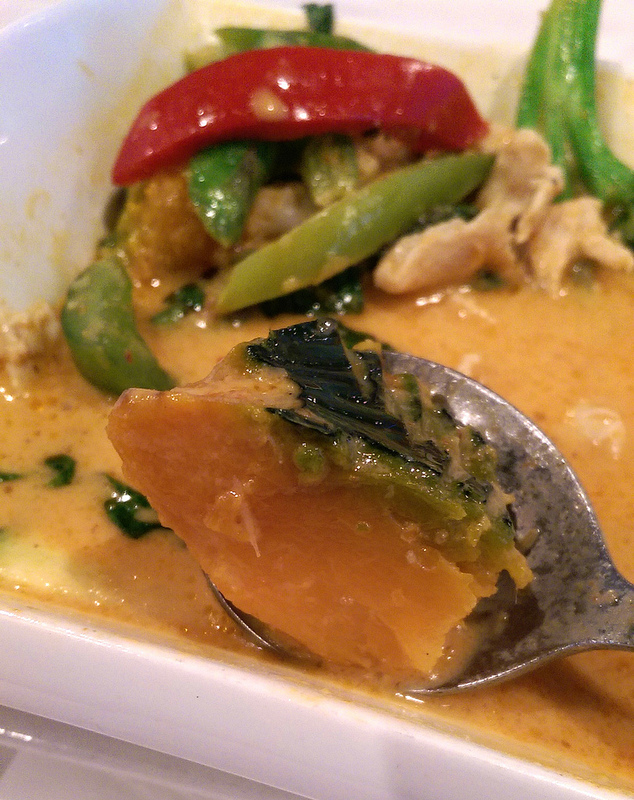
Several coworkers and I went to a Thai restaurant near work for lunch yesterday. I had the pumpkin curry with chicken. Pumpkin curry is basically yellow curry with pumpkin. Some Westerners might think freshly chopped pumpkin isn’t edible as it’s typically used for carving into Jack-o’-lanterns as a Halloween decoration. Did you know that there are green pumpkins as well? They’re green on the outside, but orange on the inside (see the second photo below). The green pumpkins are also known as kabocha.

Shana Thai’s pumpkin curry consisted of bamboo shoots, pumpkin, broccoli, cauliflower, zucchini, asparagus, bell pepper, and sweet basil with your choice of protein (beef, chicken, pork, salmon). There was also the taste of coconut milk in the curry.

Gaeng Karee Gai - 1 Gaeng Karee Gai - 2

Some info about yellow curry, from Wikipedia:

Yellow curry (แกงกะหรี่,) is one of three major kinds of Thai curry that are commonly found in Thai restaurants in the West. There are other curry types in Thai cuisine, several of which are yellow. Pre-packaged curry powder of Indian origin is sometimes also referred to as yellow curry in Western countries but is a different blend of spices from Thai yellow curry.

Thai Yellow curry, outside Thailand, usually refers to the Thai-Muslim dish kaeng kari. This curry is richer and creamier than other Thai curries, since coconut cream is used in addition to coconut milk. This richer curry tends to tone down the overall spiciness of the dish, hence its popularity on menus outside of Thailand. The primary spices in kaeng kari are cumin, coriander, turmeric, fenugreek, garlic, salt, bay leaf, lemongrass, cayenne pepper, ginger, mace and cinnamon. Sometimes a touch of palm sugar or a similar sweetener will be added, depending on the sweetness of the coconut milk.

Thai yellow curry can be made with duck, chicken, shrimp, fish or vegetables (squash, sweet potato, or pumpkin) and is eaten with steamed rice or round rice noodles known as khanom chin.

Portland & Seattle: Smoked Salmon Chowder

Restaurant: Pike Place Chowder
City: Seattle, WA

Here’s another Throwback Thursday post!

I went to Seattle with four college buddies for 5 days in October 2013. On one of the 5 days, we toured around Pike Place Market and stopped by the famous Pike Place Chowder. We ended up arriving a couple minutes before closing, so they had run out of bread bowls. Luckily, they still had plenty of chowders left!

I got the smoked salmon chowder, which had the description “authentic Pacific Northwest flavors, with Nova smoked salmon, capers, and cream cheese. A Seattle favorite!” I was also given oyster crackers and a piece of sourdough bread. On my way out, there was a bowl of Andes mint up for grabs!

smoked salmon chowder - 1smoked salmon chowder - 2

There are many variations of clam chowder across the United States, as pointed out by Venus de Milo:

A quick search for “clam chowder” on the internet found over 7 named variations: New England, Rhode Island, New Jersey (they add asparagus and sliced tomatoes?!), Delaware, Hatteras and Minorcan (from St. Augustine, Florida), and a long list of variations, including a chowder from Portland and Seattle that includes smoked salmon instead of pork.

Here’s a little bit of info, from Wikipedia:

Some restaurants also serve their own unique clam chowders that do not fall into any specific categories. Clam chowder is usually served with saltine crackers or small, hexagonal oyster crackers. Throughout the United States, “New England-style” clam chowder is often characterized as being thicker and more creamy, even though traditionally it is rather thin (with many late 19th and early 20th century recipes using condensed milk as the base). This is sometimes served in sourdough bread bowls, especially in San Francisco, where sourdough bread is popular with tourists and has been considered a signature dish since 1849. In Seattle and Portland, smoked salmon is often added to New England style chowder instead of smoked pork.

Taiwan: Sea Salt Coffee

Cafe: 85°C Bakery Cafe
City: Newark, CA

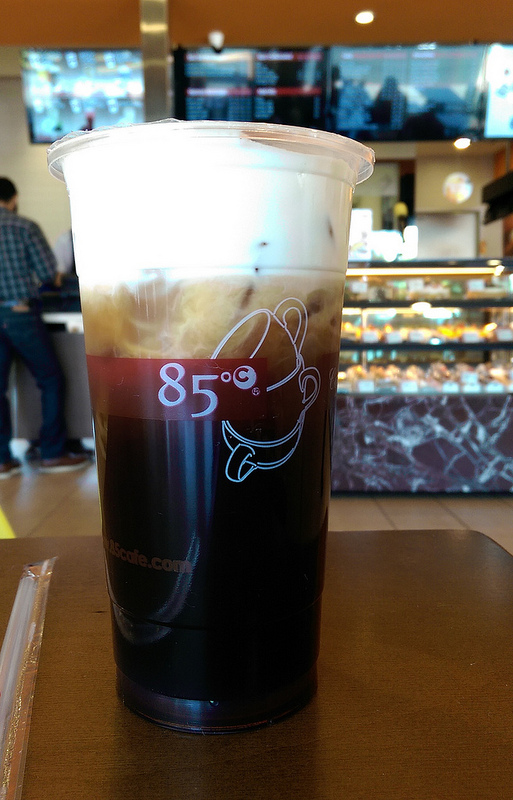
Summer is a month away, but we’ve got another heat wave here! It’s 90-100°F at most Bay Area cities this week. I slept late and woke up early today due to the heat…so I grabbed a refreshing iced coffee on my way to work this morning! :D

sea salt coffee

Here’s an excerpt about the drink, from TIME:

Chinese people like to eat foods that Westerners consider unusual, things like pig-blood cake and chicken-butt kebab, to name just a few popular snacks. So the introduction of salty coffee shouldn’t be such a shocker. What difference, after all, can a few sprinkles of salt make to your morning cup of joe? The chefs at Taiwan’s top coffeehouse, 85C Bakery Cafe, pondered that question for six months before they started serving sea-salt coffee, which became their best-selling drink following its [December 2008] debut.

What inspired those chefs to come up with sea-salt coffee? According to spokeswoman Kathy Chung, it was the Taiwanese habit of sprinkling salt on fruits like pineapple and watermelon to bring out their sweetness. Salty coffee also makes sense in a place where shaved-ice desserts are topped with corn kernels and breads get slathered with sugary frosting and bits of pork. “Taiwanese are greedy,” explains graphic designer Xena Wang, one of six friends who recently tried the drink for the first time. “We like to get all the tastes we can in one bite.”

Salty coffee may sound strange, but it isn’t so much an acquired taste as it is sequential tasting. You’re supposed to lick the salty foam to arouse your senses, then savor the sweet, creamy coffee. “Through the contrast of textures, you experience the saltiness and coffee at different times,” says architect Jeff Lu of his first encounter with the drink. “It’s a multisensual experience that works.”

If you’re interested in making it on your own, here’s a recipe that my friend JoEllen at Cuppacocoa concocted!

Hokkaido: Shio Ramen (aka Hakodate Ramen)

Restaurant: Yokohama Iekei Ramen
City: Union City, CA

I took my parents out for dinner nearby home to celebrate Mother’s Day! Yokohama Iekei Ramen is a ramen place that just opened late last year.

When I was growing up, the very same location was a Chinese-Vietnamese restaurant named Soon Kee Noodle House. My family would eat dinner there whenever my mom was too exhausted to cook, or as a special treat for the Chinese crispy noodle dish that my sister and I loved. It’s somewhat nostalgic everytime I come to this particular location. ;)

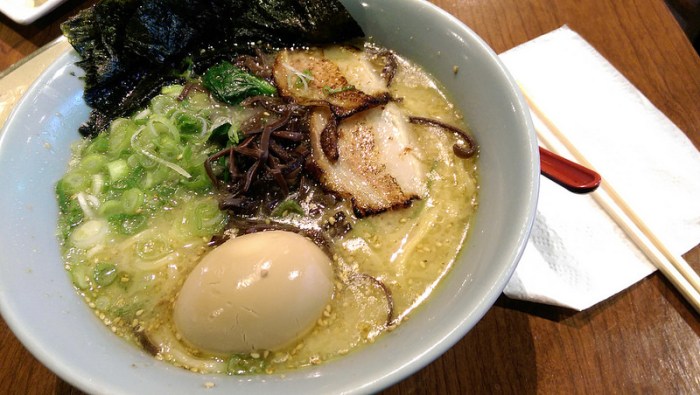
I ordered the classic shio ramen (salt flavor); tonkotsu clam soup, yuzu, Tokyo negi (green onion), nori (seaweed), sesame, spinach, chives, kikurage (cloud ear fungus), roasted pork, bamboo shoot, and soft boiled egg. The roasted pork was excellent.

shio ramen

Here’s some info about shio ramen, from Wikipedia:

Ramen soup is generally made from stock based on chicken or pork, combined with a variety of ingredients such as kombu (kelp), katsuobushi (skipjack tuna flakes), niboshi (dried baby sardines), beef bones, shiitake, and onions, and then flavored with salt, miso, or soy sauce.

Other styles that have emerged later on include curry ramen and other flavors. The resulting combination is generally divided into four categories (although new and original variations often make this categorisation less clear-cut): shio, tonkotsu, shoyu, and miso.

Shio (“salt”) ramen is probably the oldest of the four and is a pale, clear, yellowish broth made with plenty of salt and any combination of chicken, vegetables, fish, and seaweed. Occasionally pork bones are also used, but they are not boiled as long as they are for tonkotsu ramen, so the soup remains light and clear. Chāshū is sometimes swapped for lean chicken meatballs, and pickled plums and kamaboko (a slice of processed fish roll sometimes served as a frilly white circle with a pink or red spiral called narutomaki) are popular toppings as well. Noodle texture and thickness varies among shio ramen, but they are usually straight rather than curly.

And some more info, from rameniac:

Hakodate ramen is synonymous with shio ramen, a clear, salt-based soup with straight noodles virtually reminiscent of original Chinese noodle soups. As a port city with extensive international trade influence, Hakodate was introduced to ramen very early on compared to many other parts of Japan. Hokkaido ramen typically tends to be very rich due to the cold climate; Hakodate’s slightly milder weather and geographic location in the south of the island allowed for shio ramen to flourish over the years.

Burma: Ohn No Khao Swè

Restaurant: Donut Delight
City: Union City, CA

From the outside, Donut Delight sounds like an ordinary donut shop. However, once you step inside you notice they have dim sum in addition to donuts and pastries! But wait, there’s something else! On Saturdays and Sundays from 9am to 3pm, they have a Burmese menu available for dine-in and take-out!

There are 15 items on the menu, which took me forever to decide from…so I asked for recommendations. The lady behind the counter highly recommended the coconut noodle soup, which is an off-the-menu item.
ohn no khao swe

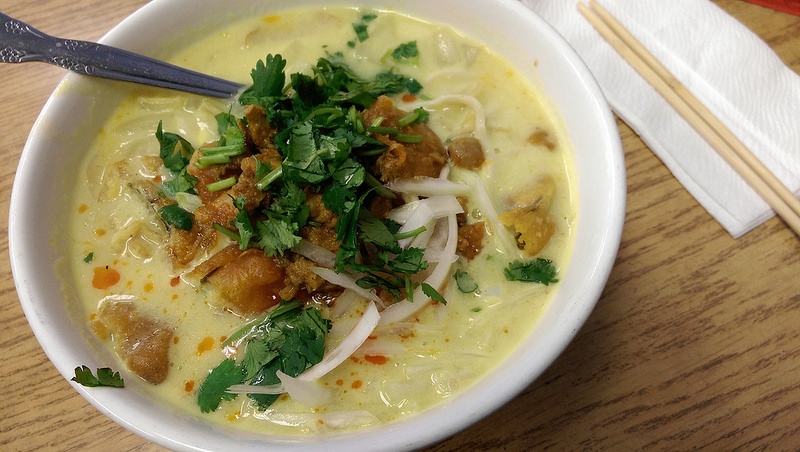
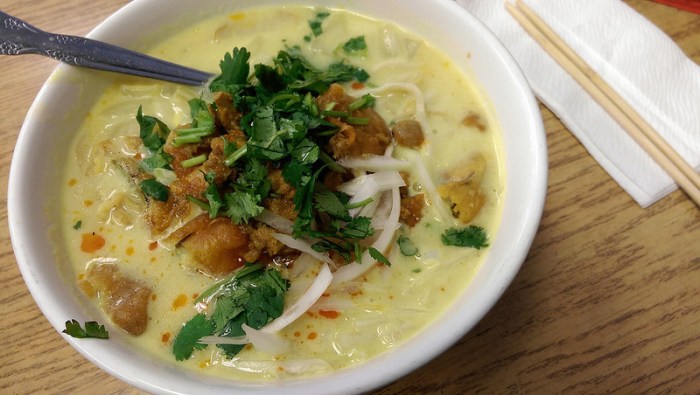
The coconut noodle soup had round rice stick noodles, Chinese donut (youtiao), chicken, fried squash, onion, and cilantro.

This dish is similar to khao poon, a Lao coconut noodle soup. The difference is that the Burmese version has a stronger coconut flavor and is on the very mild spiciness side. There were spices available on the table, however, if you wanted to make your noodle soup spicier.

Here’s some info about the dish, from Wikipedia:

Ohn no khao swè (also spelled ohn no khauk swe, on no khauk swe, ohn no khauk sway, ohn no khau sway, ohn no khau swe) is a Burmese dish consisting of wheat noodles in a curried chicken and coconut milk broth. The dish is often garnished with crisp fried bean fritters, sliced raw onions, chillies, crisp noodles, and slices of hard-boiled egg, and zested with lime or lemon juice and fish sauce.

And lots of interesting background info, from Serious Eats:

The cooking tradition of Myanmar reflects its geographical location: poised between India to the west and Thailand to the east, China looms in the northwest region. Burmese cuisine reflects the influence of its neighbors, giving new meaning to the term “Asian fusion.” Featured this week: Burmese Chicken-Coconut Soup, simmered with caramelized onions and plenty of turmeric and paprika. Poured over a bed of noodles, it’s just as soothing but far more exciting than your average chicken noodle soup.

Called “Ohn-no-khakswe,” the flavors of this Burmese Chicken-Coconut Soup speak profoundly of its culinary tradition. The use of an onion and ginger purée in the soup, as well as the doses of turmeric and chickpea flour, is a nod to India. The presence of coconut milk reveals its commonalities with Thai cuisine. Stir-frying the segments of chicken before stewing is a technique associated with wok cookery. Even the garnish of scallions on top, as the Chinese would do, seems significant. It may just be the case that fusion among geographically similar countries works more seamlessly than that among disparate ones. Certainly, the ingredients in Burmese dishes reflect the organic nature of recipes that have developed over decades, or even centuries of cross-cultural exchange.

Instead of cream, the primary thickening agent in the broth is a few spoonfuls of chickpea and fava flour. Made from ground-up chickpeas (garbanzo beans) and fava beans, the flour adds a distinctively beany depth in the resulting soup. Onion, ginger, and garlic are pureed in a blender until perfectly smooth, then added to the liquid for additional body.

And some info about the name of the dish, from meemalee:

Arguably the most famous Burmese dish is one called ohn-no khao swè – Coconut Chicken Noodles.

Outside of Burma, ohn-no khao swè is also known as khao sway, khauk swe, khaot swe and my absolute favourite, cow suey. That’s what happens when you try to transliterate a non-Roman language like Burmese. “Ohn-No Khao Swè” literally means “Coconut Milk Noodles” (and then you get into all kinds of murky cultural metonymy, as “No” not only means “milk” but also “breast” in Burmese), but the protein which is generally used is chicken, hence my paraphrase of Coconut Chicken Noodles.

“Ohn-No Khao Swè” literally means “Coconut Milk Noodles” (and then you get into all kinds of murky cultural metonymy, as “No” not only means “milk” but also “breast” in Burmese), but the protein which is generally used is chicken, hence my paraphrase of Coconut Chicken Noodles.

This is a wonderfully subtle, lightly curried dish, vaguely like laksa but comforting and flavoursome without whacking you in the face. Of course, you can also adjust the seasoning to taste – adding more fish sauce, squeezing more lime or sprinkling more chilli at the table.

Hawaii: Loco Moco

Restaurant: L&L Hawaiian BBQ
City: Mountain View, CA

L&L is a Hawaiian fast-food chain based in Honolulu and is located all over California.

I went to the Mountain View location with my coworkers for lunch and had the Loco Moco, a dish very popular in Hawaii. It’s essentially a beef patty with gravy and egg served over rice. The dish came with a macaroni salad and extra rice on the side.

loco moco

Here’s some info about the dish, from Wikipedia:

Loco moco is a meal in the contemporary cuisine of Hawaii. There are many variations, but the essential loco moco consists of white rice, topped with a hamburger patty, a fried egg, and brown gravy.

The dish is rumored to have been created at either the Lincoln Grill or May’s Fountain, two restaurants in Hilo, Hawaii, in the 1940s. The most probable origin of the name is that “loco” is a variation of “local”, while “moco” was added simply because it rhymed.

The dish is widely popular in Hawaii and now on the menu at many Hawaiian restaurants in the mainland. In keeping with the standards of Japanese cuisine, rice is used as a staple starch, finished off with the hamburger, gravy, and fried eggs to create a dish that does not require the preparation time of bento. Loco moco can be found in various forms on many Pacific islands from Hawaii to Samoa to Guam and Saipan, and is also popular in Japan.

And more info, from What’s Cooking America:

Loco Moco (loh-koo moh-koo) is Hawaii’s original homemade fast food and can be found at just about any fast food joint, roadside diner, mom and pop restaurant or lunch wagon in the Islands. It is truly unique to Hawaii, and it is a comfort food, or “local grind,” of the Hawaiian Islands. Local food is not the cuisine that is served in upscale hotels and restaurants of Hawaii. It is a basic structure was established soon after World War II – the best fast food or mixture of cuisines from many Pacific rim countries, with a special Hawaiian twist.

Loco Moco is a mountainous meal consisting of a heap of white rice topped with a hamburger patty and a Sunnyside-up egg, and then smothered in gravy. This dish is popular for breakfast, lunch, or dinner and is a candidate for the Cholesterol Hall of Fame. As you eat, break the egg – then blend the burger, egg, rice, and gravy on your fork for each bite for a real taste of paradise.

There are many people who claim to have invented Loco Moco, but it is generally agreed that around 1949, either the Cafe 100 or the Lincoln Grill (both in Hilo, Hawaii) originated the first dish of Loco Moco. According to the story, the dish was created for teenagers who wanted something different from typical American sandwiches and less time-consuming than Asian food to eat for breakfast. The nickname of the first boy to eat this concoction was Loco (“crazy” in Portuguese and Hawaiian pidgin). Moco rhymed with loco and sounded great, so Loco Moco became the name of the dish.

Guangdong & Hong Kong: Wonton Noodle Soup

Restaurant: Ying Kee Restaurant
City: Oakland, CA

I had wonton noodle soup for lunch on Sunday; the wonton at this place is superb!

The noodle soup consisted of shredded chicken, shrimp, mung bean sprouts, green onion, wonton, and egg noodles. The wonton is a type of dumpling, filled with shrimp and minced pork. I usually eat the wontons with red vinegar.

wonton noodle soup

Here’s info about the wonton (the dumpling), from Wikipedia:

In Cantonese cuisine, shrimp filled wonton within minced pork is most commonly served with thin noodles to make wonton noodles. It may also be consumed with red vinegar. The soup is made from boiling shrimp shells, pork bones and dried flounder to give it a distinct taste. Hong Kong wontons were introduced to the area after World War II as street food and later indoor eateries. Wonton is served in variety of sizes with smallest being two wonton and noodles called Sai Yung.

Here’s some info ’bout the wonton noodle soup, from Wikipedia:

Wonton noodles [Mandarin: yun-tun mian; Cantonese: wan-tan min], sometimes called wanton mee (“wanton” is a Cantonese word for dumpling while noodles in Hokkien is “mee” or in Cantonese, “min”) is a Cantonese noodle dish which is popular in Guangzhou, Hong Kong, Malaysia, Singapore and Thailand. The dish is usually served in a hot broth, garnished with leafy vegetables, and wonton dumplings. The types of leafy vegetables used are usually kailan also known as Chinese kale. Another type of dumpling known as shui jiao is sometimes served in place of wonton. It contains prawns, chicken or pork, spring onions with some chefs adding mushroom and black fungus.

In Hong Kong, wonton noodles are usually served in steaming hot soup with shrimp wontons and garnished with leafy vegetables. There are plenty of variations of this popular Cantonese dish, with different toppings and garnishes. For example, the soup and wontons in a separate bowl, the noodles being served relatively dry, with the toppings and garnishes, dressed with sauce, dipping the noodles in the soup to eat it.

There are four distinct features: First, the wontons are predominantly prawn, with small amounts of minced pork, or no pork at all. Second, aficionados will insist on fresh, smooth thin noodles which are al dente, free from the taste and odor which is characteristic in many egg noodles when cooked. Third, the bouillon is light brown (prepared from dried flounder) and is usually steaming hot. Lastly, garlic chives are used as a garnish. The first two give the dish a wet but crunchy or crispy mouthfeel. The last two give the dish a unique bouquet.

In order to ensure that the noodles are perfectly al dente and free from “noodley” taste, the cooking process and sequence must be meticulously adhered to. The wonton is cooked first, and then placed in the bowl. The noodles are blanched for only 10 seconds, after which they are rinsed under cold water and placed in the serving bowl. Piping hot bouillon is then scooped into the bowl, on top of the wonton noodles. The bouillon must be tasty, yet not so strong as to overpower the delicate taste of the wonton and the noodles which it is meant to accompany. Wonton is most popular in some provinces in China.

Jiangsu: Lion’s Head

Restaurant: Shanghai Tapas
City: Fremont, CA

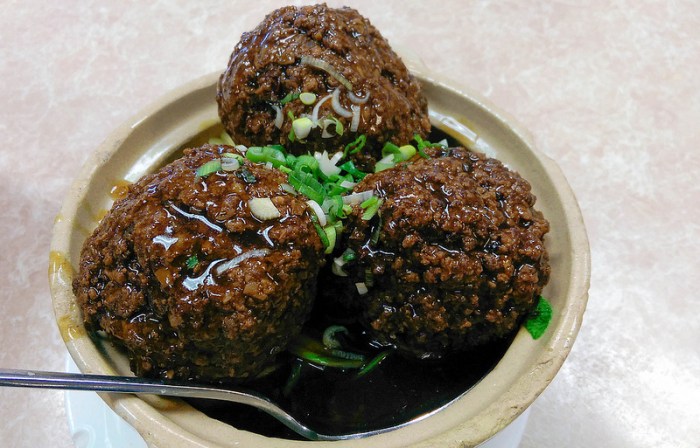
I had dinner with relatives on Saturday at Shanghai Tapas, where one of the dishes we had was these giant meatballs made out of pork and soy sauce. The meatballs were as big as my fist!

lion's head

Here’s some info about Lion’s Head, from Wikipedia:

Lion’s head is a dish from the Huaiyang cuisine of eastern China, consisting of large pork meatballs (about 7–10 cm in diameter) stewed with vegetables.

There are two varieties: the white (or plain), and the red (红烧, cooked with soy sauce). The plain variety is usually stewed or steamed with napa cabbage. The red variety can be stewed with cabbage or cooked with bamboo shoots and tofu derivatives. The minced meat in the meatball tends to be made from fatty pork (lean pork making for a less desirable taste), often with some chopped water chestnut for textural variation.

The name derives from the shape of the meatball which is supposed to resemble the head of the lion and the cabbage (or other vegetables), which is supposed to resemble the lion’s mane.

The dish originated in the region of Yangzhou and Zhenjiang in Jiangsu province, with the plain variety more common in Yangzhou and the red variety more common in Zhenjiang. The dish became a part of Shanghai cuisine with the influx of migrants in the 19th and early 20th century.