Central Mexico: Tacos al Pastor

Restaurant: Taqueria Latina
City: Sunnyvale, CA

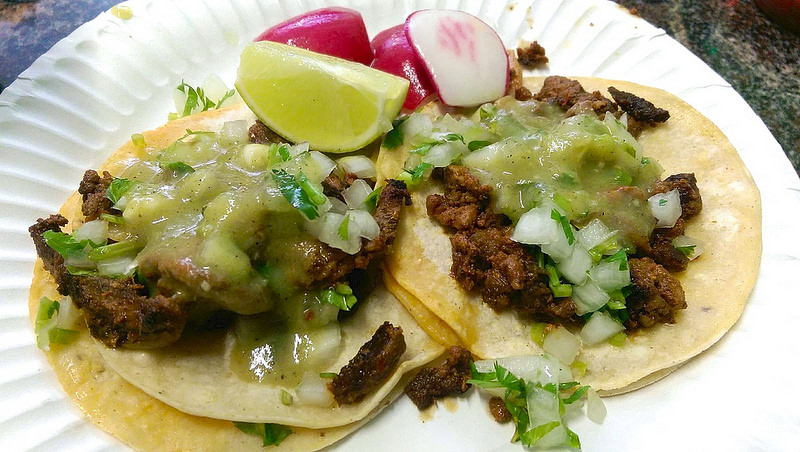
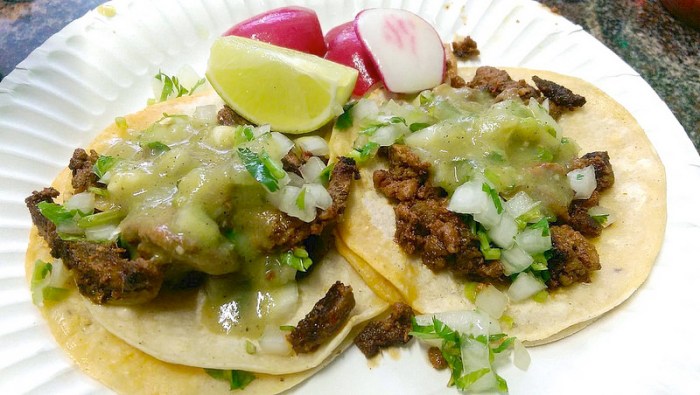
For lunch, I had tacos al pastor at a taqueria near work. There’s loads of meat to choose from and at $1.50 each, they’re cheap and tasty!
tacos al pastor

Tacos al pastor, with chopped onion, cilantro and served with a lime wedge and turnips. The soft tacos are usually made from corn or wheat, and each taco you order at the restaurant typically has not one piece of taco, but two.

Al pastor is also known as spicy pork; here’s the info from Wikipedia:

Pork is marinated in a combination of dried chiles, spices and pineapple. In some places achiote is also added, and then slowly cooked with a gas flame on a vertical rotisserie called a trompo (lit: spinning top), very similar to how shawarma is cooked, with a piece of fresh onion and a pineapple on top. The juice from the pineapple contains bromelain, an enzyme that breaks down protein and thus makes meat tender. When ready, the meat is then thinly sliced off the spit with a large knife. It is served on small tortillas, with finely chopped onions, cilantro, and occasionally, a small slice of pineapple, and usually topped with some lime juice and hot salsa.

Did you know that the idea behind tacos al pastor came to Mexico from Lebanon?! Here’s the info, from Washington City Paper:

Forgive Y&H’s obsession with tacos this week, but I’ve been fascinated by the wealth of history behind this simple Mexican street snack. Take tacos al pastor. Many taquerias don’t prepare them the traditional way, which requires a vertical rotisserie like the ones you see in shawarma shops.

In the video above, Nicholas Gilman explains the presence of these spits in Mexican taquerias. They’re legacies, it seems, of the Lebanese natives who brought them to Mexico in a wave of immigration in the mid-20th century. Mexican taco makers merely adapted them to a meat more common in Latino cuisine.

Not that I don’t trust Mr. Gilman, but I wanted to do some fact-checking on this page in culinary history, so I turned to Mark Miller’s excellent cookbook, Tacos. Miller, if you’ll recall, is trained both in anthropology and cooking. The father of Southwestern cuisine, Miller founded the Coyote Cafe in Santa Fe and the late Red Sage in D.C.

Here’s what Miller says about tacos al pastor:

The meat for these “shepherd’s” tacos is commonly seen roasting on vertical spits displayed with pride on street stands throughout Mexico. The spits are usually topped with a pineapple, which is thinly sliced and served in the tacos. This method of cooking meat is identical to that used for the spit-roasted lamb (shawarma) brought to Puebla, Mexico, by Lebanese immigrants in the 1930s. The technique was copied by the Mexican taqueros (taco masters), who substituted pork for lamb. The original stand for tacos al pastor still exists in Puebla, with vertical spits of pork still revolving in front of its huge wood-burning hearth.
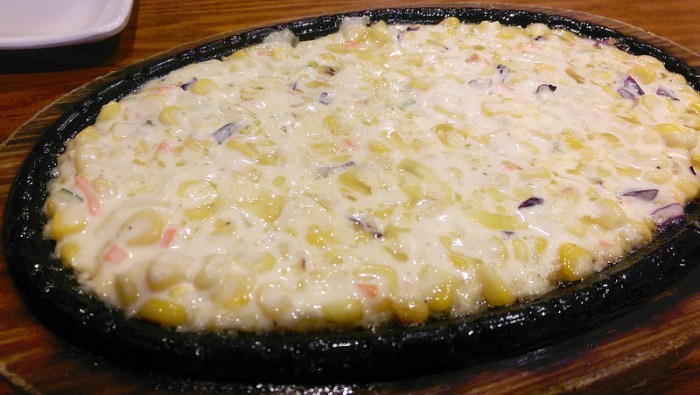
Korea: Cheese Corn

Restaurant: Bab Sang Korean BBQ & Tofu
City: Fremont, CA

I had dinner with the sister in South Fremont. There’s a small plaza with all sorts of restaurants and a McDonald’s, just off Cushing Parkway and I-880. The plaza was pretty quiet at night; I’ve heard it gets pretty busy during the day as it’s near several companies.

It was the first time we’d been to Bab Sang, so we Yelped for highlighted dishes before going there. The one dish that stood out was cheese corn. We’ve had corn with butter. We’ve had elote (Mexican corn on the cob with cheese, cayenne, and lime). But Korean cheese corn? What is that???

Well, here’s what it turned out to be:

cheese corn

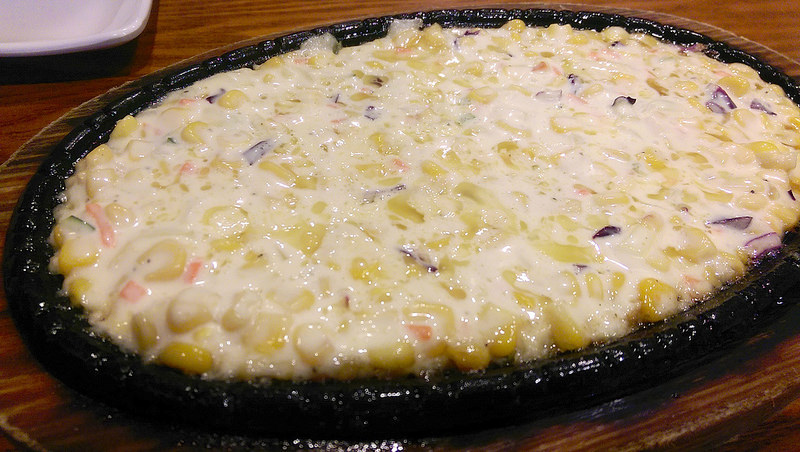
Corn with mayo, cheese, carrots, purple cabbage, and cucumber. The vegetables resembled coleslaw. Bab Sang’s cheese corn (콘치즈) was more on the mayo side than the cheese side. I expected it to be cheesier, with strings of melted cheese. However, it was still pretty good! We ate it all; my lactose-intolerant sister ate half of it!

Anyhow, it appears that cheese corn, or corn cheese, is a popular Korean appetizer or side dish, as explained by…

Perrymecium:

Korean restaurants serve something called cheese corn, which is basically corn baked with a cheese sauce that makes it gooey, crunchy, sweet, and salty.

Youncherry:

Corn cheese is a popular dish consumed with alcohol in the Korean culture.

I’m gonna have to try making it on my own next time, as it looks pretty simple and I’d be in control of how much cheese and mayo to use! Here are some recipes I’ve come across:

Kantō: Tamago-toji Katsudon

Restaurant: Gombei Bento
City: Sunnyvale, CA

I had lunch at Gombei Bento with a few coworkers. Gombei Bento is one of the four locations owned by the original Gombei at San Jose Japantown. This particular location specializes in bento-style dishes.

I had the katsudon, which is tonkatsu (deep-fried pork cutlet) with beaten egg, onion, and chives, over a bowl of rice. The egg wasn’t fully cooked; this is apparent by its shininess in the photo below.

katsudon

Here’s some general info about katsudon, from Wikipedia:

Katsudon (カツ丼) is a popular Japanese food, a bowl of rice topped with a deep-fried pork cutlet, egg, and condiments.

The dish takes its name from the Japanese words tonkatsu (for pork cutlet) and donburi (for rice bowl dish).

It has become a modern ritual tradition for Japanese students to eat katsudon the night before taking a major test or school entrance exam. This is because “katsu” is a homophone of the verb 勝つ katsu, meaning “to win” or “to be victorious”. It also a famous gag of Japanese police films: many people think that suspects will speak the truth with tears when they have eaten katsudon and are asked, “Did you ever think about how your mother feels about this?” Even nowadays, the gag of “We must eat Katsudon while interrogating” is popular in Japanese films.

Katsudon cooked with egg appears to be a dish from Tokyo, as explained by Time Out Tokyo:

Sanchoan is a soba restaurant that dates back to the Edo Period and is located close to Waseda University, at the Babashitacho intersection. Sanchoan is said to have created curry nanban, but there is one other dish that it is also said to have brought into the world: katsudon, or rather, the style of katsudon that became popular in the Tokyo area – served with a beaten egg, which is poured over the pork cutlet and partially cooked.

Miss Mochi’s Adventures explains the name ‘katsudon’ in detail:

Technically speaking, katsudon can be made several ways, but [the] preparation with the egg and onions is the most popular. In fact, most of the time when people talk about this dish, they simply call it “katsudon” rather than the more specific “Tamago-Toji Katsudon” (卵とじ カツ丼) which translates as “egg-bound cutlet bowl.”

San Francisco: Sourdough Bread Bowl w/ Clam Chowder

Restaurant: Boudin
City: Santa Clara, CA (inside Valley Fair)

If I’m very hungry after shopping at Valley Fair, I usually go to Boudin! Boudin is best known for their sourdough bread, and is based in San Francisco. The original restaurant is at Fisherman’s Wharf. I have yet to go there; it’s usually packed with tourists.

I got the sourdough bread bowl with clam chowder after shopping at Uniqlo. Sourdough is a bit tangy; some people either like it or hate it. I love it; my parents aren’t that fond of it.

IMAG0595

Bread bowls are one variation of how clam chowder is served; here’s the info from Wikipedia:

Throughout the United States, “New England-style” clam chowder is often characterized as being thicker and more creamy, even though traditionally it is rather thin (with many late 19th and early 20th century recipes using condensed milk as the base). This is sometimes served in sourdough bread bowls, especially in San Francisco, where sourdough bread is popular with tourists and has been considered a signature dish since 1849.

Sweden: Meatballs

Restaurant: IKEA Restaurant
City: East Palo Alto, CA

What do you think of, in terms of food, when you go to IKEA? I can only think of Swedish meatballs with mashed potatoes, gravy, and lingonberry jam!

I ate my meatballs together with the mashed potato, gravy (I asked for an extra scoop), and lingonberry jam. Yummmm! However, it came with food coma… To alleviate that, I walked around IKEA with a coworker before heading back to work. If you plan on eating and shopping here, be sure to hit the cafeteria-style restaurant first!

swedish meatballs

Here’s some info about the Swedish meatballs, from Wikipedia:

In Sweden, köttbullar (meatballs) are made with ground beef or a mix of ground beef, pork and sometimes veal, sometimes including breadcrumbs soaked in milk, finely chopped (fried) onions, some broth, and often including cream. They are seasoned with white pepper or allspice and salt. Swedish meatballs are traditionally served with gravy, boiled potatoes, lingonberry jam, and sometimes fresh pickled cucumber. Traditionally, they are small, measuring one inch in diameter. When Charles XII of Sweden was in exile in Istanbul in the early 18th century, he took the recipe back to Sweden.

Pennsylvania: Cheesesteak

Restaurant: Amato’s Cheesesteaks
City: San Jose, CA

I grabbed a cheesesteak from Amato’s with a few coworkers! We went to the original location on Saratoga Ave; they now have a second location on Almaden Rd.

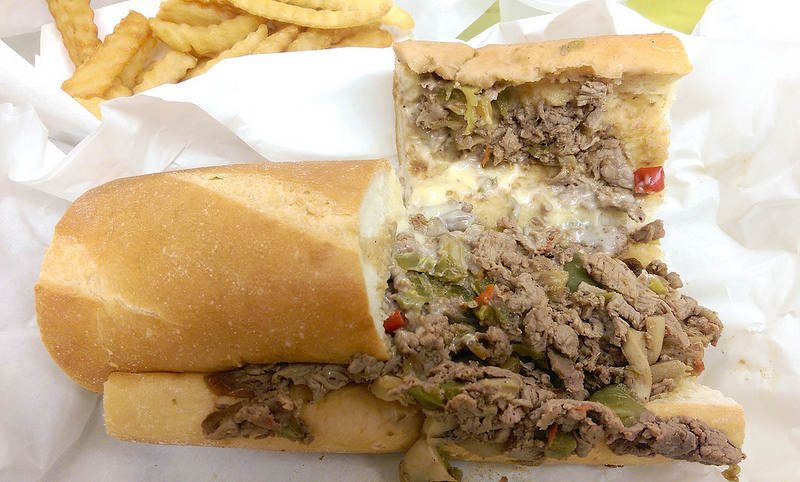
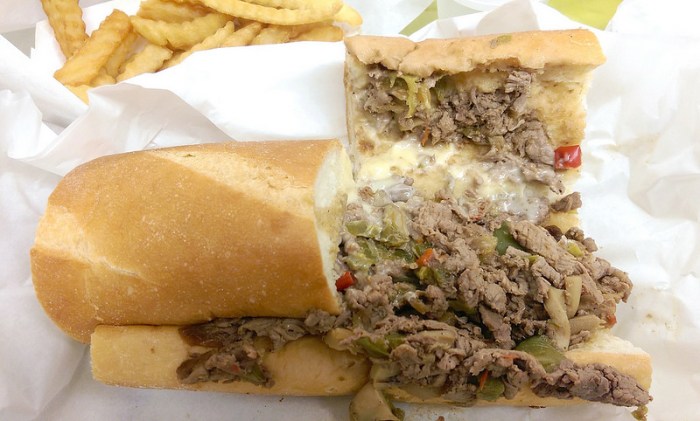
I got “The Works”, which includes mushrooms, bell peppers, onions, cheese, and steak. They also had two jars of self-serve peppers; one jar has sliced spicy peppers while the other is uncut and on the sweeter side.

philly cheesesteak - 1philly cheesesteak - 2

Read on for background info about the cheesesteak, from Wikipedia:

A cheesesteak, also known as a Philadelphia cheesesteak, Philly cheesesteak, cheesesteak sandwich, cheese steak, or steak and cheese, is a sandwich made from thinly-sliced pieces of steak and melted cheese in a long roll. A popular regional fast food, it has its roots in the city of Philadelphia, Pennsylvania.

The cheesesteak was developed in the early 20th century “by combining frizzled beef, onions, and cheese in a small loaf of bread,” according to a 1987 exhibition catalog published by the Library Company of Philadelphia and the Historical Society of Pennsylvania.

Philadelphians Pat and Harry Olivieri are often credited with inventing the sandwich by serving chopped steak on an Italian roll in the early 1930s. The exact story behind its creation is debated, but in some accounts, Pat and Harry Olivieri originally owned a hot dog stand, and on one occasion, decided to make a new sandwich using chopped beef and grilled onions. While Pat was eating the sandwich, a cab driver stopped by and was interested in it, so he requested one for himself. After eating it, the cab driver suggested that Olivieri quit making hot dogs and instead focus on the new sandwich. They began selling this variation of steak sandwiches at their hot dog stand near South Philadelphia’s Italian Market. They became so popular that Pat opened up his own restaurant which still operates today as Pat’s King of Steaks. The sandwich was originally prepared without cheese; Olivieri claims provolone cheese was first added by Joe “Cocky Joe” Lorenza, a manager at the Ridge Avenue location.”

The meat traditionally used is thinly sliced rib-eye or top round, although other cuts of beef are also used. On a lightly oiled griddle at medium temperature, the steak slices are quickly browned and then scrambled into smaller pieces with a flat spatula. Slices of cheese are then placed over the meat, letting it melt, and then the roll is placed on top of the cheese. The mixture is then scooped up with a spatula, pressed into the roll, and cut in half. Common additions include sautéed onions, peppers, mushrooms, mayonnaise, hot sauce, salt, pepper and ketchup.

In Philadelphia, most cheesesteak places use Amoroso or Vilotti-Pisanelli rolls. One source writes that “a proper cheesesteak consists of provolone or Cheez Whiz slathered on an Amoroso roll and stuffed with thinly shaved grilled meat,” while a reader’s letter to an Indianapolis magazine, lamenting the unavailability of good cheesesteaks, wrote that “the mention of the Amoroso roll brought tears to my eyes.” After commenting on the debates over types of cheese and “chopped steak or sliced,” Risk and Insurance magazine declared “The only thing nearly everybody can agree on is that it all has to be piled onto a fresh, locally baked Amoroso roll.”

Hong Kong: Pineapple Bun

Bakery: Kam Land Bakery
City: 
Oakland, CA

Yesterday morning, my father and I went to Oakland Chinatown to get several buns for our church‘s refreshment/snack time. One of the buns my father ordered was the pineapple custard bun.

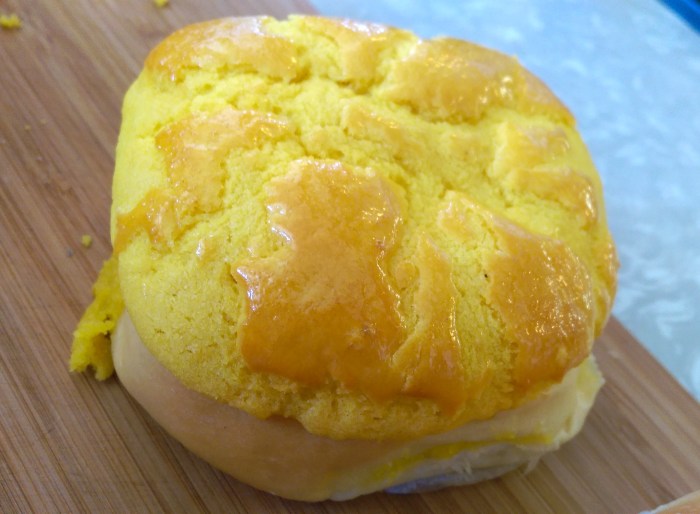
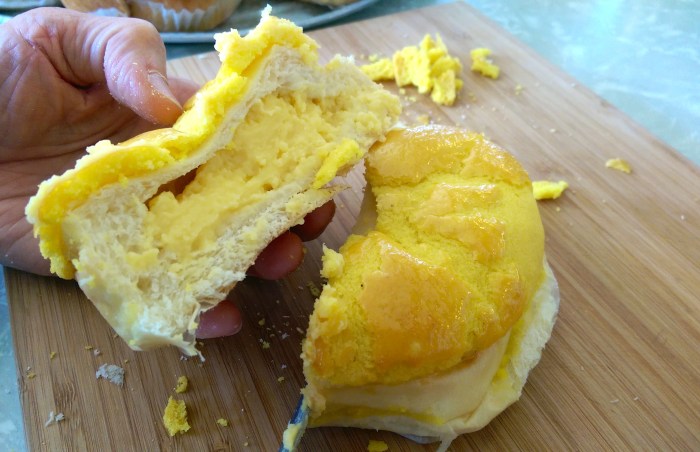
The top is crunchy but also very flaky so you have to eat with care, otherwise it all falls apart easily. The pineapple bun from this bakery also has a creamy custard filling. Some bakeries won’t have a filling. There are usually no pineapples in the bun; it’s called pineapple bun (bo lo bao) because the top is said to resemble the outer surface of a pineapple.

pineapple bun - 1 pineapple bun - 2

More info about pineapple buns, from Wikipedia:

A pineapple bun is a kind of sweet bun predominantly popular in Hong Kong and Macau, though they are not uncommon in Chinatowns worldwide. It is known in Cantonese Chinese as bo lo baau, in which “bo lo” means “pineapple”, and “baau” refers to a kind of bun-like item in Chinese cuisine.

The top of the pineapple bun (the part which is made to resemble a pineapple) is made of a dough similar to that used to make sugar cookies, which consists of sugar, eggs, flour, and lard. It is crunchy and is quite sweet compared to the bread underneath. The bread dough underneath is the same used in Chinese style Western breads, which is a softer and sweeter dough compared to Western breads. It is popular with breakfast or afternoon tea.

Although it is known as “pineapple bun”, the traditional version contains no pineapple. The name originated from the fact that its sugary top crust is cooked to a golden-brown color, and because its checkered top resembles the epicarp of a pineapple. It is very similar to the Japanese melonpan in its manner of cooking and in the fact that it is named according to its appearance.

Many Hong Kong restaurants, such as cha chaan tengs and dai pai dongs, offer an item called a “buttered pineapple bun”, which is a pineapple bun with a piece of butter stuffed inside. They are known in Cantonese Chinese as bo lo yau (菠蘿油), in which “bo lo ” means “pineapple,” and “‘yau'” (oil) refers to butter. Variants of this include using custard in place of butter. Typically, the bun would be brought hot from the oven to the diner’s table, and served halved with a large slab of butter in between the halves. This item is sometimes criticized for containing too much fat and cholesterol.

Korea: Patbingsu

Cafe: Paris Baguette
City: Milpitas, CA

We went to the Paris Baguette across the street after eating at the 237 Night Market (where I had the oyster vermicelli) on Wed night. This location recently opened and is right next to Anh Hong, where I had the bò 7 món.

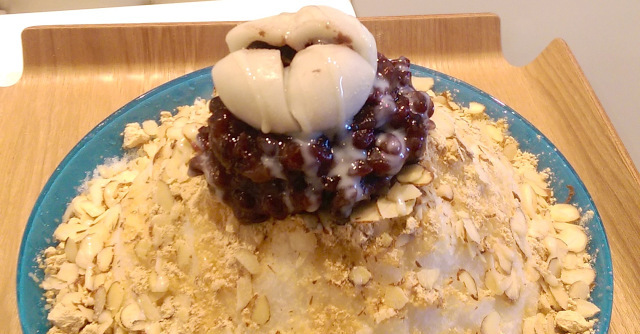
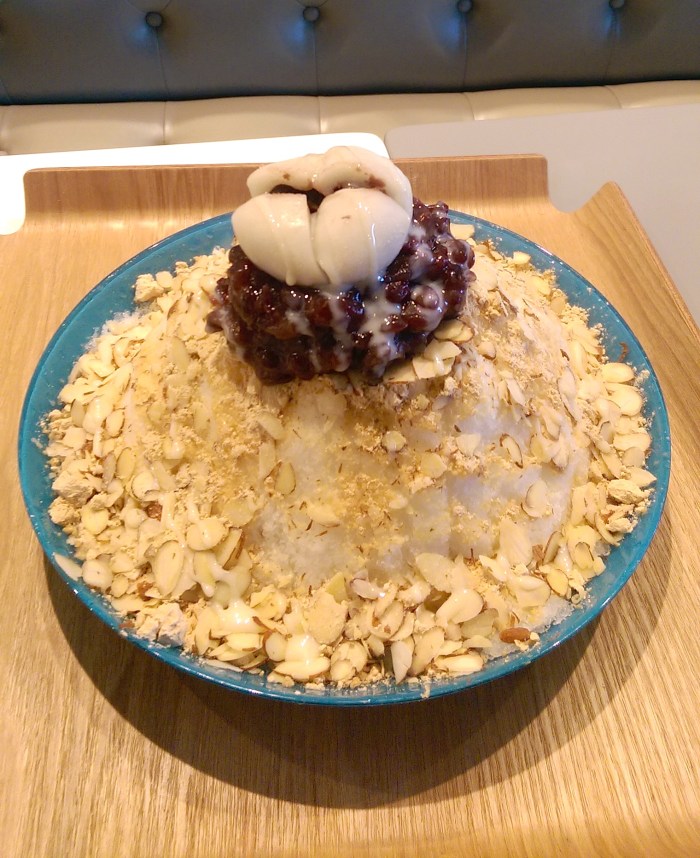
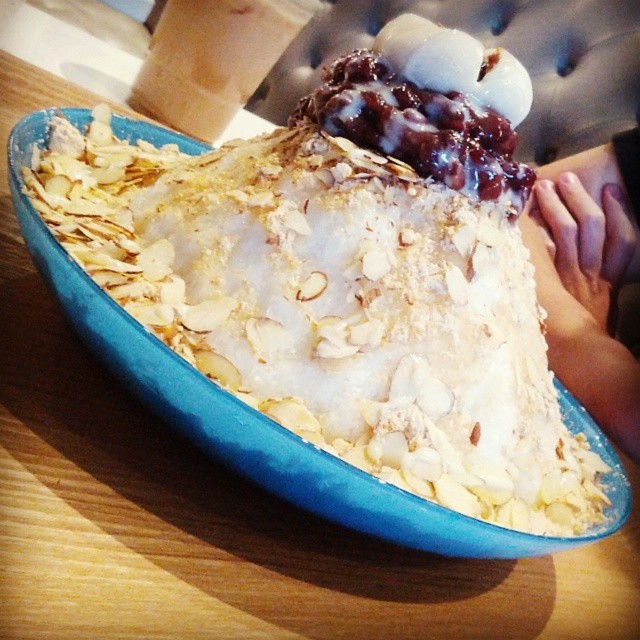
We had the “Well Being Shaved Ice”, which had sliced almond, red bean, grain powder, condensed milk, and a mochi with red bean paste on top. There’s also a mound of red bean hidden inside the shaved ice! Mix ’em all before devouring!

well being shaved icewell being shaved ice

Here’s some info about the Korean dessert, from Wikipedia:

Patbingsu (팥빙수, also stylized as patbingsoo, literally red beans with ice) is a Korean shaved ice dessert with sweet toppings such as chopped fruit, condensed milk, fruit syrup, and red bean paste. The snack is highly popular in South Korea. This snack originally began as ice shavings with red bean paste (known as pat, 팥). Many varieties of patbingsu exists in contemporary culture.

The early forms of patbingsu consisted of shaved ice and two or three ingredients, red bean paste, tteok/ddeok, and ground nut powder. The earliest forms of patbingsu can be found in the Joseon Dynasty (1392-1897). Government records show officials sharing crushed ice topped with various fruits. Some historians believe that the early forms originated from a Chinese tradition of eating snow or ice topped with fruit juices, but Korea disputes this origin.

The modern forms of patbingsu are reputed to originate during the period of Korea under Japanese rule (1910-1945) with the introduction of a cold red bean paste dish. However, the combinations of red bean paste and shaved ice is a Korean invention. During the Korean War (1950-1953), foreign influence led to the inclusion of ingredients such as Fruit cocktail, ice cream, fruits, nuts, cereal, and syrups, and whipped cream. In the 1970s and 1980s, popular ingredients included fruit cocktail, whipped cream, and maraschino cherries.

Taiwan: Oyster Vermicelli

Food Truck: Mama Liu Taiwanese Street Food
Area: South Bay (Milpitas, Mountain View, Sunnyvale, Santa Clara, San Jose)

On Wed night, I went with buddies to the 237 Night Market in Milpitas. The 237 Night Market occurs on the first Wed night of each month, till September. There was a circle of food trucks the past Wed; most of them were Taiwanese.

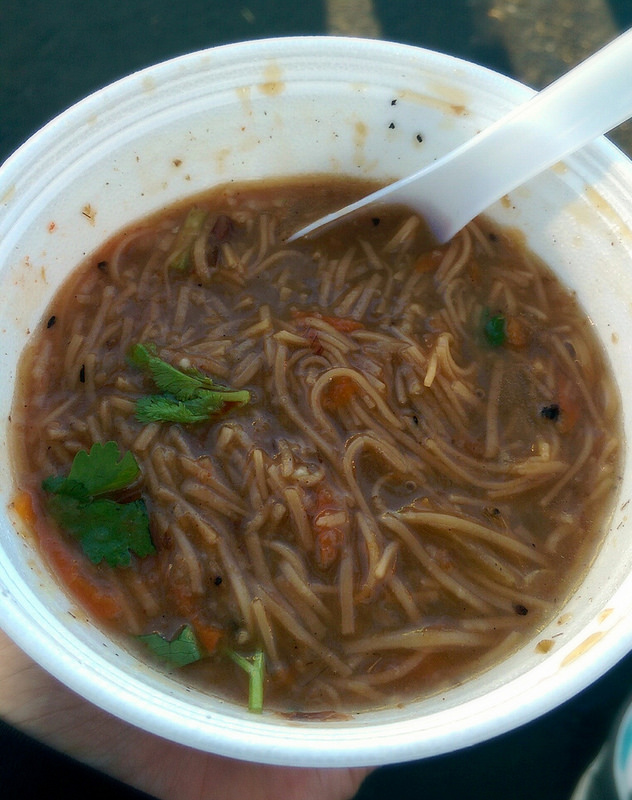
I got oyster vermicelli at the Mama Liu food truck. The vermicelli is thin, soft, and made from wheat.  There was tripe in the soup, but no oysters… Perhaps the soup was oyster flavored with the oyster sauce. The soup is on the thicker consistency side, and on the spicier side though not too spicy.

oyster vermicelli

Whizztrip has info on the vermicelli, also called misua:

Misua is originated from Fujian, China. It is also made from the wheat flour (like thin pasta) but it is thinner than noodle (the difference is about 1mm) and the color of Misua is a bit brown that is got from extensive steaming. Misua is also highly versatile in Chinese cuisine and they are served with many complementary foods and can be used as a garnish or even boiled. Misua is also called wheat vermicelli in stores.

Here’s some info about the dish, from Wikipedia:

Oamisoir (traditional Chinese: 蚵仔麵線; Taiwanese: ô-á mī-sòa) is the English name for a kind of noodle soup that is popular in Taiwan and Xiamen. Its main ingredients are oysters and misua (Taiwanese vermicelli). One of the famous places serving this is in Dihua Street, Dadaocheng, Taipei. A tan-brown variety of vermicelli used for this dish is made primarily with wheat flour and salt, and gains its unique color due to a steaming process which caramelizes the sugars in the dough allowing it to be cooked for longer periods without breaking down.

Food in Taiwan has some more info on the dish:

Oyster vermicelli (蚵仔麵線) is a kind of noodle soup that is popular all around Taiwan and Xiamen Island. This omelet and pineapple cakes are the most favorite Taiwanese food sought after from mainland China and Hong Kong tourists. It is known by the Taiwanese phrase “oh-ah misua”.

Street vendors expertly combine handmade vermicelli with main ingredients oysters and misua, or Taiwanese vermicelli, wheat flour and salt with a variety of seasoned ingredients, such as slowly cooked pork-tripe. Its superb flavor is the use of deep-fried minced shallots. The bowl is then topped off with a few oysters and a pinch of cilantro. Vinegar is usually available for the eater to add to taste..It consists of short, light brown noodles swimming in a bowl of thick soup brot It’s very rich and delicious. You can find it in many night markets and street stall in the evenings and some day markets.

A tan-brown variety of vermicelli used for this dish. It gets its unique color due to a steaming process which caramelizes the vermicelli. This allows it to be cooked for long periods without breaking down.

Southern Vietnam: Bánh Phồng Tôm (aka Prawn Cracker)

In addition to the developing duck embryo (balut) and homemade bò bía, we had prawn crackers!

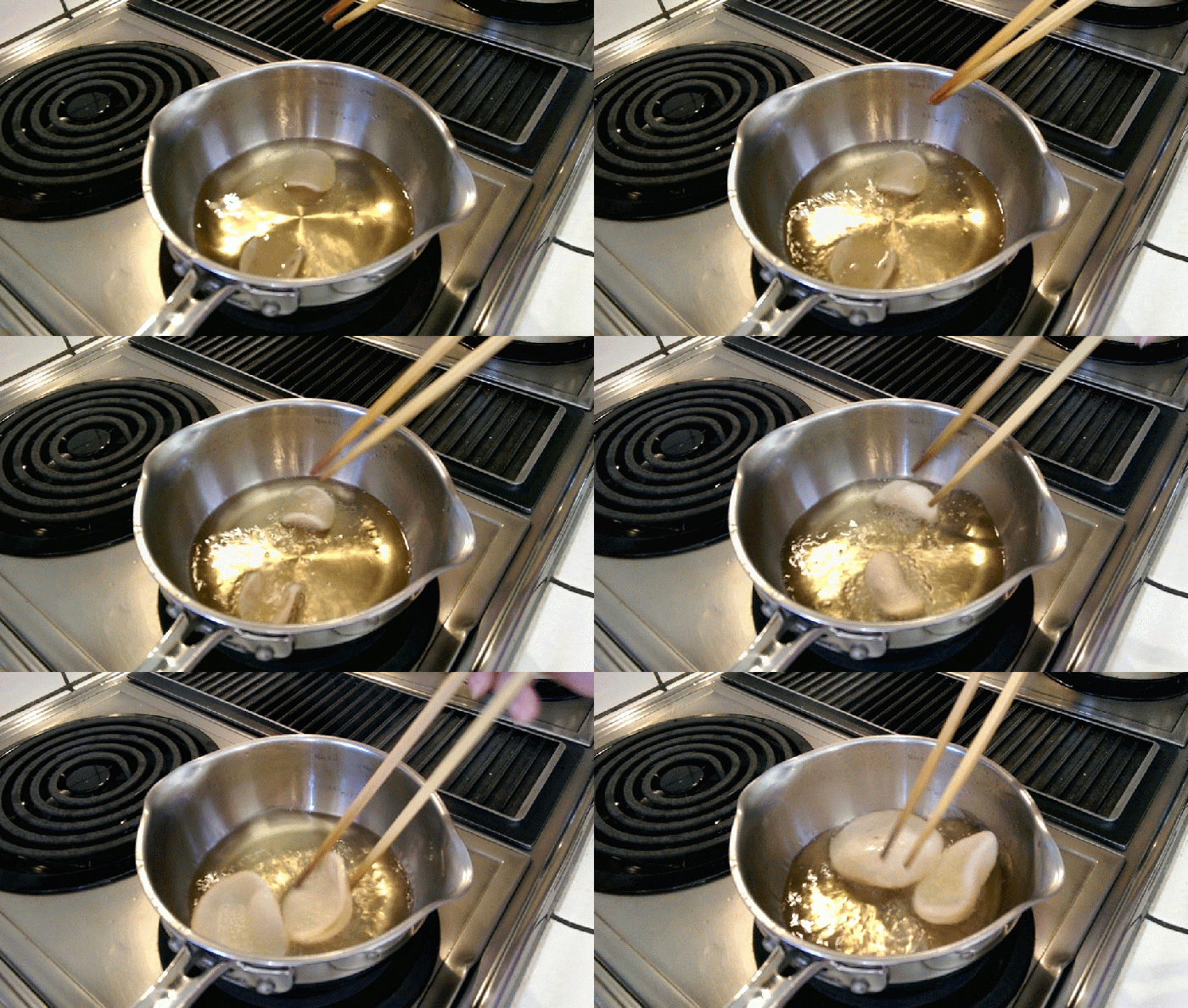
The Sa Giang (company name) Vietnamese prawn crackers are sold as a package of small, dried, and round chips. They are deep-fried and expanded to the bigger, crispy, and oily chips that are typically served with Vietnamese salads. They are to be eaten together with the salad as a scooper, but you can eat them by itself as well!

Bánh Phồng Tôm

Below is a GIF (made in Google+) that shows how quickly the chips are expanded when deep-fried.

banh phong tom

Wikipedia has some more info about the Vietnamese prawn cracker:

Sa Dec in southern Vietnam is the home of bánh phồng tôm. The traditional snack is made of ground shrimp, sometimes mixed with cuttlefish, arrowroot flour, tapioca flour, onion, garlic, sugar, fish sauce, cracked black pepper and salt. Traditionally the dough is steamed, rolled out, cut into round chips then dried. Another method is to form rolls, steam and then slice into thin rounds before being dried. Modern production favors the oval shapes such that the chips form a “scooper” as an accompaniment to salads (gỏi and nộm). The brand Sa Giang is well known.