Taiwan: Popcorn Chicken

Restaurant: Taiwan Cuisine
City: Fremont, California

I had dinner with the relatives off of Cushing Parkway. It’s located in a business/industrial area, so I would assume the restaurants here get crazy during lunch hours! During dinner, it’s relatively quiet.

Taiwan Cuisine specializes in Taiwanese food that are considered as street food in Taiwan. One of the dishes we had was the popcorn chicken (鹹酥雞). I’m not talking about the KFC Popcorn Chicken. In fact, I’ve never had that. I’m talking about the Taiwanese popcorn chicken! It’s typically found in boba shops here.

My sister and I frequent boba shops, but not my parents, aunts, and uncles. It could be a generation thing.

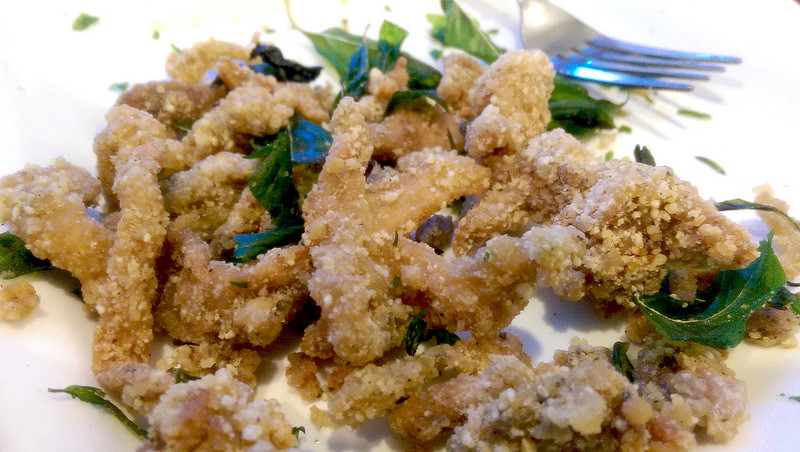
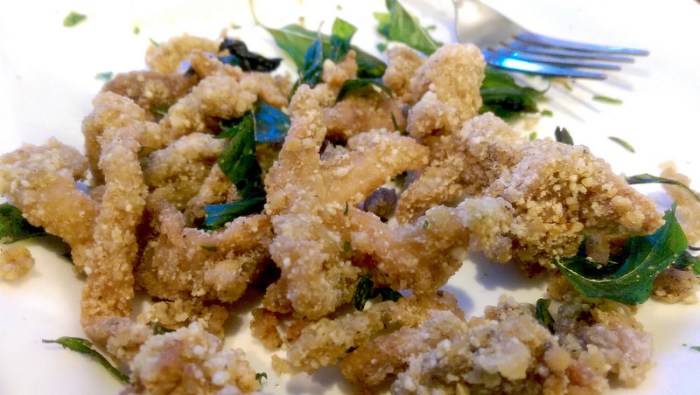
Here’s a close-up of the popcorn chicken!

taiwanese popcorn chicken

I find Taiwan Cusine’s popcorn chicken has the perfect crispiness. It’s not overly fried to the point where the chicken is slightly overcooked. The chicken is also slimmer than those I usually get at boba shops, so perhaps it also cuts the deep-frying time?

Oh, and you can usually request a certain level of spiciness (mild, medium, hot) when you order this. This one was ordered without any spiciness as some of my relatives cannot eat spicy food. Mild is usually good for me; for medium, I’d need to drink lots of water/tea!

And here’s a bit of info on the snack, from Kirbie’s Cravings. A recipe is also posted there!

Taiwanese popcorn chicken, also referred to as Crispy Chicken or Salt and Pepper Chicken, is a popular snack often found at tapioca/boba tea cafes.

The crunchy bite-sized pieces of chicken are dusted with a special mix of seasoning which makes them quite addicting. If you’ve never had them before or you’re a big fan of the snack, I definitely recommend you trying out this recipe.

Jamaica: Festival

Restaurant: Back-A-Yard
City: Menlo Park, CA

I took my aunt, uncle, family friend, and sister out to a Jamaican restaurant after window shopping at East Palo Alto IKEA.

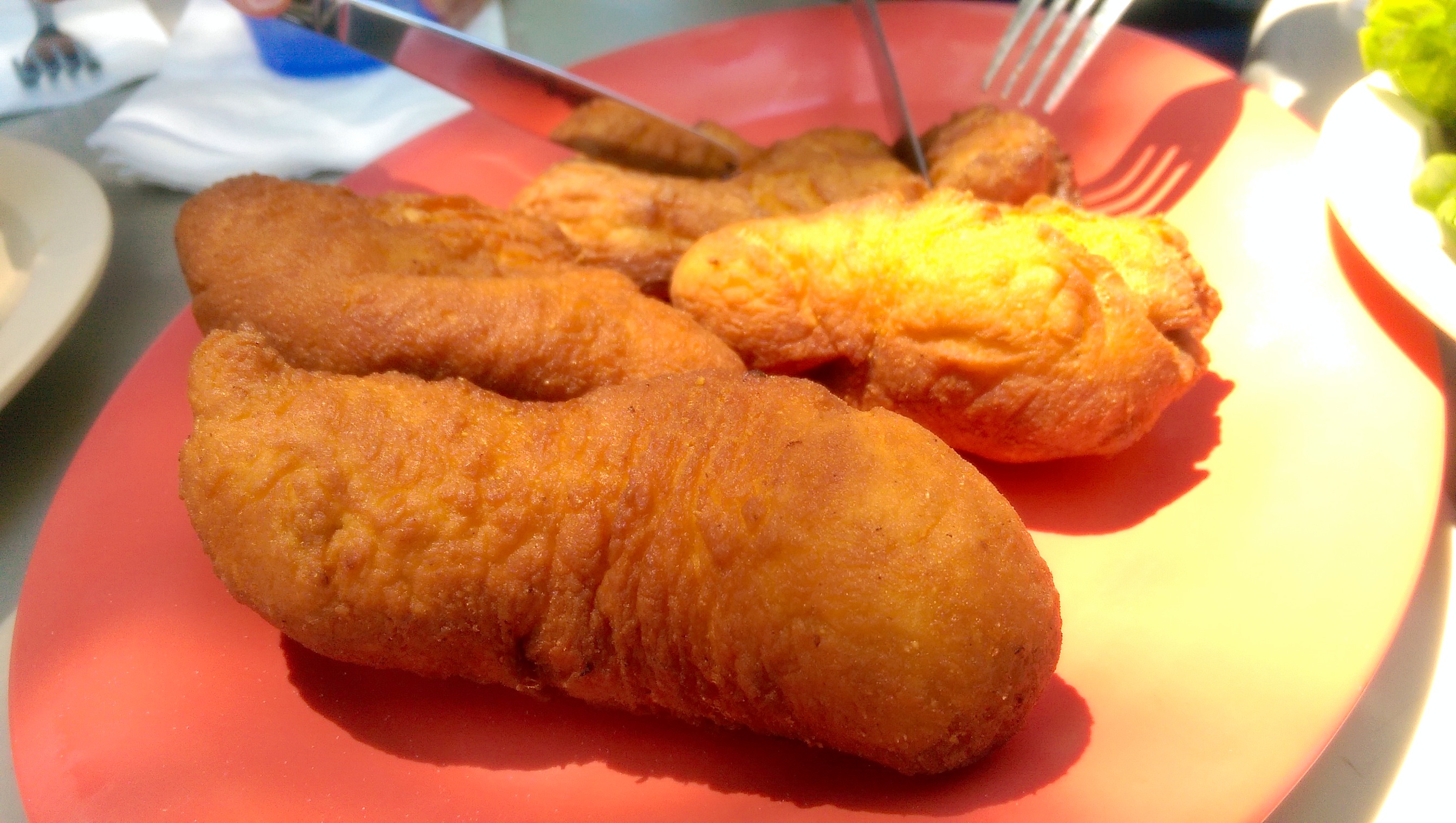
In addition to the jerk chicken, we had Back-A-Yard’s corn festivals. They’re also known as Jamaican fried dumplings, fried dough, cornbread fritters, or fried cornbread. In Jamaica, they’re simply known as festival. They’re best eaten right after it’s made, while still hot.

2014-07-18 14.18.16

Here’s a closer look at the festival:

2014-07-18 14.19.09

Recipes can be found throughout the internet, and it looks like the primary ingredients are cornmeal, all-purpose flour, baking powder, sugar, salt, and oil.

Here’s what others have said about festivals. This one’s from Virginia Burke on Leite’s Culinaria:

Slightly sweet and very moreish fried dumplings, called festival, from Jamaica, these are traditionally served with jerk meats.

And from Marcia Kiesel at Food & Wine:

According to legend these light Jamaican corn bread fritters got their name because eating them is fun—like a festival.

Jamaica: Jerk Chicken

Restaurant: Back-A-Yard
City: Menlo Park, CA

I took my aunt, uncle, family friend, and sister out to a Jamaican restaurant after window shopping at East Palo Alto IKEA.

This place is a hole-in-the-wall! Unless you’re working in Menlo Park, it’s on a street most people just drive through, from 84 to 101 and vice versa.

For five years, I’d driven by this place on my way home from work, and noticed there’d be smoke coming out from the buildings on Willow and Newbridge, and it’d smell good. I had no idea where it was coming from, till my coworker took me here a year ago.

Definitely check this place out. Perhaps after IKEA, if you’re not in the mood for Swedish meatballs. I suggest coming here when it’s bright outside as the area can get sketchy at night- it’s real close to East Palo Alto.

Back-A-Yard makes really tender and very moist jerk chicken! (Be sure to get some festivals there too!)

I got the jerk chicken meal, which included a salad, rice with beans, plantains, jerk chicken, and extra jerk sauce.

jerk chicken - 1

Here’s a closer look at that delicious chicken with jerk sauce. The jerk sauce isn’t spicy but it’s very unique and bold in flavor.

2014-07-18 14.17.27

Here’s what one food critic at Check Please Bay Area said of Jamaican jerk chicken:

I have been in love with Jamaican food since visiting the island over twenty years ago. I have since returned to Jamaica several times. I have learned that Jamaicans are easygoing people who are serious about their food. Chicken should be the national bird, and Jerk Chicken is prepared everywhere, including makeshift BBQs on the side of the road and huts near the beach.

A little background info, from Jamaica Travel and Culture:

Jerk Chicken is believed to have been conceived when the Maroons (African refugees that escaped slavery in the Americas and formed independent settlements) introduced African meat cooking techniques to Jamaica which were combined with native Jamaican ingredients and seasonings used by the Arawak. The method of smoking meat for a long period of time served two practical purposes, keeping insects away from the raw meat and preserving it for longer once it has been cooked. This process also introduces a strong smoky flavour to the meat.

There are two commonly held theories regarding how the name “Jerk” came to be used. One is that it originates from the Spanish word “Charqui”, used to describe dried meat. Over time this term evolved from “Charqui” to “Jerky” to “Jerk”. Another theory is that the name derives from the practice of jerking (poking) holes in the meat to fill with spices prior to cooking. Nowadays, the word “Jerk” is used as a noun to describe the seasoning applied to jerked food and as a verb to describe the process of cooking used.

San Francisco: Mint Mojito Iced Coffee

Cafe: Philz Coffee
City: Palo Alto, CA (on Middlefield Rd)

Philz started in San Francisco, and slowly spread throughout the Bay Area. The first Philz I went to was in Downtown San Jose, after a friend introduced me to the minty, refreshing, strong iced coffee.

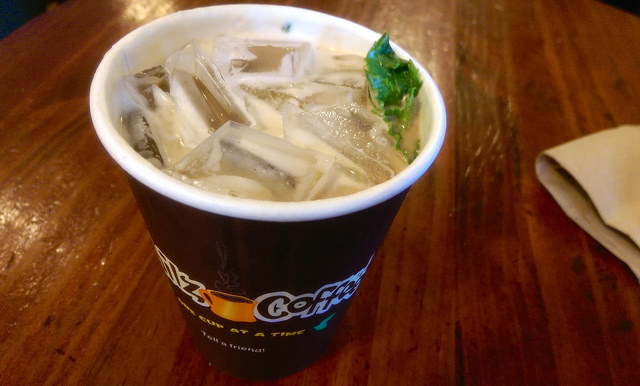
I stopped by a Philz on my way to work and grabbed a cup of Philz’ famous mint mojito iced coffee to wake me up! The iced coffee is very strong. A small cup is enough to keep me awake the rest of the day. I once got a medium sized drink in a early afternoon, and was awake till 3am! Bad choice unless you’re gaming or studying through the night.

mint mojito iced coffee

Metroactive voted this iced coffee the best of Silicon Valley in 2010:

Philz’ Mint Mojito is creamy java goodness crushed with ice and fresh mint leaves and mixed with indulgent dairy products. This cool, refreshing caffeine cocktail is best consumed sitting at a cafe table outside this hipster hangout on a sunny, hot afternoon, while listening to one of Philz’ many musician patrons.


California: Napa Sundae

Food Truck: Frozen Kuhsterd
Area: San Francisco, CA

After dinner, we got dessert during Tango’s break! We had dinner early, when there was hardly a crowd at the Tech Carnival which was just outside the stadium. So when we went back out, it was very crowded! Luckily, the line wasn’t too bad for dessert!

As the name says, Frozen Kuhsterd sells frozen custard. They had two specials for the night, a donut sundae and Napa sundae. I contemplated getting the Napa sundae, because of the olive oil, and I didn’t like Bi-Rite Creamery’s version. I ended up going for it, and it turned out to be aaaaawesome!!

Napa sundae – bottom layer of burnt caramel, scoop of vanilla bean, topped with EVOO (extra virgin olive oil) and Himalayan sea salt.

napa style sundae - 1napa style sundae - 2

SF Foghorn describes it best:

Napa Style Sundae is a single scoop of the classic vanilla bean custard that sits on top of a burnt caramel bottom, topped with olive oil and sea salt. The sweet custard flavor mixed with a salted caramel style topping is the perfect combination of salty and sweet and for $6, is the perfect indulgence.

Bi-Rite Creamery’s version (“Sam’s Sundae”) had chocolate ice cream with bergamot olive oil, maldon sea salt, and whipped cream. I think it was the chocolate ice cream (I dislike chocolate) and the type of oil that threw me off. Frozen Kuhsterd’s version had vanilla bean instead of chocolate, burnt caramel, and extra virgin olive oil, which was waaaay better, IMO.

From searching all over the net, I can only find that the Lucero Olive Oil company is famous for its Napa sundae. Lucero is based in Northern California that have been growing olives for over 27 years, and recently opened a store in Napa. (LuceroRed Bluff Daily News, and SF Gate)

Guatemala: Shrimp Pico de Gallo

Food Truck: Sabor de San Miguel
Area: San Francisco Bay Area

I went to Candlestick Park for the Silicon Valley Sports League‘s 2nd annual Tech Carnival! The Tech Carnival had food trucks, tech swag, and carnival games that included bull riding, rock climbing, and inflatable games! There was also the SVSL Playoffs & Championship.

SVSL has two divisions, San Francisco and Palo Alto. The division champions would go on to play against each other to win a billboard on 101. Each knockout tournament would be a different game, rotating from ultimate frisbee, flag football, and soccer.

2014-07-16 20.10.20

Two buddies work for Tango, which was one of the many tech companies at the playoffs. Tango first played ultimate frisbee against Flipboard and won. Then they beat Box flag football, then moved on to soccer against Yahoo. They scored two points fairly quickly at the beginning but ultimately lost… :(

This was my first and last time at the Stick which was a bittersweet moment for me… The Niners recently moved to Levi Stadium and the Stick will be torn down in a year. But, I had a chance to try a Guatemalan dish from a food truck that was on Food Network! With front row seats!!!

shrimp pico de gallo - 1

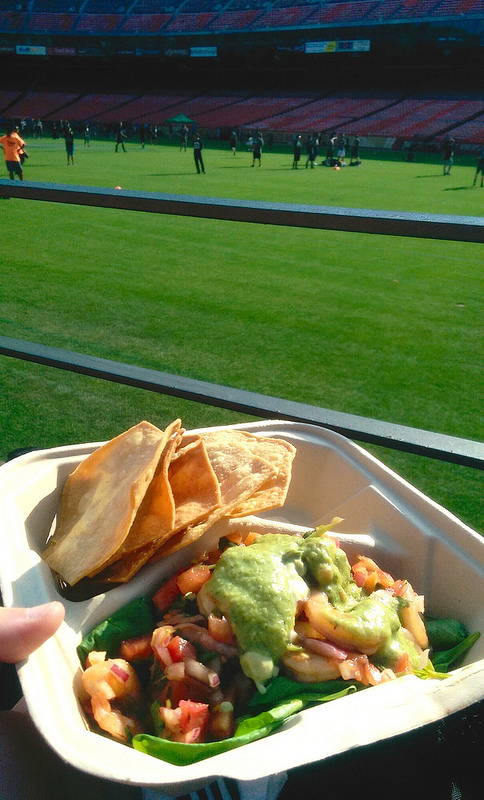
Isn’t that a pretty sweet view at the Stick?! I had the shrimp pico de gallo, which had fully chopped shrimp seasoned with chopped red onion, cilantro, tomato, lemon juice, and mint. It was served over a bed of lettuce, with house made tostada on the side. I also requested it in mild. Here’s a closer look at my dinner!

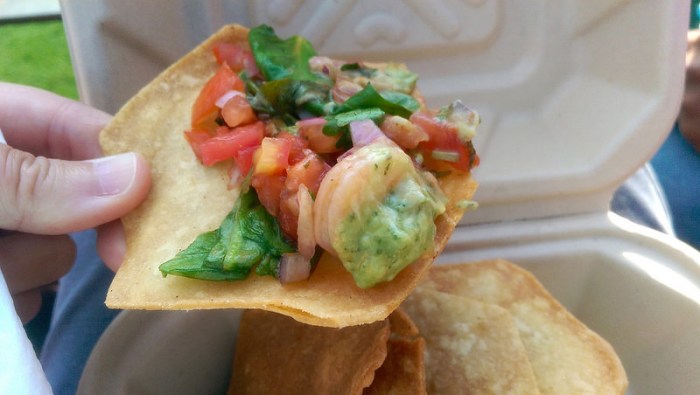
shrimp pico de gallo - 2

The tostadas were eaten with the pico de gallo, with the help of a fork. It’s a somewhat messy dish when eaten without a table, but it was really good! It’s similar to the Mexican version (called ceviche or salsa fresca) but without the strong lime taste.

shrimp pico de gallo - 3

Sabor de San Miguel was on Food Network’s Food Court Wars, where they battled to have a spot at the NewPark Mall food court. So, if you’re ever in Newark, don’t forget to check out their sit-down restaurant inside the mall!

Brazil: Açaí na Tigela (aka Açaí in the Bowl, Açaí Bowl)

Place: Néktər Juice Bar
City: Mountain View, CA

Néktər first opened in SoCal in 2010 and recently opened in Mountain View. I went with two coworkers during another trip to Belmont to pick up a controller.

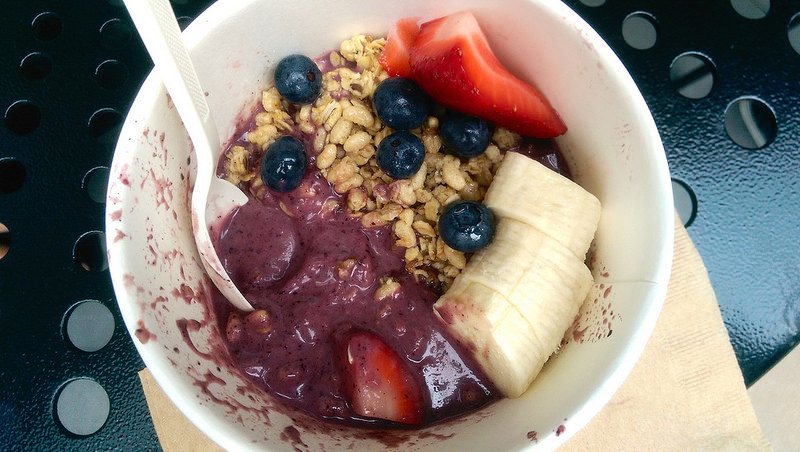
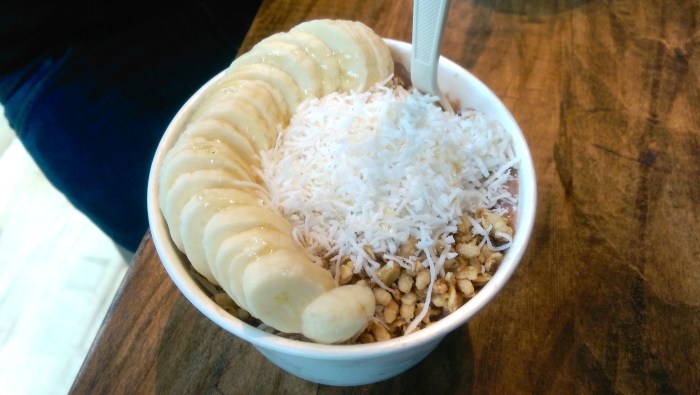
I got the acai banana berry bowl, which is acai, strawberries, blueberries, banana, and housemade vanilla cashew milk blended together and topped with hempseed granola, fresh strawberries, blueberries, bananas, and agave nectar.

nekter acai bowl - 1nekter acai bowl - 2

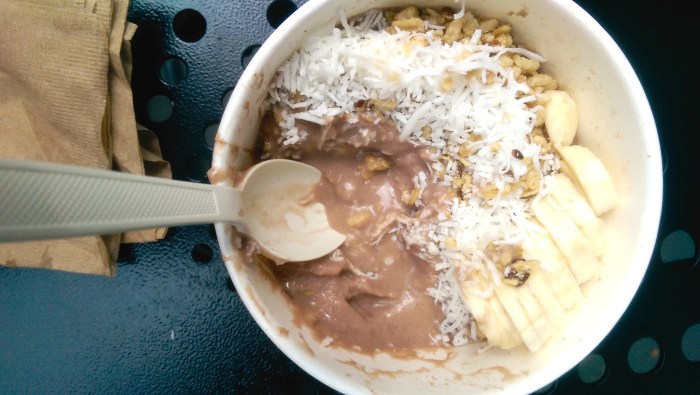
A coworker got the acai tropical bowl, which is acai, banana, pineapple, coconut, butter, and housemade vanilla cashew milk blended together and topped with hempseed granola, raw coconut flakes, bananas, and agave nectar.

2014-07-14 15.08.36 2014-07-14 15.21.44

If you were to ask for my opinon on which is the better of the two, I’d say the banana berry bowl in a heartbeat. I’m not a fan of coconut water, and the blend in the tropical bowl had a taste reminiscent of coconut water (and looks like poop). So, if you like coconut water, get the tropical bowl! Néktər also has a peanut butter bowl, and a pitaya (dragonfruit) bowl.

Here’s some info about the acai bowl, from Wikipedia:

Açaí na tigela (“açaí in the bowl”) is a typical Brazilian dish made of frozen and mashed açaí palm fruit from the Amazonian region. Its preparation in Brazilian southern and northeastern is different from how it is prepared in the Amazonian region. It is served like a smoothie in a bowl or in a glass, is commonly topped with granola, banana, and mixed with other fruits, with the addition of guaraná syrup. Açaí na tigela is popular in Rio de Janeiro, Florianópolis, São Paulo and also along northeastern coast, where it is sold in most kiosks lining the beach promenade as well as in corner juice bars throughout the cities.

More info from Tambor:

Origins of Acai

The history of the acai bowl traces back to time before memory. Throughout the Amazonian basin the acai palm thrives. The edible palm heart and berry are a vital source of food for many people of the region. Unlike the modern incarnation of sweetened acai bowls, the acai berry pulp was (and still is) eaten as a staple, unsweetened and alongside manioc, and perhaps with a main course like fish.This is the original acai bowl.

There is deep history between acai berry and the Amazon. But how did acai make its way out of the Amazon? Here is an account of the modern history of the acai bowl.

Modern History of Acai Bowl

In the early 1970′s, frozen acai pulp began to travel from the Amazon to northern Brazilian cities. In the 80′s, it was legendary Brazilian Jujitsu founder Carlos Gracie who likely popularized the acai bowl (frozen acai pulp blended with banana) in southern cities like Rio de Janiero. Gracie established his own brand of diet called the Gracie Diet which sought to maximize the performance of his fighters. A center piece of it was the acai bowl. You might imagine for a moment, his rough, tough, and buff students hanging out in Rio near the beach, eating an acai bowl on a hot summer day. More than a few impressed passerby’s likely remarked, “what are they eating?” with the hopes of manifesting similar physiques, bite by delicious bite. Sorry people, acai is very good for you, but not capable of creating miracle health breakthroughs. Aside from an organic acai bowl everyday, it will take some sweat and effort.

As time went on Brazilian surfers and fitness enthusiasts began to partake in the acai bowl trend through the 90′s. In the 2000′s organic acai pulp first boarded a flight to the USA- the party was only just beginning. Hawaii and Southern California became the first places where the acai bowls really found a home. It was popularized by surfers who sought a tasty and healthy after session pick-me-up. Imagine eating cool organic acai topped with fesh banana after a mid-morning, scorching session: heavenly. Acai bowls can now be found all over Hawaii and Southern California, where they have become a staple, and beyond.

Taiwan: Gua Bao (aka Taiwanese Pork Belly Bun, Taiwanese Burger)

Restaurant: Chou Ma Ma’s Kitchen
City: Newark, CA

I had dinner with the family and a family friend at a Taiwanese restaurant near home. This place has several appetizers that are typically sold as street food in Taiwan.

We had a few dishes I’d never had before, thanks to the family friend from Hong Kong who is more knowledgeable about Taiwanese food than my parents are!

Another dish we had was the Taiwanese pork belly bun, aka Taiwanese burger.

gua bao - 1gua bao - 2

Serious Eats describes gua bao the best:

True Taiwanese pork belly buns have five defining components: the fluffy steamed bun, tender braised pork belly, pickled mustard greens, fresh cilantro, and powdered peanuts. All combined, it’s a messy, colorful, glorious snack of salty, sweet, pungent, and fresh flavors, with multiple textures to boot.

More in-depth info from Wall Street Journal:

Consider the Taiwanese gua bao: pork belly, preserved mustard greens, peanuts crushed with sugar and a few sprigs of cilantro stuffed into a fluffy steamed bun. The gua bao is sweet, sour and salty, irresistibly sloppy and richly meaty, but sized to satisfy, not overwhelm. Swaddled in paper or plastic, it fits snugly in the palm — an ideal on-the-go nosh and a near-perfect street food.

Yet despite its merits, the gua bao is unknown in too many quarters. Like Taipei, a street-food hub that’s often overlooked in favor of other Asian cities like Singapore and Bangkok, it languishes in the shadow of Taiwan’s more famous xiao long bao (soup dumplings) and niu rou mian (beef noodles).

It shouldn’t be so. After all, the Taiwanese specialty is delicious enough to have inspired numerous variations abroad.

But the gua bao is Taiwanese through and through. Its filling of soy-sauce-stewed pork, reminiscent of Hokkien dish hong bak, and preserved mustard — a staple in China south of the Yangtze River — speak of the island’s large Hokkien and Hakka populations. Its garnish, a thick dusting of peanuts crushed with sugar, is made with two of Taiwan’s most historically important crops. More than just an earthly delight, gua bao is offered during the final annual worship of the Earth God, Taiwan’s most ubiquitous deity. At end-of-the-year celebrations employers give the clamshell-shaped specialty, which with its overflowing filling recalls a purse stuffed with money, to staff. Gua bao is so rooted in Taiwanese culture it even has a nickname: hu yao zhu, or Tiger Bites Pig.

Taiwan: Tsao Mi Fun / Tsa Bi Whun

Restaurant: Chou Ma Ma’s Kitchen
City: Newark, CA

I had dinner with the family and a family friend at a Taiwanese restaurant near home. This place has several appetizers that are typically sold as street food in Taiwan.

We had a few dishes I’d never had before, thanks to the family friend from Hong Kong who is more knowledgeable about Taiwanese food than my parents are!

We had Taiwanese stir fried rice stick noodle, or “tsao mi fun” in Mandarin and “tsa bi whun” in Taiwanese.

tsao mi fun

Chou Ma Ma’s dish had rice stick noodles, Chinese cabbage, pork, bean sprouts, carrots, and onion. As with most Chinese stir-fried dishes, the ingredients may vary but the rice stick used is Taiwanese.


Beijing: Peking Duck

Restaurant: Moongate Garden
City: Milpitas, CA

My aunt and uncle from the Mojave Desert is in town for my cousin’s baby shower, so I had dinner with relatives from my dad’s side!

My dad is the youngest boy with 7 siblings. It’s really rare to have all of my dad’s siblings in town, as he also has a sibling in New York, Texas, and Virginia. He has two siblings in the same town I live in. So, when I have dinner with my aunts and uncles here, it’s usually with the ones in town and the ones from the Mojave Desert. When that happens, one family would take turns treating all of us to dinner.

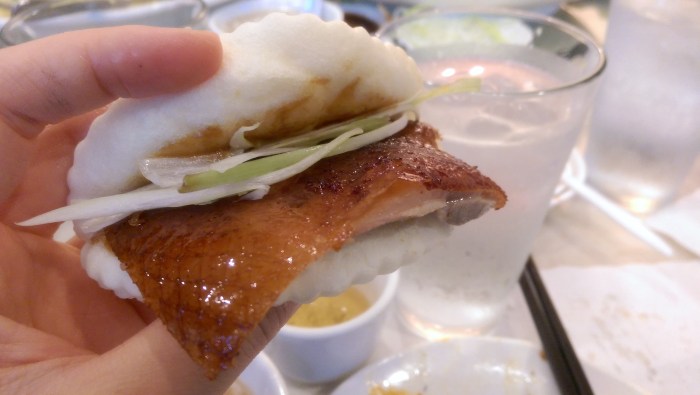
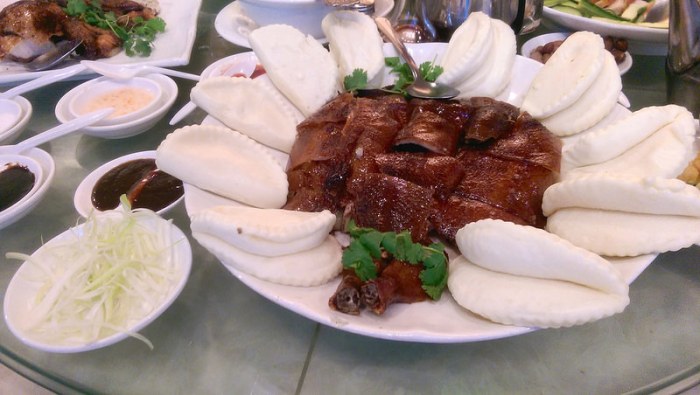
Tonight’s dinner was at a Chinese restaurant in Milpitas. They have big portions for a reasonable price! One of the dishes we had was the Peking duck! It’s traditionally eaten with the steamed buns, hoisin sauce, and onion. The duck is fatty, oily, but oh so gooooood!
peking duck2014-07-12 20.02.20 2014-07-12 20.11.49

Each restaurant has its own way of preparing and serving Peking duck; some may serve with a half-opened steamed bun and some with a thin sheet of steamed “pancake”.

And here’s the info from Wikipedia:

Peking duck is a famous duck dish from Beijing that has been prepared since the imperial era. The meat is prized for its thin, crisp skin, with authentic versions of the dish serving mostly the skin and little meat, sliced in front of the diners by the cook. Ducks bred specially for the dish are slaughtered after 65 days and seasoned before being roasted in a closed or hung oven. The meat is eaten with scallion, cucumber and sweet bean sauce with pancakes rolled around the fillings. Sometimes pickled radish is also inside, and other sauces (like hoisin sauce) can be used.

History

Duck has been roasted in China since the Southern and Northern Dynasties. A variation of roast duck was prepared for the Emperor of China in the Yuan Dynasty. The dish, originally named “Shaoyazi” (燒鴨子), was mentioned in the Complete Recipes for Dishes and Beverages (飲膳正要) manual in 1330 by Hu Sihui (忽思慧), an inspector of the imperial kitchen. The Peking Roast Duck that came to be associated with the term was fully developed during the later Ming Dynasty, and by then, Peking Duck was one of the main dishes on imperial court menus. The first restaurant specialising in Peking Duck, Bianyifang, was established in the Xianyukou, Qianmen area of Beijing in 1416.

By the Qianlong Period (1736–1796) of the Qing Dynasty, the popularity of Peking Duck spread to the upper classes, inspiring poetry from poets and scholars who enjoyed the dish. For instance, one of the verses of Duan Zhu Zhi Ci, a collection of Beijing poems was, “Fill your plates with roast duck and suckling pig”. In 1864, the Quanjude (全聚德) restaurant was established in Beijing. Yang Quanren (楊全仁), the founder of Quanjude, developed the hung oven to roast ducks. With its innovations and efficient management, the restaurant became well known in China, introducing the Peking Duck to the rest of the world.

By the mid-20th century, Peking Duck had become a national symbol of China, favored by tourists and diplomats alike.

Preparation

Rasing the Duck

The ducks used to prepare Peking Duck originated in Nanjing. They were small, had black feathers, and lived in the canals around the city linking major waterways. With the relocation of the Chinese capital to Beijing, supply barge traffic increased in the area. Often these barges would spill grain into the canals, providing food for the ducks. By the Five Dynasties, the new species of duck had been domesticated by Chinese farmers. Nowadays, Peking Duck is prepared from the Pekin duck (Anas platyrhynchos domestica). Newborn ducks are raised in a free range environment for the first 45 days of their lives, and force fed 4 times a day for the next 15–20 days, resulting in ducks that weigh 5–7 kg (11–15 lbs). The force feeding of the ducks led to an alternate name for the dish, Peking Stuffed Duck (simplified Chinese: 北京填鸭; traditional Chinese: 北京填鴨; pinyin: běijīng tián yā).

Cooking

Fattened ducks are slaughtered, plucked, eviscerated and rinsed thoroughly with water. Air is pumped under the skin through the neck cavity to separate the skin from the fat. The duck is then soaked in boiling water for a short while before it is hung up to dry. While it is hung, the duck is glazed with a layer of maltose syrup, and the inside is rinsed once more with water. Having been left to stand for 24 hours, the duck is roasted in an oven until it turns shiny brown.

Peking Duck is traditionally roasted in either a closed oven or hung oven. The closed oven is built of brick and fitted with metal griddles (Chinese: 箅子; pinyin: bì zi). The oven is preheated by burning Gaoliang sorghum straw (Chinese: 秫秸; pinyin: shú jiē) at the base. The duck is placed in the oven immediately after the fire burns out, allowing the meat to be slowly cooked through the convection of heat within the oven.

The hung oven was developed in the imperial kitchens during the Qing Dynasty and adopted by the Quanjude restaurant chain. It is designed to roast up to 20 ducks at the same time with an open fire fueled by hardwood from peach or pear trees. The ducks are hung on hooks above the fire and roasted at a temperature of 270 °C (525 °F) for 30–40 minutes. While the ducks are cooking, the chef may use a pole to dangle each duck closer to the fire for 30 second intervals. Almost every part of a duck can be cooked. The Quanjude Restaurant even served their customers the “All Duck Banquet” in which they cooked the bones of ducks with vegetables.

Serving

The cooked Peking Duck is traditionally carved in front of the diners and served in three stages. First, the skin is served dipped in sugar and garlic sauce. The meat is then served with steamed pancakes (simplified Chinese: 春饼; traditional Chinese: 春餅; pinyin: chūn bǐng), spring onions and sweet bean sauce. Several vegetable dishes are provided to accompany the meat, typically cucumber sticks. The diners spread sauce, and optionally sugar, over the pancake. The pancake is wrapped around the meat with the vegetables and eaten by hand. The remaining fat, meat and bones may be made into a broth, served as is, or the meat chopped up and stir fried with sweet bean sauce. Otherwise, they are packed up to be taken home by the customers.

If you’re in Beijing, be sure to check out the newly opened Roast Duck Museum! It was opened to celebrate the 150th anniversary of restaurant chain Quanjude that is most famous for its roast duck.  Here’s the info, from thebeijinger:

Beijing has a brand new museum to add to its wacky, and oddly specific, collection (see also: the Watermelon Museum or the China Honey Bee Museum): a roast duck museum.

The museum celebrates the 150th anniversary of Quanjude, Beijing’s most famous roast duck brand (although in my opinion, not its best). Located at the brand’s Hepingmen branch, the 1,000 square meter location touts over 500 duck-related exhibits, including a coupon for duck dating back to the Qing Dynasty, adverts from the Republican era and endless photos of various celebrities enjoying their kao ya.

Along with the museum, Quanjude also celebrated the sale of its 196 millionth duck. As the WSJ comments, this being China and all, the details of how they came up with this figure are characteristically fuzzy.

As of last week, each duck sold at Quanjude is accompanied by a souvenir “ID card” so if you are that way inclined you can boast you were the one who ate the 196,001,623rd bird.

Genuine cultural significance or shameless marketing ploy? We’ll let you be the judge.

The museum is open Tuesday-Sunday 10am-6pm, free entry.