Korea: Honey Jujube Tea

Honey jujube tea can be found at most Korean supermarkets.

honey jujube tea

Jujube tea (대추차, daechucha) is a traditional Korean tea made with dried jujubes (대추, daechu). There are two ways of making daechucha: boiling dried jujubes or diluting the juice of fresh or preserved jujubes into boiling water. Honey is added for sweetness. Daechucha is known to be abundant in iron, potassium, vitamins B and C. A pre-prepared daechucha syrup containing jujube pieces is also commercially available in Korean grocery stores. (Wikipedia)

Macau: Portuguese Egg Tart

Restaurant: Napoleon Super Bakery
City: Oakland, CA

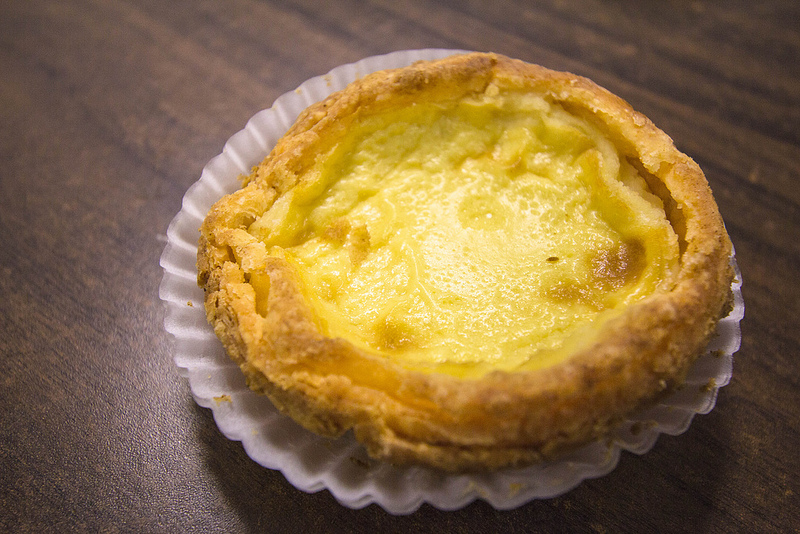
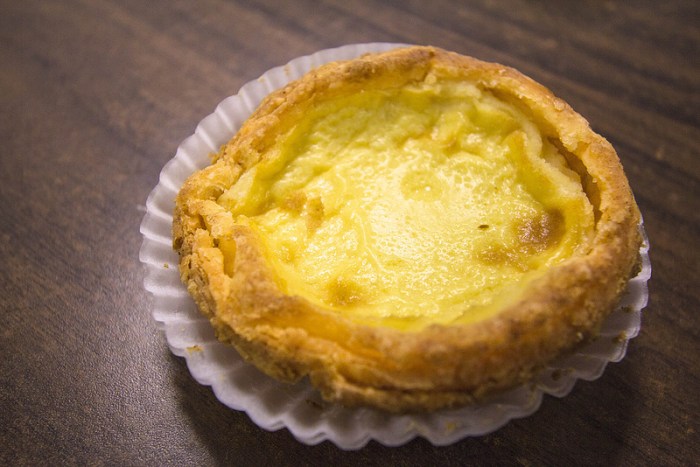
portuguese egg tart

Portuguese egg tarts, or “po taat” in Cantonese, are my favorite egg tarts. Shown above is what I ate earlier today; it should have been baked or torched longer for a more caramelized top. These are the best Portuguese egg tarts I can find in Oakland Chinatown, however. I have only seen the regular Hong Kong egg tarts in other bakeries in that area.

Portuguese egg tarts (蛋挞, literally egg tart) are a typical pastry from Macau having its origin in the colonial past of the city, and nowadays a dessert expanded all over Asia. This tart basically is made of a puff pastry case filled with custard in a crème brûlée-like consistency, caramelized on top. Do not confuse with the “simple” egg tart, which is not tasty as this one! Portuguese egg tarts are sightly “evolved” from “pastéis de nata” (葡式蛋撻), a traditional Portuguese custard pastry. Evolved in the way that in Portugal are served warm with cinnamon, and in Asia without it, for example. Good Portuguese egg tarts should taste like slightly burnt sweet caramel and custard. (logafter)

Japan: Calpico

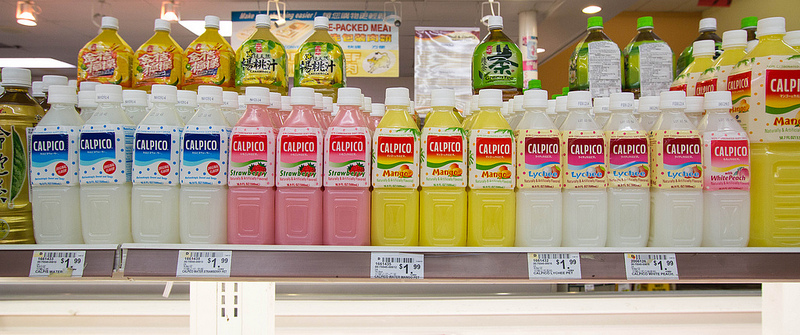
Calpico can be found at most Asian supermarkets. There are different flavors, such as lychee, strawberry, peach, and mango. Personally, my favorite is the lychee flavor.

calpico

Calpis (カルピス Karupisu) is a Japanese uncarbonated soft drink, manufactured by Calpis Co., Ltd. (カルピス株式会社 Karupisu Kabushiki-gaisha), headquartered in Shibuya, Tokyo. In some English speaking countries, such as the United States, the name Calpis is changed to Calpico, believed to be so because Calpis sounds similar to cow piss in English.  The beverage has a light, somewhat milky, and slightly acidic flavor, similar to plain or vanilla-flavored yogurt or Yakult. Its ingredients include water, nonfat dry milk and lactic acid, and is produced by lactic acid fermentation. It was first marketed on July 7, 1919. It quickly became popular in pre-war Japan as its concentrated form meant it kept well without refrigeration. (Wikipedia)

West Bengal: Kati Roll

Restaurant: Curry Up Now
City: Palo Alto, CA

Curry Up Now started as the first Indian food truck in the SF Bay Area, then started a brick and motar restaurant in San Mateo in 2011. They now have two other locations, in Palo Alto and San Francisco.
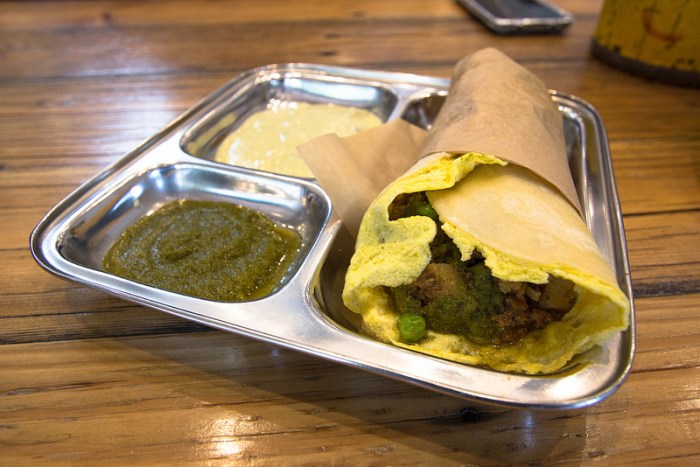
kati roll

Egg washed pan fried flat bread, pickled onions & chutneys rolled up with chicken, beef, lamb, pork belly, paneer, aloo, tofu, or aloo gobi. Curry Up Now named this as “kathi roll”, whereas it’s more globally spelled as “kati roll”.

Kati roll is street-food originating from Kolkata, India. Its original form was a kati kabab enclosed in a paratha, but over the years many variants have evolved all of which now go under the generic name of kati roll. Traditionally, a kati roll is a kati kabab wrapped in a layered paratha. The paratha is typically dough that is kneaded into a rope, then coiled into a round patty. This is then flattened with a rolling pin and partly fried in oil on a tawa. These semi-cooked parathas are then kept aside till needed, at which time they’re put back on the tawa and cooked through. If an egg is to be added, it is usually cracked into the tawa and the paratha put on top of the egg; they both cook together and the paratha gets coated on one side with the egg. (Wikipedia)

India: Deconstructed Samosas

Restaurant: Curry Up Now
City: Palo Alto, CA

Curry Up Now started as the first Indian food truck in the SF Bay Area, then started a brick and motar restaurant in San Mateo in 2011. They now have two other locations, in Palo Alto and San Francisco.

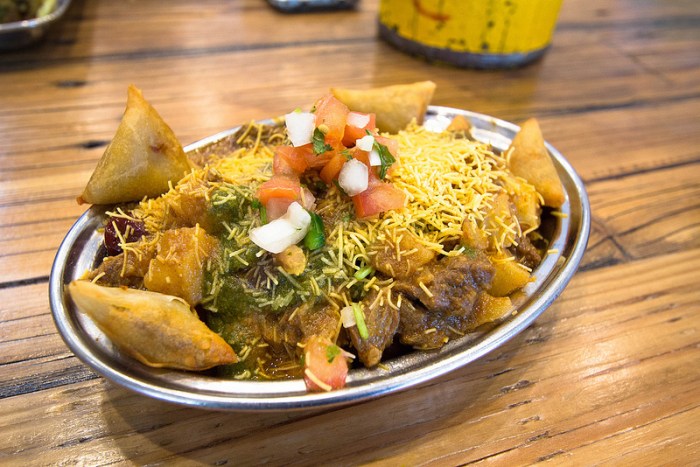
deconstructed samosa

An inside out samosa loaded with garbanzo beans, pico & chutneys, dressed with mini samosas. I chose lamb, and the dish was also topped with sev.

Sev are small pieces of crunchy noodles made from chickpea flour paste which is seasoned with turmeric and cayenne before being deep-fried in oil. These noodles vary in thickness. Ready-to-eat varieties of sev, including flavoured sev are available in Indian stores. (Wikipedia)

A samosa is a fried or baked pastry with a savory filling, such as spiced potatoes, onions, peas, lentils, ground lamb, ground beef or ground chicken. Its size and consistency may vary, but typically, it is distinctly triangular. Samosas are often accompanied by chutney. With its origins in Uttar Pradesh, they are a popular appetizer or snack in the Indian Subcontinent, Southeast Asia, Central Asia and Southwest Asia, the Arabian Peninsula, the Mediterranean, the Horn of Africa, North Africa and South Africa. (Wikipedia)

Taiwan: 85°C Bakery Cafe’s Marble Taro

85°C Bakery Cafe is a self-serve bakery chain from Taiwan. They’ve had stores in Southern California since 2009. On November 5, 2013, they finally opened their first store in Northern California, in Newark, CA. They will be opening their San Jose, CA store in April.

The Newark location has only been open for 8 weeks now, and I’ve been there 16 times since then. Call me crazy…but almost everytime I go, there’s a line that starts when you pick up your tray and tongs at the breads side. The most popular signature items, the marble taro and brioche, are usually held behind the cash registers. They do that because during the first grand opening weekend, customers literally fought for them, as soon as the marble taro and brioche were brought outside. So, it’s now a first come, first serve at the cash registers. There is seldom a line at the drinks and cakes side.

marble taro
marble taro

The marble taro is shown above; the marble taro was cut in half. This was my breakfast this morning!

My favorite breads are the milk pudding, red bean, rose, marble taro, and taro breads. I’m actually not a fan of taro, but I liked 85°C Bakery Cafe’s taro breads. I find the consistency and sweetness different than how taro usually is. I also like the mini cheesecake bites, and mochi egg tart.

Cambodia: Chicken Curry

Restaurant: Chez Sovan
City: San Jose, CA

Chez Sovan is a hole-in-wall Cambodian restaurant, and is only open M-F, 11am to 1:45pm.

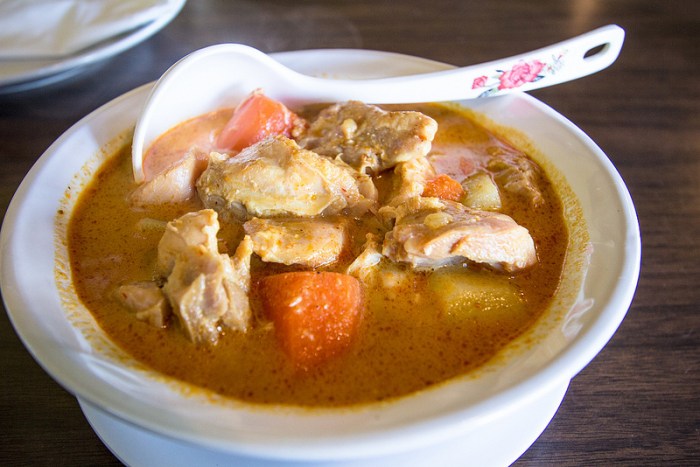
cambodian chicken curry

Chicken curry simmered with potatoes, carrot in yellow curry paste, Cambodian spices and coconut milk. The curry wasn’t spicy as most Thai or Indian curry dishes are, but the taste of coconut milk was there.

Cambodian cuisine shares many commonalities with the food of neighboring Thailand—although, less chilli, sugar and coconut cream are used for flavor—and of neighboring Vietnam, with which it shares and adopts many common dishes, as well as a colonial history, as both formed part of the French colonial empire in Southeast Asia. It has drawn upon influences from the cuisines of China and France, powerful players in Cambodian history. The Chinese began arriving in the 13th century, but Chinese migration accelerated during the French period. Curry dishes, known as kari (in Khmer, ការី) show a trace of cultural influence from India. The many variations of rice noodles show the influences from Chinese cuisine. Preserved lemons are another unusual ingredient not commonly found in the cooking of Cambodia’s neighbours; it is used in some Cambodian dishes to enhance the sourness. The Portuguese and Spanish also had considerable influence in Cambodian affairs in the 16th century, introducing chilli and peanuts into Asia from the New World. However, chilli never gained the same status or prominence as it did with the cuisines of neighboring Thailand, Laos, and Malaysia. Even today very few recipes include chilli. (Wikipedia)

Cambodia: Ginger Fish

Restaurant: Chez Sovan
City: San Jose, CA

Chez Sovan is a hole-in-wall Cambodian restaurant, and is only open M-F, 11am to 1:45pm.

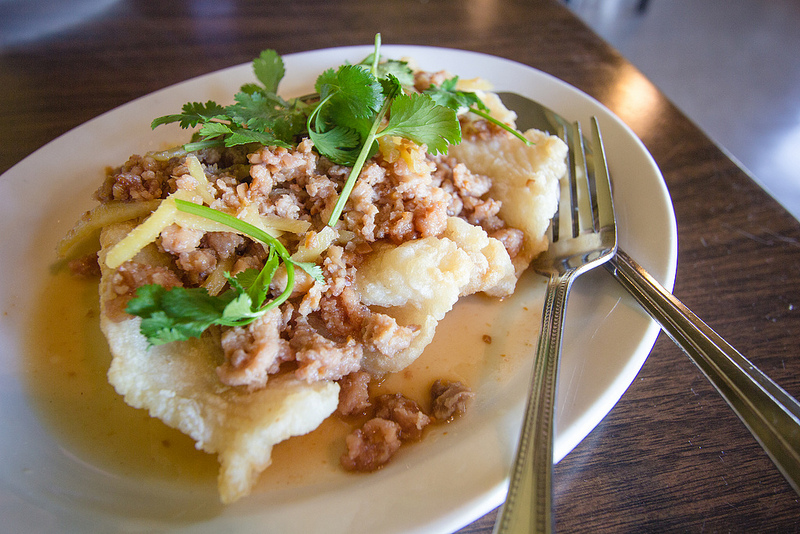
ginger catfish

Crispy deep fried Basa fish fillet topped with ginger sauce, ground chicken, salted beans, shallots, and garnished with cilantro. Also tasted fish sauce in this dish.

Turmeric, galangalgingerlemongrass, and kaffir lime leaves are essential spices in Khmer cooking, Khmer stews, and nearly all curries. (Wikipedia)

Cambodia: Amok Trey

Restaurant: Chez Sovan
City: San Jose, CA

Chez Sovan is a hole-in-wall Cambodian restaurant, and is only open M-F, 11am to 1:45pm.

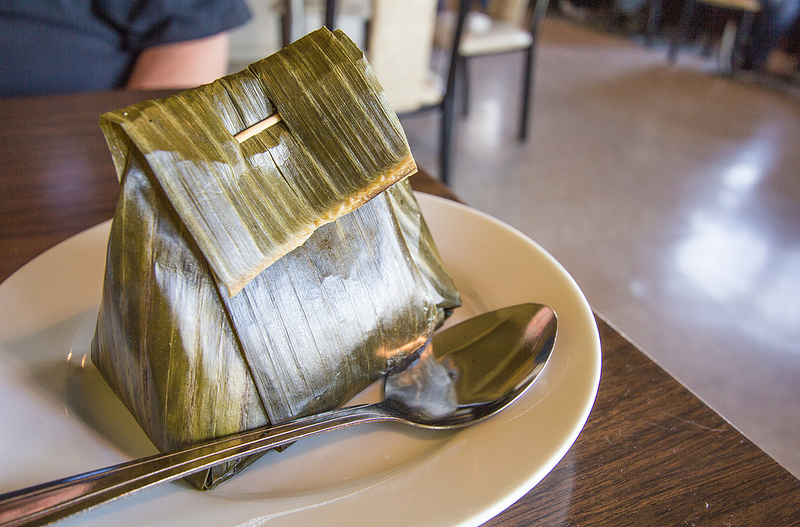
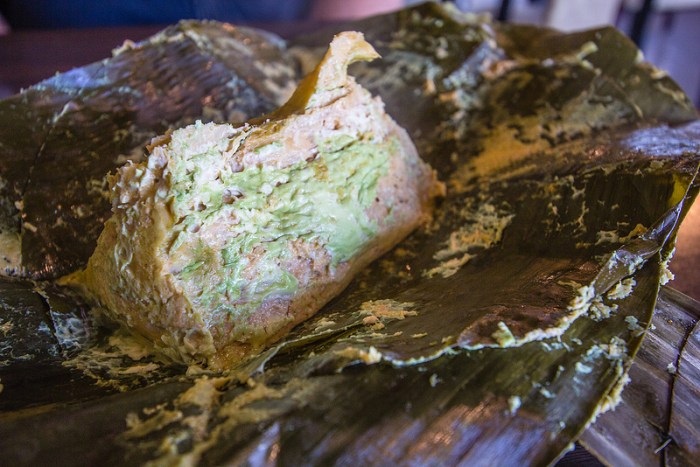
amok trey
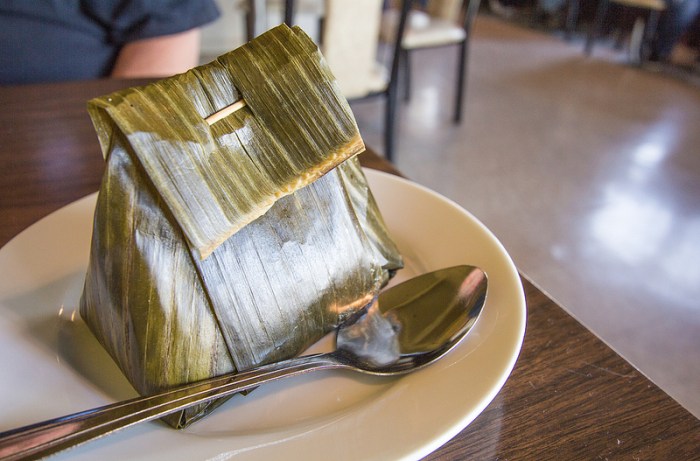
amok trey

Amok trey is my favorite Cambodian dish! It has a very unique taste; it’s fishy from the catfish, with a strong curry taste.

Amok trey (ហហ្មុកត្រី) is a traditional dish of Cambodian cuisine. It is fish (commonly snakehead fish, or Mekong catfish) covered with an aromatic kroeung (pounded shallots, lemongrass, garlic, kaffir lime), roasted crushed peanuts, coconut milk, and egg and then wrapped in banana leaves and steamed until it achieves a mousse-like texture. Amok refers to the process of steam cooking curry in banana leaves, or to the resulting dish. Trey refers to the fish. Unlike the Thai, Lao, and Malaysian versions of the same dish, it is not intended to be spicy but rather fragrant, zesty and flavorful. (Wikipedia)

South Korea: Paris Baguette’s Royal Pudding

Paris Baguette is a South Korean chaebol (a conglomerate of businesses, usually owned by a single family) under SPC Group. Pretty fascinating… Didn’t know this until last night. I’m constantly learning something new about what I’m eating, partly because of this blog!

I got two Royal Pudding, milk pudding and strawberry pudding. I did not get any pastries or cakes because I’ve had enough from 85°C Bakery Cafe in Newark, CA… Each pudding came with a long plastic spoon, which allows you to scoop from the bottom of the glass to the top! It was like eating flavored pudding (the very top layer) with flan.

Royal Pudding